The Term Number
The Term Number
We have seen a few examples of sequences involving both numbers and images. So we now want to ask ourselves, how do we describe the position of the numbers in sequences?
To answer this question, think about the sequence of odd numbers
\(1,~3,~5,~7,~9, \ldots\)
What is the \(3^{rd}\) odd number?
Solution
Well, to identify the third odd number, you would locate the number in the \(3^{rd}\) position of this sequence:
\(1,~3,~\class{hl2}{5},~7,~9, \ldots\)
We say, "the \(3^{rd}\) term of this sequence is \(5\)."
A number's position in a sequence can help us talk about specific values in any sequence that we're working with.
The term number tells the position of an item in a sequence.
If we look at our sequence of odd numbers again, we can list the term numbers:
\(\underbrace{1}_{\substack{1^{st} \\ \text{term}}}, \underbrace{3}_{\substack{2^{nd} \\ \text{term}}}, \underbrace{5}_{\substack{3^{rd} \\ \text{term}}}, \underbrace{7}_{\substack{4^{th} \\ \text{term}}}, \underbrace{9}_{\substack{5^{th} \\ \text{term}}}, \underbrace{\ldots}_{\substack{\text{more} \\ \text{terms}}}\)
Example 2
Let's now do an example using that new terminology.
Consider this sequence of numbers:
\(4,~8,~12,~16, \ldots\)
- Describe the pattern rule.
- Find the \(6^{th}\) term in the sequence.
Take a moment and try this problem on your own.
Solution
So recall, the pattern rule is what generates the sequence.
\(4,\class{hl2}{\overset{+4}{\longrightarrow}} 8,\class{hl2}{\overset{+4}{\longrightarrow}} 12, \class{hl2}{\overset{+4}{\longrightarrow}} 16, \ldots\)
- Pattern Rule: Start at \(4\) and add \(4\) each time.
- Now to find the \(6^{th}\) term in the sequence, we would need to apply the pattern rule and find the next two terms.
\(4,\class{hl2}{\overset{+4}{\longrightarrow}} 8,\class{hl2}{\overset{+4}{\longrightarrow}} 12, \class{hl2}{\overset{+4}{\longrightarrow}} 16, \class{hl2}{\overset{+4}{\longrightarrow}} 20 ,\class{hl2}{\overset{+4}{\longrightarrow}} 24, \ldots\)
Therefore, the \(6^{th}\) term is \(24\).
Check Your Understanding 3
Question
Find the \(7^{th}\) term in the following sequence.
\(\)\(2,~6,~10,~14, \ldots\)
Answer
\(26\)
Feedback
Consider the given terms of the sequence.
\(2, \class{hl2}{\xrightarrow{+4}} 6, \class{hl2}{\xrightarrow{+4}} 10, \class{hl2}{\xrightarrow{+4}} 14, \ldots\)
The pattern rule is: Start at \(2\) and add \(4\) each time.
We must extend the sequence to the \(7^{th}\) term, following the pattern rule.
\(2, \class{hl2}{\xrightarrow{+4}} 6, \class{hl2}{\xrightarrow{+4}} 10, \class{hl2}{\xrightarrow{+4}} 14, \class{hl2}{\xrightarrow{+4}} \boxed{\phantom\square}, \class{hl2}{\xrightarrow{+4}} \boxed{\phantom\square}, \class{hl2}{\xrightarrow{+4}} \boxed{\phantom\square}, \ldots\)
Doing so, we get
\(2, \class{hl2}{\xrightarrow{+4}} 6, \class{hl2}{\xrightarrow{+4}} 10, \class{hl2}{\xrightarrow{+4}} 14, \class{hl2}{\xrightarrow{+4}} 18, \class{hl2}{\xrightarrow{+4}} 22, \class{hl2}{\xrightarrow{+4}} 26, \ldots\)
Thus, the \(7^{th}\) term in the sequence is \(26\).
Example 3
Once we start extending sequences and assigning term numbers to sequences, we can use a table to organize information and help reveal relationships.
As we continue looking for patterns, tables can also be used to write expressions that can describe those patterns.
Consider the following sequence of images where squares are arranged in the following way.
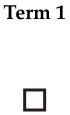
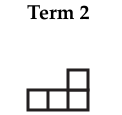
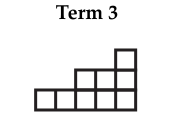
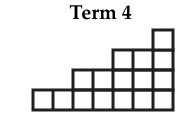
Create a table that relates the term number to the number of squares.
Solution
The wording of the question here can be a little bit hard to understand. But essentially, we're being asked to create a table, where the term number and the number of squares in each image are paired up.
So in the first column of our table, we're going to put the Term Number, and in the second column of the table, we're going to put the Number of Squares.
In the first row, we put the information from the first image.
If we look at that first image, the term number is \(1\), and there is \(1\) square making up the image.
In the second row, we put the information from the second image.
Here, the term number is \(2\), and the number of squares is \(4\).
In the third row, we put the information from the third image.
The term number is \(3\), and the number of squares is \(9\).
Finally, in the fourth row, we put the information from the fourth image, where the term number is \(4\), and the number of squares is \(16\).
We now have a table which pairs every term number with the number of squares in that term.
| Term Number |
Number of Squares |
| \(1\) |
\(1\) |
| \(2\) |
\(4\) |
| \(3\) |
\(9\) |
| \(4\) |
\(16\) |
Example 4
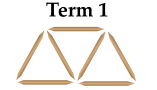
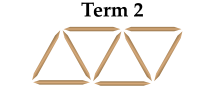
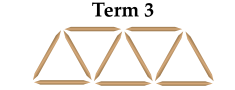
Consider the following sequence of images where toothpicks are arranged to form adjoining triangles.
- Draw the \(4^{th}\) term.
- Create a table that relates the term number to the number of triangles for the first six terms.
Take a moment and try this problem on your own.
Solution
- We start by drawing that fourth image. Each image contains one more triangle than the image before it in the sequence. So to create the fourth image, we add one triangle to the third image, using two additional toothpicks.
Source: Toothpick - melliott1605/iStock/Getty Images Plus
- Next, we want to create the table. In the first column of our table, we're going to put the Term Number. And in the second column of the table is going to go the Number of Triangles.
In the first row, the first term has \(3\) triangles.
In the second row, Term \(2\) has \(4\) triangles.
In the third row, Term \(3\) has \(5\) triangles.
And in the fourth row, Term \(4\) has \(6\) triangles.
| Term Number |
Number of Triangles |
| \(1\) |
\(3\) |
| \(2\) |
\(4\) |
| \(3\) |
\(5\) |
| \(4\) |
\(6\) |
We can now use our table to extend the sequence.
Term \(5\) has \(1\) more triangle than Term \(4\), and so Term \(5\) is going to have \(7\) triangles.
Term \(6\) is going to have \(1\) more triangle than Term \(5\). So Term \(6\) has \(8\) triangles.
| Term Number |
Number of Triangles |
| \(1\) |
\(3\) |
| \(2\) |
\(4\) |
| \(3\) |
\(5\) |
| \(4\) |
\(6\) |
| \(5\) |
\(7\) |
| \(6\) |
\(8\) |
Our table is now complete with the first six terms of the sequence.
Check Your Understanding 4
Question
Consider the sequence of images below.
Fill in the table to relate the term number to the number of triangles.
| Term Number |
Number of Triangles |
| \(1\) |
|
| \(2\) |
|
| \(3\) |
|
| \(4\) |
|
| \(5\) |
|
| \(6\) |
|
Answer
| Term Number |
Number of Triangles |
| \(1\) |
\(1\) |
| \(2\) |
\(5\) |
| \(3\) |
\(9\) |
| \(4\) |
\(13\) |
| \(5\) |
\(17\) |
| \(6\) |
\(21\) |
Feedback
The following sequence represents the number of triangles in each term of the given image sequence.
\(1, \class{hl2}{\xrightarrow{+4}} 5, \class{hl2}{\xrightarrow{+4}} 9, \ldots\)
The pattern rule is: Start at \(1\) and add \(4\) each time.
We must extend the sequence to find the first \(6\) terms.
\(1, \class{hl2}{\xrightarrow{+4}} 5, \class{hl2}{\xrightarrow{+4}} 9, \class{hl2}{\xrightarrow{+4}}, \boxed{\phantom \square} \class{hl2}{\xrightarrow{+4}},\boxed{\phantom \square} \class{hl2}{\xrightarrow{+4}} \boxed{\phantom \square},\ldots\)
Doing so, we get
\(1, \class{hl2}{\xrightarrow{+4}} 5, \class{hl2}{\xrightarrow{+4}} 9, \class{hl2}{\xrightarrow{+4}} 13, \class{hl2}{\xrightarrow{+4}} 17, \class{hl2}{\xrightarrow{+4}} 21,\ldots\)
Take It With You
Draw a sequence of images to represent the information in the following table.
Fill in the title of the second column.
| Term Number |
Number of a blank space here to be filled in_________ |
| \(1\) |
\(9\) |
| \(2\) |
\(12\) |
| \(3\) |
\(15\) |
| \(4\) |
\(18\) |