Exercises


  1. Which of the following pairs of expressions are equivalent? Justify your answer.
    1. \(5n + 3\) and \(7n + 2 - 2n\)
    2. \(9n-4\) and \(5n\)
    3. \(4(n+6)\) and \(4n + 24\)
  2. Consider the image sequence shown below.
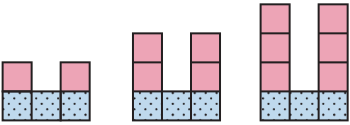
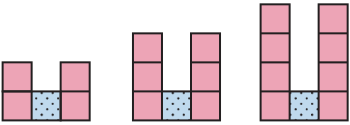
    The following sequence consists of squares arranged to form a U shape. Term 1 has 5 squares, term 2 has 7 squares and term 3 has 9 squares.
    The following two sets of diagrams show two different ways of counting the total number of squares in each image.
    Image 1
    The middle square of the bottom row is dotted for all the terms. The remaining terms are solid.
    Image 2
    The entire bottom row (3 square) of each term are dotted. The rest are solid.

    Write two different expressions to represent the general term of the image sequence using the two representations as your guide.

  3. For each sequence below, find three different expressions to represent the number of toothpicks in term \(n\).
    1. Term 1 contains 5 toothpicks arranged to form a house shape.Term 2 contains 9 toothpicks arranged to form two house shapes with an adjoining side.Term 3 contains 13 toothpicks arranged to form three house shapes with two adjoining sides.
    2. Term 1 contains 6 toothpicks to form a hexagon.Term 2 contains 11 toothpicks to form two hexagons with an adjoining side.Term 3 contains 16 toothpicks arranged to form three hexagons with two adjoining sides.
    3. Term 1 contains 4 toothpicks that form a square, and 2 additional toothpicks to form a triangle on the right adjoining side.Term 2 contains 7 toothpicks that form two adjoining squares, and 2 additional toothpicks to form a triangle on the right adjoining side.Term 3 contains 10 toothpicks that form three adjoining squares, and 2 additional toothpicks to form a triangle on the right adjoining side.
  4. Consider the following sequence of images.
    Term 1 contains 3 by 3 squares, term 2 contains 4 by 3 squares, and term 3 contains 5 by 3 squares.
    The expressions \((2n+6)+n\) and \(2(n+2) + (n+2)\) both represent the number of squares in term \(n\) of this sequence. Using two different shades, illustrate how you can decompose these images to reflect each of the two expressions.
  5. Lesia and Devan each wrote an expression to represent the general term of a sequence of numbers. Lesia said that the expression \(5n+2\) is a general term for her sequence and Devan said that the expression \(2n+2+3n-1\) was a general term for his sequence.
    1. Are Lesia and Devan's sequences the same?
    2. What is similar about their two sequences?
  6. Consider the sequence that begins with the terms\[1^2-0^2,~ 2^2-1^2,~ 3^2-2^2,~ 4^2-3^2, \ldots\]
    1. Identify a possible pattern generating these numbers, and then calculate the values for the first \(8\) terms of this sequence.
    2. Find \(2\) different expressions to represent term \(n\) in this sequence.
    1. The expression \(7n-3n+1+2\) represents term \(n\) in a sequence. Explain how you know that \(4n+3\) also represents term \(n\) of this sequence.
    2. If \(3n - 5\) represents term \(n\) in a different sequence, find two other expressions that also represent term \(n\).
  7. Consider the two expressions \((n+1)^2 - n^2\) and \(2n+1\).
    1. Verify that these two expressions give the same value for \(n=1,~2,~3,~4,~5\).
    2. Can you determine whether these two expressions are equivalent?