- Use the following figures to answer the following questions.
Starting Figure
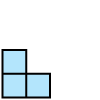
Figure 1
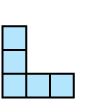
Figure 2
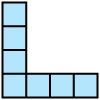
- Given the pattern, complete the table of values and use the first five points to create a scatter plot.
Figure
Number |
Total Number
of Tiles |
| \(0\) |
\(3\) |
| \(1\) |
|
| \(2\) |
|
| \(3\) |
|
| \(6\) |
|
| \(11\) |
|
| \(15\) |
|
- What is the starting value in the pattern shown? Identify this value in the table of values and on your graph.
- How many more blocks do you need each time you increase the figure number by one?
- How many blocks would you need to complete the \(30\)th figure?
- Roy is ordering a pita. The store charges \($8\) for a ham pita with no toppings. Each additional topping costs \($0.50\) each.
- Complete the table of values and create the corresponding scatter plot.
Number
of Toppings |
Total Cost
of Pita |
| \(0\) |
|
| \(1\) |
|
| \(2\) |
|
| \(3\) |
|
| \(6\) |
|
| \(11\) |
|
| \(15\) |
|
- How much would it cost Roy if he ordered \(26\) toppings?
- Bradley and Meddy have a set of rectangular blocks that have side length measurements of \(5\) cm by \(5\) cm by \(10\) cm. Bradley and Meddy stack the blocks differently but are consistent in the placement of the blocks when building their individual towers. Determine the possible growth rates of their towers?
- Sydney's grandmother gave her \($25.00\) for her birthday. She keeps it in a piggy bank in her room. She also does babysitting and is able to save \($5.00\) more every week which also goes in her piggy bank.
- Write an equation to represent the relationship between \(M\), total amount in Sydney's piggy bank, and \(w\), the number of weeks passed since her birthday.
- How much money will Sydney have after \(6\) weeks of saving?
- Rider is placing pattern blocks along the floor. The pattern he uses is square, trapezoid, square, trapezoid, etc. The squares have side lengths of \(4\), and the bottom of each trapezoid has a base length of \(10\).

Bryce says the relationship between the total bottom length of the blocks and the number of blocks used is not linear. Rider agrees with Bryce if each block is considered individually, but tells Bryce there is a way he can consider the relationship linear. Determine how Bryce could do this.
- Tina has just found a new job. She has been given a signing bonus of \($500\) and will earn \($30\) for every hour she works.
She has worked \(14\) hours so far and her total earning is \($920\). She believes that after working \(28\) hours she will have earned at total of \($1840\). Do you agree or disagree with Tina's calculation? Justify your answer.
- At a hair salon, an adult cut costs \($40\) and a child's cut costs \($15\).
If you buy a membership card for \($30\), each haircut is \(25\%\) off.
- Write an equation to represent the relationship between cost and number of haircuts for an adult who purchases a membership card.
-
Write an equation to represent the relationship between cost and number of haircuts for a child who purchases a membership card.
- A second salon charges \($35\) for any haircut and also has a membership card for \($30\). With their membership, every time you get a haircut, you are given a scratch and save card with the potential for \(20\%\), \(25\%\), or \(30\%\) off your haircut. Can you write an equation to represent a linear relationship between cost and number of haircuts for someone who purchases a membership card at this second salon? If not, explain why.