\(x\)- and \(y\)-Intercepts
Take a moment to remember the definition of the \(y\)-intercept.
Recall
The \(y\)-intercept can be defined as the value of the \(y\)-coordinate when the \(x\)-coordinate is equal to \(0\). In a graphical representation of a linear relation, it is the value where the line crosses the \(y\)-axis.
Now, we will define the \(x\)-intercept as:
The \(x\)-intercept can be defined as the value of the \(x\)-coordinate when the \(y\)-coordinate is equal to \(0\). In a graphical representation of a linear relation, it is the value where the line crosses the \(x\)-axis.
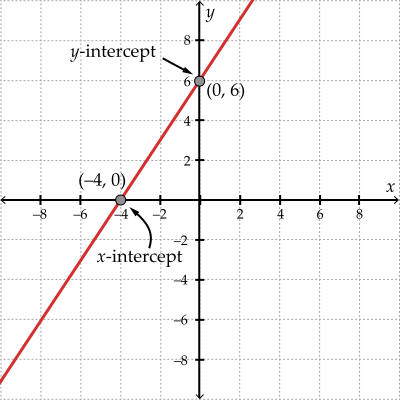
- Looking at the graph, we can see that the \(y\)-intercept is equal to \(6\). It is represented by the point \((0,6)\) on the line.
- The \(x\)-intercept is equal to \(-4\). It is represented by the point \((-4,0)\) on the line.
Knowing that we only need two points to graph a straight line, we will now look at using both the \(x\)- and \(y\)-intercept points to graph the linear relations in examples that follow.
Example 4
Create a graph of the linear relation \(y=-\dfrac{8}{5}x+8\) using \(x\)- and \(y\)-intercepts.
Solution
Determining the \(y\)-intercept
To determine the \(y\)-intercept, we will set the value of \(x\) equal to \(0\).
\[\begin{align*} y&=-\frac{8}{5}x+8\\ y&=-\frac{8}{5}(0)+8\\ y&=8 \end{align*}\]
Therefore, the point \((0,8)\) is on the line.
Determining the \(x\)-intercept
To determine the \(x\)-intercept, we will set the value of \(y\) equal to \(0\) and solve for \(x\).
\[\begin{align*} y&=-\frac{8}{5}x+8\\ 0&=-\frac{8}{5}x+8\\ -8&=-\frac{8}{5}x\\ -40&=-8x\\ 5&=x \end{align*}\]
Therefore, the point \((5,0)\) is on the line.
Now that we know the points \((0,8)\) and \((5,0)\) are on the line, we can plot the two points on the Cartesian Plane and draw a line to represent the relation.
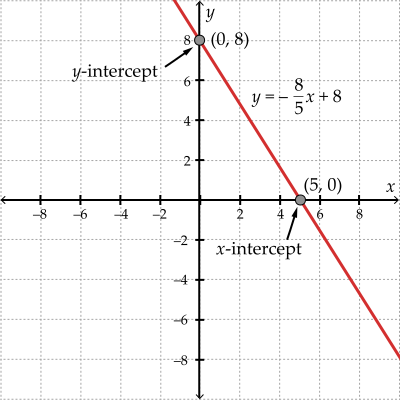
The line represents the infinite number of points that satisfy the relation.
Example 5
Create a graph of the linear relation \(y=5x\) using \(x\)- and \(y\)-intercepts.
Solution
Determining the \(y\)-intercept
To determine the \(y\)-intercept, we will set the value of \(x\) equal to \(0\).
\[\begin{align*} y&=5x\\ y&=5(0)\\ y&=0 \end{align*}\]
Therefore, the point \((0,0)\) is on the line.
Determining the \(x\)-intercept
To determine the \(x\)-intercept, we will set the value of \(y\) equal to \(0\) and solve for \(x\).
\[\begin{align*} y&=5x\\ 0&=5x\\ \frac{0}{5}&=x\\ 0&=x \end{align*}\]
Therefore, the point \((0,0)\) is on the line.
Notice that the \(x\)- and \(y\)-intercepts are the exact same point. Therefore, we need a second point.
Note that it does not matter what value of \(x\) you choose to determine this point.
- We will use \(x=3\).
- Solving for \(y\) we find that the point \((3,15)\) is on the line.
Now we know the points \((0,0)\) and \((3,15)\) are on the line.
Plot the two points on the Cartesian Plane and draw a line to represent the relation.
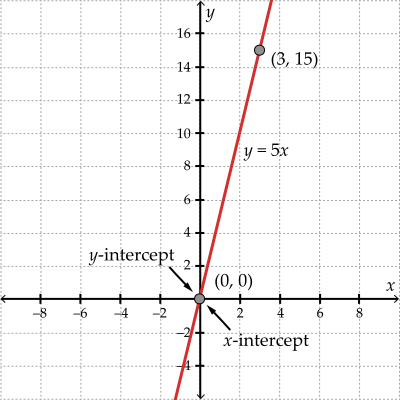
The line represents the infinite number of points that satisfy the relation.
Example 6
Create a graph of the linear relation \(-3x+5y=15\) using \(x\)- and \(y\)-intercepts.
Solution
Determining the \(y\)-intercept
To determine the \(y\)-intercept, we will set the value of \(x\) equal to \(0\) and solve for \(y\).
\[\begin{align*} -3x+5y&=15\\ -3(0) +5y&=15\\ 5y&=15\\ y&=3 \end{align*}\]
Therefore, the point \((0,3)\) is on the line.
Determining the \(x\)-intercept
To determine the \(x\)-intercept, we will set the value of \(y\) equal to \(0\) and solve for \(x\).
\[\begin{align*} -3x+5y&=15\\ -3x +5(0)&=15\\ -3x&=15\\ x&=-5 \end{align*}\]
Therefore, the point \((-5,0)\) is on the line.
Plotting the points \((0,3)\) and \((-5,0)\) and drawing the linear relation, we now have the graph of \(-3x+5y=15\).

The graphing method of using the \(x\)- and \(y\)-intercepts will often be the preferred choice when the relation is given in the form \(Ax+By=C\).