Alternative Format — Lesson 4: Slope and the \(y\)-Intercept

Let's Start Thinking

The Variables \(x\) and \(y\)

In many of our previous lessons when working with linear relations, our examples had a story or description outlining the relationship between the independent and dependent variables.

A graph with Number of Days worked along the x-axis and Money earned along the y-axis. Jane and Jasper have points plotted along the graph.

A graph with Number of Blocks along the x-axis and Height of Tower along the y-axis. Sam, Karen, and Johnathon have points plotted on the graph.

Sometimes, when we are working with mathematical ideas and we want to learn more about a relationship, we generalize the ideas and extend the properties to mathematical situations that do not have an associated story.

In these situations, where there is no context, we often use the general variables \(x\) and \(y\).

A chalkboard with x+y=? written on it

A chalkboard with a y-axis and x-axis written on it

In this lesson, we will work with algebraic linear relations represented in tables, graphs, and equations to explore the ideas of slope and the \(y\)-intercept.

We will work with the variables \(x\) and \(y\), which will represent the independent and dependent variables, respectively.


Lesson Goals

  • Define the terms \(y\)-intercept and slope.
  • Identify or calculate the \(y\)-intercept and slope of a linear relation given a graph, table of values, or an equation.
  • Explore linear families.

Try This!

How might you group the following linear relations?

  1. \(x\) \(y\)
    \(-2\) \(-6\)
    \(-1\) \(-1\)
    \(0\) \(4\)
    \(1\) \(9\)
    \(2\) \(14\)
  2. \(y=-2x\)
  3. \(x\) \(y\)
    \(-2\) \(14\)
    \(-1\) \(12\)
    \(0\) \(10\)
    \(1\) \(8\)
    \(2\) \(6\)
  1. A straight line is drawn through the points (negative 5, 5) and (0, negative 5)
  2. \(y=2x+4\)
  3. A straight line is drawn through the points (0, 4) and (2, negative 2)                       

The \(y\)-Intercept


The \(y\)-Intercept

Historical Fact

The Cartesian plane was named after the French mathematician René Descartes.

Let's begin by recalling the variables used on a Cartesian plane are typically \(x\) and \(y\).

A Cartesian plane with x-axis and y-axis labelled.

The horizontal axis, or independent variable is often labelled with an \(x\).

A Cartesian plane with x-axis highlighted.

The vertical axis, or dependent variable is often labelled as \(y\).

A Cartesian plane with y-axis highlighted.

The Cartesian plane has four quadrants. These quadrants extend to include all real numbers for \(x\) and all real numbers for \(y\).

A Cartesian plane with the four quadrants labelled

Let's also take a moment to recall that the initial value of a linear relation is defined as the value of the dependent variable when the independent variable is equal to \(0\).

A Cartesian plane with a positive linear relation passing through an initial value of (0,6)

The \(y\)-intercept is defined as the value of the \(y\)-coordinate where the \(x\)-coordinate is equal to \(0\). In a graphical representation of a linear relation on a Cartesian plane, it is the value where the line crosses the \(y\)-axis.

The initial value in a linear relation is the \(y\)-intercept.

A common variable used to represent the \(y\)-intercept is \(b\).

Example 1

For each of the given graphs, determine the value of the \(y\)-intercept.

  1. Graph 1
    A graph of a positive linear relation.
  2. Graph 2
    A graph of a negative linear relation.

In this example, we are given a linear relation in Graph 1 and a second linear relation in Graph 2.

Solution — Part A

In Graph 1, we can see that the line crosses the \(y\)-axis at \(3\).

A graph of a positive linear relation with y-Intercept at (0,3).

This means that \(3\) is the value of the \(y\)-intercept, and that the point \((0, 3)\) is on the line.

Solution — Part B

In Graph 2, we can see that the line crosses the \(y\)-axis at \(-2\).

A graph of a negative linear relation with y-Intercept at (0,-2)

This means that \(-2\) is the value of the \(y\)-intercept, and that the point \((0,-2)\) is on the line.


Explore This 1

Description

How does the value of the \(y\)-intercept affect the equation and the graph of a linear relation?

Example 1

The equation \(y=-4x-3\) has a \(y\)-intercept of \(-3\).

The equation \(y=-4x+3\) has a \(y\)-intercept of \(2\).

Example 2

The equation \(y=x+4\) has a \(y\)-intercept of \(4\).

The equation \(y=x-1\) has a \(y\)-intercept of \(-1\).

Interactive Version

Exploring the \(y\)-Intercept of a Line


Explore This 1 Summary

In Explore This 1, a slider was provided to change the value of the \(y\)-intercept while the rate of change remained the same. Moving the slider moved the line up and down.

If we look at the graph of \(y=2x+3\) and \(y=2x-5\), we can see that these graphs cross the \(y\)-axis at \(3\) and \(-5\) respectively.

The line y equals 2x + 3 crosses the y-axis at (0,3). The line y equals 2x-5 crosses the y-axis at (0,-5).


Example 2

Given the linear relation in the table of values, determine the \(y\)-intercept.

\(x\) \(y\)
\(-2\) \(-1\)
\(-1\) \(\dfrac{1}{3}\)
\(0\) \(\dfrac{5}{3}\)
\(1\) \(3\)
\(2\) \(\dfrac{13}{3}\)

Solution

When determining the \(y\)-intercept from a table of values, we can look in the table to find the point \((x,y)\) where \(x\) is equal to \(0\). 

In our table, we can see that the \(y\)-intercept is equal to \(\dfrac{5}{3}\) when \(x\) is equal to \(0\).

Later on in this lesson, we will look at a table of values where we will need to do some calculations to determine the \(y\)-intercept because the point where \(x\) is equal to \(0\) is missing.

Check Your Understanding 1

Question

Given the following linear relation, determine the \(y\)-intercept.

\(x\) \(y\)
\(-2\) \(-5\)
\(-1\) \(-3\)
\(0\) \(-1\)
\(1\) \(1\)
\(2\) \(3\)

Answer

The \(y\)-intercept is \(-1\).

Feedback

The \(y\)-intercept is \(-1\). This is the value of \(y\) when \(x\) is equal to \(0\).

Check Your Understanding 2

Question — Version 1

Given the following linear relation, determine the \(y\)-intercept.

A graph of the line y equals negative 2 x plus 3.

Answer — Version 1

The \(y\)-intercept is \(3\).

Feedback — Version 1

The \(y\)-intercept is \(3\). This is the value of \(y\) when \(x\) is equal to \(0\).

Question — Version 2

Given the following linear relation, determine the \(y\)-intercept.

A graph of the line y equals 2x minus 2.

Answer — Version 2

The \(y\)-intercept is \(-2\).

Feedback — Version 2

The \(y\)-intercept is \(-2\). This is the value of \(y\) when \(x\) is equal to \(0\).

Example 3

Given the following linear relations, determine the \(y\)-intercept.

  1. \(y=\dfrac{9}{7}x-14\)
  2. ​​​​\(15x-12y=60\)

Solution — Part A

First, we will look at \(y=\dfrac{9}{7}x-14\).

When we are given a linear relation as an equation, we can substitute a value of \(0\) in for \(x\) and solve for the value of \(y\). Substituting \(x=0\) gives us the equation

\(\begin{align*} y &=\frac{9}{7}(0)-14 \\ &=0-14 \\ &=-14 \end{align*}\)

Therefore, the \(y\)-intercept is equal to \(-14\).

This means that the point \((0,-14)\) is on the line.

Solution — Part B

Recall part b): Given the linear relation \(15x-12y=60\), determine the \(y\)-intercept.

Again, we are given an equation of a linear relation. So to determine the \(y\)-intercept, we will solve for the value of \(y\) when \(x\) is equal to \(0\). Substituting in \(x=0\), we get

\(\begin{align*} 15(0)-12(y) &=60 \\-12 y &=60 \\ y &=\frac{60}{-12} \\ y &=-5 \end{align*}\)

Therefore, the \(y\)-intercept is equal to \(-5\).

The graph of the linear relation will cross the \(y\)-axis at \(-5\), and the point \((0,-5)\) is on the line.


Check Your Understanding 3

Question — Version 1

Given the following linear relation, determine the \(y\)-intercept.

\(3x+9y=-8\)

Answer — Version 1

The \(y\)-intercept is \(-\dfrac{8}{9}\).

Feedback — Version 1

To solve for the \(y\)-intercept, substitute in a value of \(0\) for the variable \(x\).

\(\begin{align*} 3 x+9 y &=-8 \\ 3(0)+9 y &=-8 \\ 9 y &=-8 \\ y &=\frac{-8}{9} \\ y &=-\frac{8}{9} \end{align*}\)

Therefore, the \(y\)-intercept is \(-\dfrac{8}{9}\).

Question — Version 2

Given the following linear relation, determine the \(y\)-intercept.

\(-4x-7y=-6\)

Answer — Version 2

The \(y\)-intercept is \(\dfrac{6}{7}\).

Feedback — Version 2

To solve for the \(y\)-intercept, substitute in a value of \(0\) for the variable \(x\).

\(\begin{align*}-4 x-7 y &=-6 \\-4(0)-7 y &=-6 \\-7 y &=-6 \\ y &=\frac{-6}{-7} \\ y &=\frac{6}{7} \end{align*}\)

Therefore, the \(y\)-intercept is \(\dfrac{6}{7}\).


Slope


Explore This 2

Description

How does the value of the rate of change affect the equation and the graph of a linear relation?

Example 1

The equation \(y=-9x+4\) has a rate of change of \(-9\).

The line y equals negative 9x plus 4 crosses the y-axis at 4.

The equation \(y=-3x+4\) has a rate of change of \(-3\).

The line y equals negative 3x plus 4 crosses the y-axis at 4.

Example 2

The equation \(y=x-2\) has a rate of change of \(1\).

The line y equals x minus 2 crosses the y-axis at negative 2.

The equation \(y=5x-2\) has a rate of change of \(5\).

The line y equals 5x minus 2 crosses the y-axis at negative 2.

Interactive Version

Exploring the Slope of a Line


Explore This 2 Summary

In the Explore This activity a slider was used to change the steepness of a line. The slider was altering the rate of change for a linear relation.

You may have noticed the following:

  • If the value of the rate of change is positive, the \(y\)-values increase as the \(x\)-values increase.
  • If the value of the rate of change is negative, the \(y\)-values decrease as the \(x\)-values increase.
  • The further away from \(0\) the rate of change is, the faster the values of \(y\) will change.

Steepness

In a previous lesson, we defined the rate of change as the ratio of the change in the dependent variable with respect to the change in the independent variable.

In a graphical representation of a linear relation when the rate of change is a larger positive or larger negative value, the line on the graph becomes quite steep. The closer the rate of change is to \(0\), the less steep the line is.
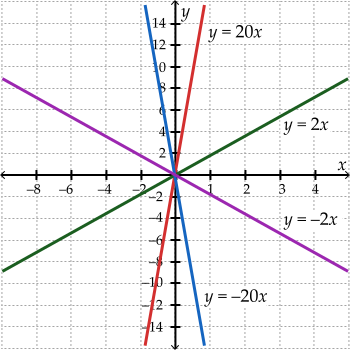
A graph of y=20x, y=2x, y=-2x, and y=-20x.

In other words,

The magnitude of the rate of change affects the steepness of a straight line.

The magnitude of a number is its value ignoring the sign. For example, the magnitude of both \(5\) and \(-5\) is equal to \(5\).

We can visually see the difference in steepness on the graph shown here where the lines with the rates of change of \(20\) and \(-20\) look much steeper than the lines with the rates of change of \(2\) and \(-2\).
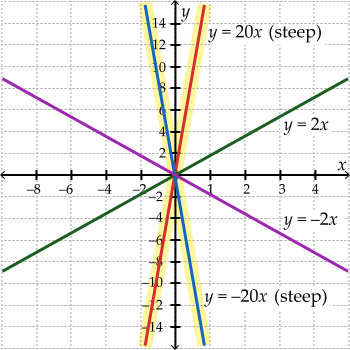
A graph of y=20x, y=2x, y=-2x and y=-20x, where y=20x and y=-20x are highlighted.

Slope

Because the rate of change affects the steepness of the line when graphed, another term used to describe the rate of change is slope.

The slope of a straight line is defined as the ratio of the change in \(y\)-values with respect to the change in \(x\)-values.

The change in \(y\) describes the vertical rise, or fall, of the line between two points. And the change in \(x\) describes the horizontal run of the line between two points.

\(\begin{align*} \text { Slope } &=\frac{\text { change in } y}{\text { change in } x} \end{align*}\)

A graph of a positive linear relation with a rate triangle connecting two points on the relation representing the slope

We say the slope is equal to rise over run.

\(\begin{align*} \text { Slope } &=\frac{\text { rise }}{\text { run }} \end{align*}\)

A graph of a positive linear relation, and a rate triangle with vertical distance labelled rise and the horizontal distance labelled run

The slope of a linear relation is always constant, and if a relation has a constant slope, then it is linear.

A common variable used to represent slope is \(m\).

Example 4

Given the graph of the linear relation, determine the slope of the line and the \(y\)-intercept.

Use this information to write an equation to represent the linear relation shown in the graph.
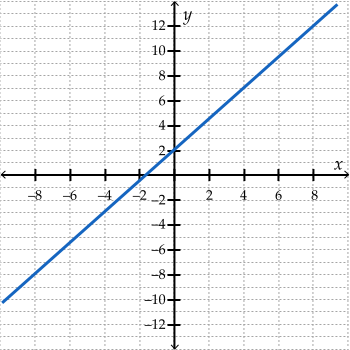
A graph of a positive linear relation with points at  ‌(−8,−8), ‌(−4,−3), ‌(0,2), ‌(4,7), and ‌(8,12).

If we start with the slope, we first need to remember that when calculating the rate of change, two points are needed to do the calculation. Because slope and rate of change mean the same thing, two points are also needed to calculate slope.

Remember to look for friendly points or coordinates that meet at intersecting grid lines and are easy to read on the graph.

Solution

On the graph, we can see that the points \((-8,-8)\), \((-4,-3)\), \((0,2)\), \((4,7)\), and \((8,12)\) are all points that would be considered friendly.
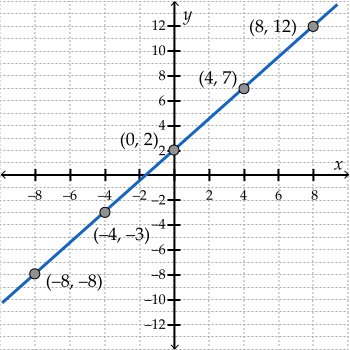
A graph of a positive linear relation with points (negative 8,negative 8), (negative 4,negative 3), (4,7), and (8,12) labelled.

Remember, you can choose any two points to work with. Therefore, any of these two points can be used to calculate the slope of the line.

For our solution, we will draw a right triangle and use the starting point \((-4,-3)\)  and the ending point \((4,7)\).
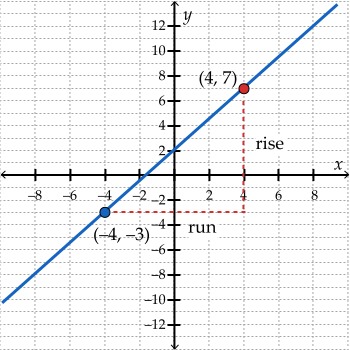
A graph of a positive linear relation, and a rate triangle drawn from (-4,-3) to (4,7)

Remember that a right triangle will always be a right triangle where the height represents the rise and the base represents the run.

Also remember the order in which the points are subtracted matters. This is why we will label our points as starting and ending to help us keep track of this order. If you subtract the starting value of \(y\) from the ending value of \(y\), you must subtract the starting value of \(x\) from the ending value of \(x\).

We know slope is equal to the change in \(y\) divided by the change in \(x\), or the rise over run. To find the rise, we will take the ending \(y\)-value, \(7\), and subtract the starting \(y\)-value, negative \(3\). To calculate the change in \(x\)-values, or the run, we will take the ending \(x\)-value, \(4\), and subtract the starting \(x\)-value, \(-4\).

To summarize,

\(\begin{align*} &= \dfrac{\text{change in }y}{\text{change in }x} \\ &=\dfrac{\text { rise }}{\text { run }} \\ &=\dfrac{7-(-3)}{\text { run }}=\dfrac{7-(-3)}{4-(-4)} \\ &=\dfrac{10}{8} \\ &=\dfrac{5}{4} \end{align*}\)

A graph of a positive linear relation with rise=10 and run=8, and a rate triangle drawn from (-4,-3) to (4,7)

Therefore, reduced to lowest terms we get \(\dfrac{5}{4}\).

Now we have the slope of the line is equal to \(\dfrac{5}{4}\). Next, we can determine the \(y\)-intercept.

Looking at the graph, we can identify the \(y\)-intercept for this relation as \(2\) or the value where the line crosses the \(y\)-axis.
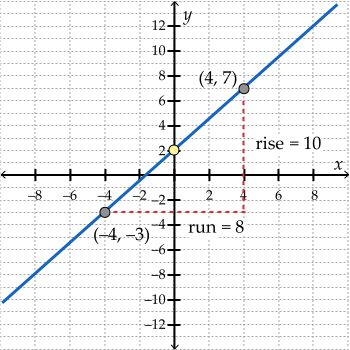
A graph of a positive linear relation with rise=10 and run=8, and the y-Intercept labelled at (0,2)

Previously, when working with the rate of change and initial value, we use them together to develop an equation to represent a linear relation. We can now do the same thing when we know the slope and \(y\)-intercept.

A linear equation is often written as \(y=\class{hl1}{m}x+\class{hl2}{b}\) where \(m\) represents the slope and \(b\) represents the \(y\)-intercept​.

For this example, we can represent the linear relation with the equation ‌\(y=\dfrac{5}{4}x+2\).

The linear relation is represented by y=5/4x+2.

Example 5

Given the graph of the linear relation, determine the slope of the line.
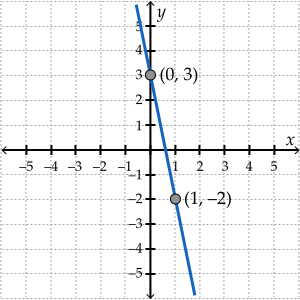
Graph of a linear relation with negative slope with points at (0,3) and (1,-2).

Solution

On this graph, we are given the labelled points \((0,3)\) and \((1,-2)\).

We can draw a right triangle between these two points and calculate the slope. Slope is equal to rise over run. To find the rise, we can take the ending \(y\)-value, \(-2\), and subtract the starting \(y\)-value, \(3\). To calculate the run, we take the ending \(x\)-value, \(1\), and subtract the starting \(x\)-value, \(0\).

This gives us a slope of

\(\begin{align*} m &=\dfrac{\text { rise }}{\text { run }} \\ &=\dfrac{-2-3}{\text { run }}=\dfrac{-2-3}{1-0} \\ &=\dfrac{-5}{1} \\ &=-5 \end{align*}\)

Graph of a linear relation with negative slope and rise=negative 5 and run=1, with rate triangle drawn from the two given points

A negative slope means the \(y\)-values are decreasing from left to right. You can see on the graph that the line falls to the right.

A positive slope means the \(y\)-values are increasing from left to right. A line with a positive slope rises to the right.
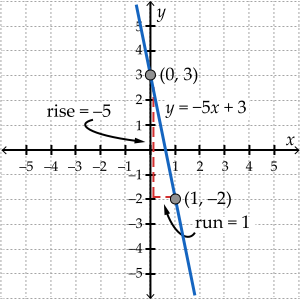
 The equation y=negatvie 5x+3 represents the linear relation.


Check Your Understanding 4

Question — Version 1

Given the following linear relation, determine the slope.

A line with a positive slope with points at (1,1) and (6,2).

Answer — Version 1

The slope is \(\dfrac{1}{5}\).

Feedback — Version 1

Using the points \((1,1)\) and \((6,2)\),

\(\begin{align*} m &= \dfrac{\text{rise}}{\text{run}} \\ m&= \dfrac{2-1}{6-1}\\ m &= \dfrac{1}{5} \end{align*}\)

Therefore, the slope is \(\dfrac{1}{5}\).

Question — Version 2

Given the following linear relation, determine the slope.

A line with a negative slope with points at (0,5) and (1,-4).

Answer — Version 2

The slope is \(-9\).

Feedback — Version 2

Using the points \((1,-4)\) and \((0,5)\),

\(\begin{align*} m &= \dfrac{\text{rise}}{\text{run}} \\ m&= \dfrac{5-(-4)}{0-1} \\ m &= -9 \end{align*}\)

Therefore, the slope is \(-9\).


The Importance of the Order of Subtraction

When we are calculating slope, we are using two points, a starting point and an ending point.  Let's take a moment to look at why it is very important to keep the order of subtraction of the points consistent.   

We will consider a line that passes through the points \((-1,9)\) and \((5,12)\).

Case 1

Calculate the slope with the starting point of \((-1,9)\) and the ending point of \((5,12)\).

\[\begin{align*} m&=\frac{\text{rise}}{\text{run}}\\ &=\frac{12-9}{5-(-1)}\\ &=\frac{3}{6}\\ &=\frac{1}{2} \end{align*}\]

Case 2

Calcluate the slope with the starting point \((5,12)\) and the ending point of \((-1,9)\).

\[\begin{align*} m&=\frac{\text{rise}}{\text{run}}\\ &=\frac{9-12}{-1-5}\\ &=\frac{-3}{-6}\\ &=\frac{1}{2} \end{align*}\]

Notice that both options give us a slope of \(\dfrac{1}{2}\).

Now let's look at the error that will occur if we were inconsistent with the order of subtraction.  Again, we will use the points \((-1,9)\) and \((5,12)\).

\[\begin{align*} m&=\frac{\text{rise}}{\text{run}}\\ &=\frac{9-12}{5-(-1)}\\ &=\frac{-3}{6}\\ &=-\frac{1}{2} \end{align*}\]

Notice that we were not consistent with our starting and ending points.  To find the difference in the \(y\)-values, we had a starting point of \((5,12)\) and an ending point \((-1,9)\).  When we went to calculate the difference in the \(x\)-values, we used a starting point of \((-1,9)\) and an ending point of \((5,12)\).  This gives us an error in the sign of the slope.  We end up with a negative slope instead of the correct positive slope.

Example 6

Given information about a linear relation in the table of values,

  1. determine the slope and \(y\)-intercept, and
  2. write an equation to represent this relation in the form \(y=mx+b\).
\(x\) \(y\)
\(-4\) \(-\dfrac{26}{3}\)
\(-2\) \(-4\)
\(0\) \(\dfrac{2}{3}\)
\(2\) \(\dfrac{16}{3}\)
\(4\) \(10\)

Solution — Part A

To determine the slope, we will calculate the ratio of the change in \(y\) (rise) with respect to the change in \(x\) (run). Remember, it does not matter which two points are used for the slope calculation. The simpler points to choose would be \((-2,-4)\) and \((4,10)\) because they are integer values. Let's complete the slope calculation using these two points and then we will work through a second solution with \(\left(-4, -\dfrac{26}{3}\right)\) and \(\left(2,\dfrac{16}{3}\right)\) to show we can use any two points.

Using Two Points on the Line

We will refer to \((-2, -4)\) as the starting point and \((4,10)\) as the ending point. We will subtract the starting point from the ending point to calculate the rise and the run. Remember it is very important to keep the order of the points consistent. 

\[\begin{align*} m&=\frac{\text{rise}}{\text{run}}\\ &=\frac{10-(-4)}{4-(-2)}\\ &=\frac{14}{6}\\ &=\frac{7}{3} \end{align*}\]

Step 1: Find the difference between the \(x\) and \(y\) -coordinates of the ending point and the starting point.

Step 2: Solve.

Step 3: Reduce to lowest terms.

Using Two Different Points on the Line

We will refer to \(\left(-4, -\dfrac{26}{3}\right)\) as the starting point and \(\left(2,\dfrac{16}{3}\right)\) as the ending point.

\[\begin{align*} m&=\dfrac{\text{rise}}{\text{run}}\\ &=\dfrac{ \frac{16}{3}- \left(-\frac{26}{3} \right)}{2-(-4)}\\ &=\dfrac{\frac{42}{3}}{6}\\ &=\dfrac{42}{3} \times \frac{1}{6}\\ &=\dfrac{42}{18}\\ &=\dfrac{7}{3} \end{align*}\]

Step 1: Find the difference between the \(x\) and \(y\) -coordinates of the ending point and the starting point.

Step 2: Solve and remember that when dividing fractions, we use the reciprocal and change the operation to multiplication.

Step 3: Reduce to lowest terms.

Therefore, using either pair of points, we see that the slope of this linear relation is \(\dfrac{7}{3}\).

Determine the \(y\)-intercept:

Looking at the table of values, we can see that the \(y\)-intercept value is \(\dfrac{2}{3}\). This is where the \(x\)-value is equal to \(0\).

\(x\) \(y\)
\(-4\) \(-\dfrac{26}{3}\)
\(-2\) \(-4\)
\(0\) \(\dfrac{2}{3}\)
\(2\) \(\dfrac{16}{3}\)
\(4\) \(10\)

Solution — Part B

Equation in the Form \(y=mx+b\):

Recall that the value of \(m\) in this equation represents the slope, and the value of \(b\) represents the \(y\)-intercept. For this example, we can write this linear relation as \(y=\dfrac{7}{3}x+\dfrac{2}{3}\). 

We can check our equation by substituting in values for \(x\) and \(y\) to see if the left side is equal to the right side. We check the point \((4,10)\) below.

 \(\begin{align*} \text{LS} &= 10 \end{align*}\)

\(\begin{align*} \text{RS} &=\frac{7}{3}\times4+\frac{2}{3}\\ &=\frac{28}{3}+\frac{2}{3}\\ &=\frac{30}{3}\\ &=10 \end{align*}\)

Therefore, the left side equals the right side.

Example 7

Given information about a linear relation in the table of values,

  1. determine the slope and the \(y\)-intercept, and
  2. write an equation to represent this relation in the form \(y=mx+b\).
\(x\) \(y\)
\(-4\) \(\dfrac{89}{6}\)
\(-1\) \(\dfrac{17}{6}\)
\(3\) \(-\dfrac{79}{6}\)
\(7\) \(-\dfrac{175}{6}\)
\(9\) \(-\dfrac{223}{6}\)

Solution — Part A

We will calculate the rise and the run with the points \(\left(-1, \dfrac{17}{6}\right)\) and \(\left(7,-\dfrac{175}{6}\right)\). We will refer to \(\left(-1, \dfrac{17}{6}\right)\) as the starting point and \(\left(7,-\dfrac{175}{6}\right)\) as the ending point. We will subtract the starting point from the ending point to calculate the rise and the run, remembering the order in which we subtract matters.

\[\begin{align*} m&=\dfrac{\text{rise}}{\text{run}}\\ &=\dfrac{ -\frac{175}{6}- \frac{17}{6} }{7-(-1)}\\ &=\dfrac{-\frac{192}{6}}{8}\\ &=-\dfrac{32}{8}\\ &=-4 \end{align*}\]

Step 1: Find the difference between the \(x\) and \(y\) -coordinates of the ending point and the starting point.

Step 2: Solve.

Therefore, the slope of this linear relation is \(-4\).

Looking at the table of values, we can see that the value of \(x=0\) is not given.

\(x\) \(y\)
\(-4\) \(\dfrac{89}{6}\)
\(-1\) \(\dfrac{17}{6}\)
\(3\) \(-\dfrac{79}{6}\)
\(7\) \(-\dfrac{175}{6}\)
\(9\) \(-\dfrac{223}{6}\)

This means that we need to calculate the initial value, or the \(y\)-value, when \(x=0\). We can do this by using a point in the table and the slope we just calculated.

We know we can write a linear relation as \(y=mx+b\). We can substitute the slope in for \(m\) and a point given in the table for the values of \(x\) and \(y\). This means the only unknown in the equation is \(b\), which represents the \(y\)-intercept.

To solve for \(b\), it does not matter which point you choose. For our solution, we will use the point \(\left(3,-\dfrac{79}{6}\right)\).

\[\begin{align*} y&=mx+b\\ y&=-4x+b\\ -\frac{79}{6}&=-4 (3)+b\\ -\frac{79}{6}&=-12+b\\ -\frac{79}{6}+12&=b\\ -\frac{79}{6}+\frac{72}{6}&=b \\ -\frac{7}{6}&=b \end{align*}\]

Therefore, the \(y\)-intercept is \(-\dfrac{7}{6}\).

Equation in the form \(y=mx+b\):

Now that we know both the slope and the \(y\)-intercept, we can write this linear relation as \(y=-4x-\dfrac{7}{6}\).

Here we will do an informal check and replace the variable \(x\) with a value from the table and check to make sure the result is the corresponding \(y\)-value.

Mental Check

\((-4)(-4)-\dfrac{7}{6}=\dfrac{89}{6}\)Correct!


Check Your Understanding 5

Question — Version 1

Given the following linear relation, determine:

  1. the slope,
  2. the \(y\)-intercept, and 
  3. the equation of the line in the form \(y=mx+b\).
\(x\) \(y\)
\(-5\) \(-27\)
\(-1\) \(-11\)
\(4\) \(9\)
\(7\) \(21\)
\(11\) \(37\)

Answer — Version 1

  1. The slope is \(4\).
  2. The \(y\)-intercept is \(-7\).

  3. The equation of the line in the form \(y=mx+b\) is \(y=4x+7\).

Feedback — Version 1

  1. Use two points to calculate the slope. One possible solution, using points \((7, 21)\) and \((11, 37)\), would be:

    \( \text{slope} = \dfrac{\text{rise}}{\text{run}} = \dfrac{37 - 21}{11 - 7} = \dfrac{16}{4} = 4 \)

    Therefore, the slope is \(4\).

  2. Use one point and the slope to calculate the \(y\)-intercept. One possible solution, using the point \((4, 9)\), would be:

    \(\begin{align*}y &= mx + b \\ 9 &= 4(4) + b \\ 9 - 16 &= b \\ -7 &= b\end{align*}\)

    Therefore, the \(y\)-intercept is \(-7\).

  3. Use the slope and the \(y\)-intercept to write the equation of the line as \(y = 4x - 7\).

Question — Version 2

Given the following linear relation, determine:

  1. the slope,
  2. the \(y\)-intercept, and 
  3. the equation of the line in the form \(y=mx+b\).
\(x\) \(y\)
\(-4\) \(-\dfrac{15}{8}\)
\(-1\) \(-\dfrac{3}{8}\)
\(2\) \(\dfrac{9}{8}\)
\(5\) \(\dfrac{21}{8}\)
\(7\) \(\dfrac{29}{8}\)

Answer — Version 2

  1. The slope is \(\dfrac{1}{2}\).
  2. The \(y\)-intercept is \(\dfrac{1}{8}\).
  3. The equation of the line in the form \(y=mx+b\) is \(y=\dfrac{1}{2}x+\dfrac{1}{8}\).

Feedback — Version 2

  1. Use two points to calculate the slope. One possible solution, using points \(\left(-1, -\dfrac{3}{8}\right)\) and \(\left(2, \dfrac{9}{8}\right)\), would be:

    \( \text{slope} = \dfrac{\text{rise}}{\text{run}} = \dfrac{\frac{9}{8} - \left(-\frac{3}{8}\right)}{2 - (-1)} = \dfrac{\frac{12}{8}}{3} = \dfrac{12}{8} \times \dfrac{1}{3} = \dfrac{1}{2}\)

    Therefore, the slope is \(\dfrac{1}{2}\).

  2. Use one point and the slope to calculate the \(y\)-intercept. One possible solution, using the point \(\left(-4, -\dfrac{15}{8}\right)\), would be:

    \(\begin{align*} y &= mx + b \\ -\dfrac{15}{8} &= \dfrac{1}{2}(-4) + b \\ -\dfrac{15}{8} + 2 &= b \\ -\dfrac{15}{8} + \dfrac{16}{8} &= b \\ \dfrac{1}{8} &= b \end{align*}\)

    Therefore, the \(y\)-intercept is \(\dfrac{1}{8}\).

  3. Use the slope and the \(y\)-intercept to write the equation of the line as \(y = \dfrac{1}{2}x + \dfrac{1}{8}\).

Family of Lines


Families of Lines

Family members often share common characteristics or attributes. For example, siblings may have the same eye color or be a similar height or have a similar looking nose.

Families of lines either share a common \(y\)-intercept or a common slope.

Families of Lines Sharing a \(y\)-Intercept

If we consider a family of lines that all have a common \(y\)-intercept of \(5\), we can write the general equation to represent the family as \(y=mx+5\), where \(m\) can be any real number.

This means there will be an infinite number of lines that are members of this family.

This graph shows four lines from this family. We can see all of them pass through the point \((0, 5)\).

A graph of 4 linear relations labelled y=-0.5x+5, y=2x+5, y=-3x+5 and y=4x+5, all sharing the same y-Intercept of 5

Families of Lines Sharing a Slope

If we consider a family of lines that all have a common slope of \(-3\), we can write the general equation to represent the family as \(y=-3x+b\), where \(b\) can be any real number.

This means there will be an infinite number of lines that are members of this family.

This graph shows four lines from the family. Here, we can see the lines are all parallel to each other.

A graph of 4 linear relations labelled y=-3x-2, y=-3x, y=-3x+5 and y=-3x+3/2, all sharing the same slope of -3


Try This Revisited

At the start of this lesson you were asked how you might group the following linear relations:

  1. \(x\) \(y\)
    \(-2\) \(-6\)
    \(-1\) \(-1\)
    \(0\) \(4\)
    \(1\) \(9\)
    \(2\) \(14\)
  2. \(y=-2x\)
  3. \(x\) \(y\)
    \(-2\) \(14\)
    \(-1\) \(12\)
    \(0\) \(10\)
    \(1\) \(8\)
    \(2\) \(6\)
  4. A straight line is drawn through the points (negative 5, 5) and (0, negative 5)
  5. \(y=2x+4\)
  6. A straight line is drawn through the points (0, 4) and (2, negative 2)                       

Grouping the Relations

Using what we know from this lesson, let's take a moment to first determine the slope and \(y\)-intercept for each relation provided.

\[\begin{align*} \text{slope} &= \dfrac{\text{rise}}{\text{run}}\\ &=\frac{-5-5}{0-(-5)}\\ &=\frac{-10}{5}\\ &=-2 \end{align*}\]

Therefore the slope of this line is \(-2\).

  1. \(x\) \(y\)
    \(-2\) \(-6\)
    \(-1\) \(-1\)
    \(0\) \(4\)
    \(1\) \(9\)
    \(2\) \(14\)

    We can see from the table the \(y\)-intercept is \(4\).

    We will calculate the slope using two points.

    \[\begin{align*} \text{slope} &= \dfrac{\text{rise}}{\text{run}}\\ &=\frac{14-9}{2-1}\\ &=5 \end{align*}\]

    Therefore the slope of this line is \(5\).

    We can write this relation as the equation \(y=5x+4\).

  2. For \(y=-2x\), we can see that the slope of the line is \(-2\) and the \(y\)-intercept is \(0\).

  3. \(x\) \(y\)
    \(-2\) \(14\)
    \(-1\) \(12\)
    \(0\) \(10\)
    \(1\) \(8\)
    \(2\) \(6\)

    We can see from the table the \(y\)-intercept is \(10\).

    We will calculate the slope using two points.

    \[\begin{align*} \text{slope} &= \dfrac{\text{rise}}{\text{run}}\\ &=\frac{6-8}{2-1}\\ &=-2 \end{align*}\]

    Therefore the slope of this line is \(-2\).

    We can write this relation as the equation \(y=-2x+10\).

  4. A straight line is drawn through the points (0, 4) and (2, negative 2)

    We can see from the graph the \(y\)-intercept is \(4\).

    We will calculate the slope using two points. Friendly points on our graph are \((0,4)\) and \((2,-2)\).

    \[\begin{align*} \text{slope} &= \dfrac{\text{rise}}{\text{run}}\\ &=\frac{-2-4}{2-0}\\ &=\frac{-6 }{2}\\ &=-3 \end{align*}\]

    Therefore the slope of this line is \(-3\).

    We can write this relation as the equation \(y=-3x+4\).

  5. For \(y=2x+4\), we can see that the slope of the line is \(2\) and the \(y\)-intercept is \(4\).
  6. A straight line is drawn through the points (negative 5, 5) and (0, negative 5)

    We can see from the graph the \(y\)-intercept is \(-5\).

    We will calculate the slope using two points. Friendly points on our graph are \((-5,5)\) and \((0,-5)\).

    \[\begin{align*} \text{slope} &= \dfrac{\text{rise}}{\text{run}}\\ &=\frac{-5-5}{0-(-5)}\\ &=\frac{-10}{5}\\ &=-2 \end{align*}\]

    Therefore the slope of this line is \(-2\).

    We can write this relation as the equation \(y=-2x-5\).

Now looking back at the six linear relations, one way to group these lines is by common slope and common \(y\)-intercept. In other words, we can group them by family of lines.

Group 1: Common \(y\)-intercept of \(4\)

\(y=2x+4\)

\(y=5x+4\)

\(y=-3x+4\)

Group 2: Common Slope of \(-2\)

\(y=-2x\)

\(y=-2x+10\)

\(y=-2x-5\)


Check Your Understanding 6

Question — Version 1

Below are three linear relations.

Relation A

A graph of a line with a negative slope with points at (0,7) and (1,2).

Relation B

\(x\) \(y\)
\(-2\) \(-24\)
\(-1\) \(-19\)
\(0\) \(-14\)
\(1\) \(-9\)
\(2\) \(-4\)

Relation C

\(y = 5x + 12\)

Which two relations belong to the same family of lines?

  1. Relations A and B
  2. Relations B and C
  3. Relations A and C

Answer — Version 1

  1. Relations B and C

Feedback — Version 1

Relation A

\(\text{slope} = \dfrac{2-7}{1-0} = -5\)

\(y\text{-intercept} = 7\)

Relation B

\(\text{slope} = \dfrac{-4-(-9)}{2-1} = \class{hl1}{5}\)

\(y\text{-intercept} = -14\)

Relation C

\(\vphantom{\dfrac{1}{2}}\text{slope} = \class{hl1}{5}\)

\(y\text{-intercept} = 12\)

Since Relations B and C share a common slope of \(5\), they are part of the same family of lines.

Question — Version 2

Below are three linear relations.

Relation A

A graph of a line with a negative slope with points at (-5,5) and (0,-4).

Relation B

\(x\) \(y\)
\(-2\) \(-10\)
\(-1\) \(-7\)
\(0\) \(-4\)
\(1\) \(-1\)
\(2\) \(2\)

Relation C

\(y = -4x + 3\)

Which two relations belong to the same family of lines?

  1. Relations A and B
  2. Relations B and C
  3. Relations A and C

Answer — Version 2

  1. Relations A and B

Feedback — Version 2

Relation A

\(\text{slope} =\dfrac{-4-5}{0-(-3)} = -3\)

\(y\text{-intercept} = \class{hl1}{-4}\)

Relation B

\(\text{slope} = \dfrac{2-(-1)}{2-1} = 3\)

\(y\text{-intercept} = \class{hl1}{-4}\)

Relation C

\(\vphantom{\dfrac{1}{2}}\text{slope} = -4\)

\(y\text{-intercept} = 3\)

Since Relations A and B share a common \(y\)-intercept of \(-4\), they belong to the same family of lines.


Wrap-Up


Lesson Summary

In this lesson, we looked at both the \(y\)-intercept and slope of a linear relation and then used these properties to identify families of lines. Some of the key ideas presented throughout the lesson are listed below.

In general, the variable \(x\) is used to represent the independent variable in a linear relation and the variable \(y\) is used to represent the dependent variable.

\(y\)-intercept

  • The \(y\)-intercept is the value of the \(y\)-coordinate when the \(x\)-coordinate is equal to \(0\). On a graph of a linear relation, it is where the line crosses the \(y\)-axis.
  • A common variable used to represent the \(y\)-intercept is \(b\).

Slope

  • The magnitude of the rate of change affects the steepness of a linear relation.
  • The slope of a straight line is the ratio of the change in \(y\)-values with respect to the change in \(x\)-values.
  • A linear relationship will always have a constant slope.
  • A relationship that has a constant slope will always be a linear relationship.
  • A common variable used to represent the slope is \(m\).

In General

  • We can determine or calculate both the slope and the \(y\)-intercept of a linear relation given in the form of a graph, table of values, or an equation.
  • If we know the slope and the \(y\)-intercept of a linear relation, we can write the equation of the line as \(y=mx+b\), where \(m\) represents the slope and \(b\) represents the \(y\)-intercept.

Family of Lines

  • A family of lines will either share a common \(y\)-intercept or a common slope.

Take It With You

Graph the linear relation \(y=\dfrac{3}{4}x-2\) by using the slope and the \(y\)-intercept.