Try This Revisited
A triangle has vertices \(A(-3,1)\), \(B(2,4)\), and \(C(2,-2)\). Calculate the length of each side to determine if the triangle can be classified as scalene, isosceles, or equilateral.
Solution
Recall the different types of triangles based on their side lengths.
Equilateral
All three side lengths
are the same.
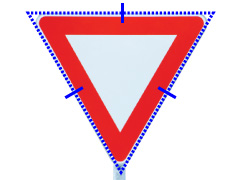
Source: Yield - Brilt/iStock/Thinkstock
Isosceles
Two side lengths are
the same.
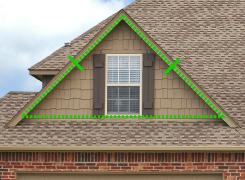
Source: House - rickmartinez/iStock/Thinkstock
Scalene
All three sides have
different lengths.
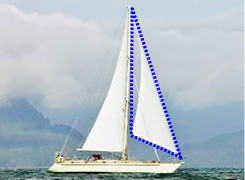
Source: Sailboat - Con Tanasiuk / Design Pics/ Valueline/Thinkstock
Calculate the length of \(AB\)
\(A(-3,1)\) and \(B(2,4)\)
\(\begin{align*} d_{AB}&=\sqrt{(\Delta x)^2+(\Delta y)^2}\\ d_{AB}&=\sqrt{(x_2-x_1)^2+(y_2-y_1)^2}\\ d_{AB}&=\sqrt{(2-(-3))^2+(4-1)^2}\\ d_{AB}&=\sqrt{(5)^2+(3)^2}\\ d_{AB}&=\sqrt{25+9}\\ d_{AB}&=\sqrt{34} \end{align*}\)
Calculate the length of \(BC\)
\(B(2,4)\) and \(C(2,-2)\)
\(\begin{align*} d_{BC}&=\sqrt{(\Delta x)^2+(\Delta y)^2}\\ d_{BC}&=\sqrt{(x_2-x_1)^2+(y_2-y_1)^2}\\ d_{BC}&=\sqrt{(2-2)^2+(-2-4)^2}\\ d_{BC}&=\sqrt{(0)^2+(-6)^2}\\ d_{BC}&=\sqrt{0+36}\\ d_{BC}&=\sqrt{36}\\ d_{BC}&=6 \end{align*}\)
Calculate the length of \(AC\)
\(A(-3,1)\) and \(C(2,-2)\)
\(\begin{align*} d_{AC}&=\sqrt{(\Delta x)^2+(\Delta y)^2}\\ d_{AC}&=\sqrt{(x_2-x_1)^2+(y_2-y_1)^2}\\ d_{AC}&=\sqrt{(2-(-3))^2+(-2-1)^2}\\ d_{AC}&=\sqrt{(5)^2+(-3)^2}\\ d_{AC}&=\sqrt{25+9}\\ d_{AC}&=\sqrt{34} \end{align*}\)
Therefore, because \(d_{AB}=d_{AC}\ne d_{BC}\), the triangle is isosceles.
Let's look at one last example where we can use both the midpoint and length of a line segment to answer the question.