Explore This 1 Summary
In the Explore This, you may have noticed that there are many second endpoints that would satisfy the condition that the line segment is \(5\) units long. In the diagram shown here, we can see some of these possible end points. Every line segment shown has an equal length of \(5\) units.
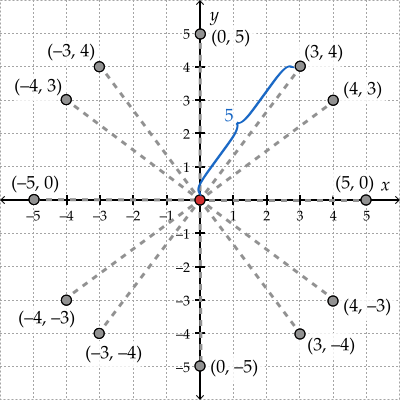
In fact, there are infinite points that will satisfy the condition that the second end point is \(5\) units from the origin. All of these points form a circle centered at \((0,0)\) with a radius of \(5\).
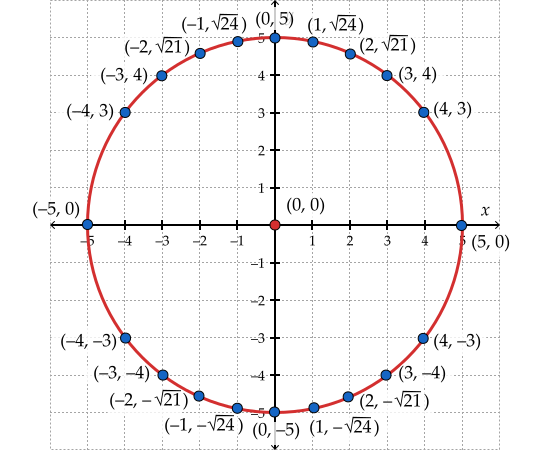
Developing the Equation of a Circle Centred at \((0,0)\)
Recall when we worked with linear relations involving two variables, \(x\) and \(y\), we could represent the relationship between these variables with an equation. Often we use the form \(y=mx+b\). In fact, we can also represent a circular relationship between \(x\) and \(y\) with an equation.
We will develop this equation using the distance formula, which we recall is based on the Pythagoream Theorem.
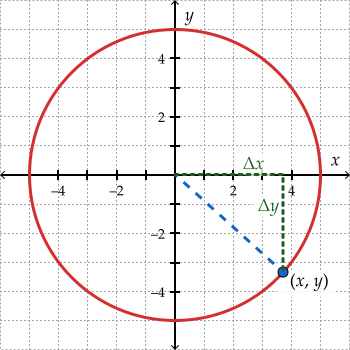
Recall the distance formula \(d=\sqrt{(\Delta x)^2 + (\Delta y)^2}\)
We know that every point along the circle centred at the origin and having a radius of \(5\) units will satisfy the equation:
\(5=\sqrt{(\Delta x)^2+(\Delta y)^2}\), or
\(5=\sqrt{(x-0)^2+(y-0)^2}\)
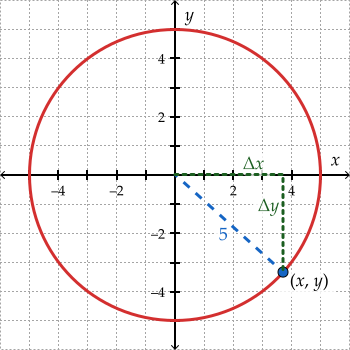
We can simplify this to
\(5=\sqrt{x^2+y^2}\)
Squaring both sides we can write
\(25=x^2+y^2\)
Therefore, the equation of the circle shown in this diagram with a radius of \(5\) has the equation \(x^2+y^2=25\).
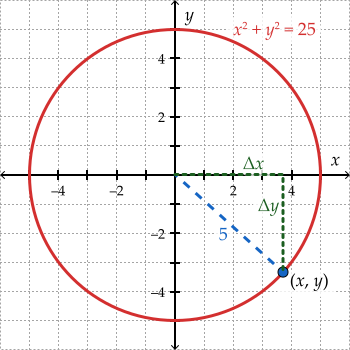
We know not all circles will have a radius of \(5\) units. We can generalize this equation for a circle with any radius as stated in the following important fact.
A circle centred at \((0,0)\)can be represented by the equation:
\(x^2+y^2=r^2\)
where \(r\) represents the radius of the circle.
Let's now look at how we can use the equation of a circle to draw a sketch.
Example 1
Sketch a graph of the circle represented by the equation \(x^2+y^2=1\).
Solution
Every circle centered at the origin will have two \(x\)-intercepts and two \(y\)-intercepts. Or in other words, the circle will cross the \(x\)-axis twice, and it will cross the \(y\)-axis twice. If we are asked to sketch a circle centered at \((0, 0)\), as we are here, we can quickly calculate these four intercept points.
Let's first calculate the \(x\)-intercepts. Remember, this is where the \(y\)-coordinate is equal to \(0\). So we can substitute \(y=0\) into the equation and solve for the values of \(x\).
\(\begin{aligned} x^{2}+y^{2} &=1 \\ x^{2}+(0)^{2} &=1 \\ x^{2} &=1 \\ x &=\pm \sqrt{1} \\ x &=\pm 1 \end{aligned}\)
Therefore, the circle crosses the \(x\)-axis at the points \((-1,0)\) and \((1,0)\).
Next, we will calculate the \(y\)-intercepts. Remember, this is where the \(x\)-coordinate is equal to \(0\), so we can substitute \(x=0\) into the equation and solve for the values of \(y\).
\(\begin{aligned} x^{2}+y^{2} &=1 \\(0)^{2}+y^{2} &=1 \\ y^{2} &=1 \\ y &=\pm \sqrt{1} \\ y &=\pm 1 \end{aligned}\)
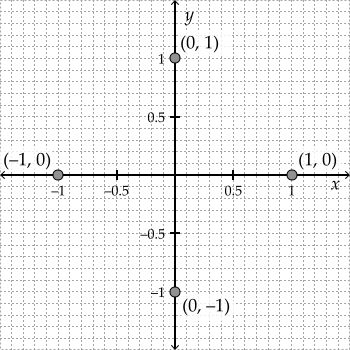
Therefore, the circle crosses the \(y\)-axis at the points \((0,-1)\) and \((0,1)\).
Alternatively, instead of solving for the intercepts, we know that the equation \(x^2+y^2=1\) gives a circle centered at the origin with the radius equal to \(1\). Thus, we could have determined these four intercepts by moving \(1\) unit left, right, up, or down, beginning from the origin each time.
Let's take a moment to plot the four intercept points, \((0,1)\), \((1,0)\), \((0,-1)\), and \((-1,0)\):
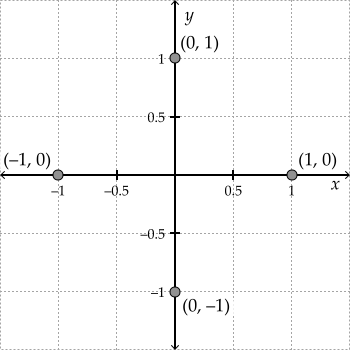
Recall that when we plotted points from a linear relation, we stated that it didn't matter if the scale on the \(x \)-axis and \(y\)-axis was the same. However, when we are plotting points on a circle, if you want this circle to not look stretched, i.e. more oval in shape, the scales on the \(x\)- and \(y\)-axes need to be the same. For this example, we will use a scale of \(0.5\) on both axes.
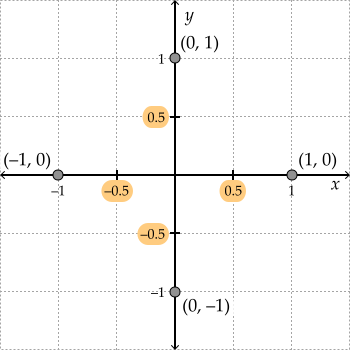
Also note that our four intercept points provide us with the limits of the coordinate values for both \(x\) and \(y\). All of our \(x\)- and \(y\)-coordinates are greater than or equal to \(-1\) and less than or equal to \(1\). Any number outside of this will not satisfy the equation.
For example, if we were to substitute a value of \(4\) in for \(x\), we would not be able to solve for a real value of \(y\), as we would be trying to take the square root of a negative number.
If we try solving for \(y\) when \(x=4\):
\(\begin{aligned} x^{2}+y^{2} &=1 \\ 4^{2}+y^{2} &=1 \\ y^{2} &=1-16 \\ y^{2} &=-15 \end{aligned}\)
No real solution
Remember, two identical numbers multiplied together will never give you a negative value.
We can now use these intercept points to hand draw a sketch of the circle as shown here.
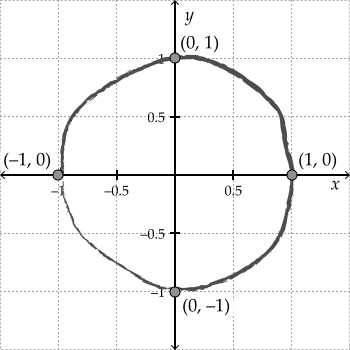
Remember we were asked to sketch the relation, so an imperfect circle is OK. We do not need to use a compass.
For this example, because the radius is equal to \(1\) and is part of a Pythagorean triple, we could be a bit more accurate with our sketch by finding additional friendly points to plot along the circle. Let's go back to just having our four intercept points plotted and add to our graph.
If we think of our radius \(1\) as being \(10 \div 10\), we can use the Pythagorean triple, \((6, 8, 10)\) each divided by \(10\), to give us a Pythagorean triple of \((0.6, 0.8, 1)\).
This gives us additional \(x\)- and \(y\)-coordinates of \(\pm 0.6\) and \(\pm 0.8\). Therefore, our additional points would be as follows: \((-0.8, 0.6)\), \((-0.8, -0.6)\), \((-0.6, 0.8)\), \((-0.6, -0.8)\), \((0.6, 0.8)\), \((0.6, -0.8)\), \((0.8, 0.6)\), and \((0.8, -0.6)\).
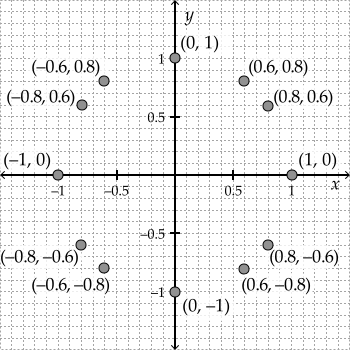
Having these extra points on our graph, we can sketch a more accurate circle as shown here.
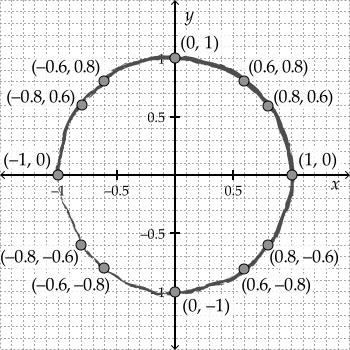
We won't always be given a radius value that belongs to a Pythagorean triple. But if we can recognize when this occurs, it will help with finding additional friendly points that lie on the circle. For any circle relation, we can determine more points by substituting values in for \(x\) and solving for \(y\) or vice versa.
However, because we are taking the square root to solve for the value, these points will often be difficult to plot. We can do our best to estimate these points on a graph. This is why we are only asked to sketch a circular relationship. For accurate graphs, graphing technology is a great tool to use.