Tables of Values
In a linear relationship, the first differences are constant.
For example:
| \(x\) |
\(y\) |
First Difference |
| \(-2\) |
\(7\) |
|
| \(-3\) |
| \(-1\) |
\(4\) |
| \(-3\) |
| \(0\) |
\(1\) |
| \(-3\) |
| \(1\) |
\(-2\) |
| \(-3\) |
| \(2\) |
\(-5\) |
| |
This relationship is linear since the first differences are constant.
In a quadratic relationship, the second differences are constant (provided that the first differences were not constant).
For example:
| \(x\) |
\(y\) |
First Difference |
Second Difference |
| \(-2\) |
\(8\) |
|
|
| \(-6\) |
| \(-1\) |
\(2\) |
\(4\) |
| \(-2\) |
| \(0\) |
\(0\) |
\(4\) |
| \(2\) |
| \(1\) |
\(2\) |
\(4\) |
| \(6\) |
| \(2\) |
\(8\) |
|
| |
This relationship is quadratic since the first differences are not constant but the second differences are.
Graphs
The graph of a linear relationship is a line.
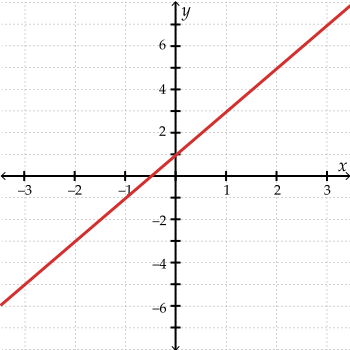
Linear Relationship
The graph of a quadratic relationship is a parabola.
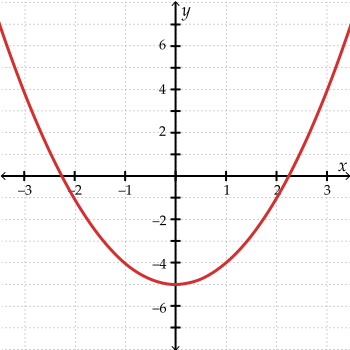
Quadratic Relationship
Equations
Equations of linear relationships:
written in the form
\(y=mx+b\)
(or in the case of vertical lines, \(x=a\))
Equations of quadratic relationships:
written in the form
\(y=ax^2+bx+c\), where \(a \ne 0\)
As with lines, a given quadratic relationship has multiple equations that model the relationship. For instance, the equations \(M=f^2+2f\), \(M=f(f+2)\) and \(M=(f+1)^2-1\) all model the same relationship.
In future lessons, we will develop ways to change any given form to the form \(y=ax^2+bx+c\).