Example 4
Determine the vertex form equation of the parabola modelled by \(y=-\dfrac{2}{3}(x+4)(x-6)\).
Solution
The equation \(y=-\dfrac{2}{3}(x+4)(x-6)\) is written in factored form.
Our approach will be to:
- use factored form to determine the vertex, and
- write the vertex form equation.
From \(y=-\dfrac{2}{3}(x+4)(x-6)\), we observe that:
- The zeros are the \(x\)-values that make either factor \(0\). Thus, the zeros are \(-4\) and \(6\).
- The axis of symmetry is always halfway between the two zeros. The number halfway between \(-4\) and \(6\) is their average, \(\dfrac{-4+6}{2}=1\). Thus, the axis of symmetry is \(x=1\).
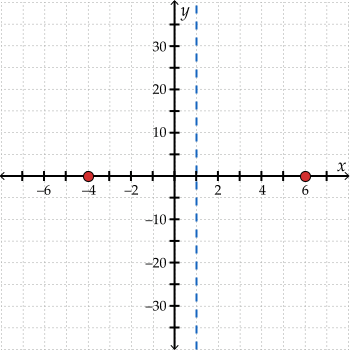
Since the axis of symmetry is \(x=1\), we know the \(x\)-coordinate of the vertex is \(1\).
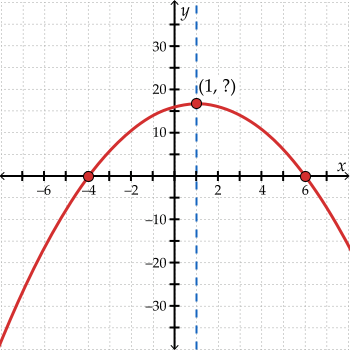
We find the \(y\)-coordinate of the vertex by substituting \(x=1\) into the equation:
\(\begin{align*} y &= -\frac{2}{3}(x+4)(x-6)\\ y_\text{vertex} &= -\frac{2}{3}(1+4)(1-6)\\ y_\text{vertex} &= -\frac{2}{3}(5)(-5)\\ y_\text{vertex} &= \frac{50}{3}\\ \end{align*}\)
Thus, the vertex is \(\left(1, \dfrac{50}{3}\right)\).
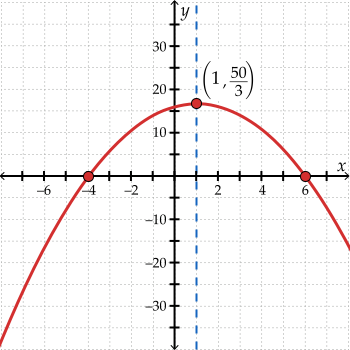
Since the vertex is \(\left(1, \dfrac{50}{3}\right)\):
- The vertex form equation is of the form \(y=a(x-1)^2+\dfrac{50}{3}\).
- \(a\) in factored form and vertex form are the same.
- Since the factored form equation is \(y=-\dfrac{2}{3}(x+4)(x-6)\), we have \(a=-\dfrac{2}{3}\).
Thus, the vertex form equation is \(y=-\dfrac{2}{3}(x-1)^2+\dfrac{50}{3}\).
Check Answer
To check our answer, we can confirm that the vertex form equation \(y=-\dfrac{2}{3}(x-1)^2+\dfrac{50}{3}\) has the same zeros as the factored form equation \(y=-\dfrac{2}{3}(x+4)(x-6)\):
Zero \(x=-4\):
\(\begin{align*} y & =-\frac{2}{3}(x-1)^2 +\frac{50}{3}\\ y & =-\frac{2}{3}(-4-1)^2 +\frac{50}{3}\\ y & =-\frac{2}{3}(25) +\frac{50}{3}\\ y & =-\frac{50}{3} +\frac{50}{3}\\ y & =0\\ \end{align*} \)
Zero \(x=6\):
\(\begin{align*} y & =-\frac{2}{3}(x-1)^2 +\frac{50}{3}\\ y & =-\frac{2}{3}(6-1)^2 +\frac{50}{3}\\ y & =-\frac{2}{3}(25) +\frac{50}{3}\\ y & =-\frac{50}{3} +\frac{50}{3}\\ y & =0\\ \end{align*} \)
Since the two equations have the same zeros and the same \(a\)-value, we have confirmed that they describe the same parabola.
Steps to Convert a Factored Form Equation to a Vertex Form Equation
- From the factored form equation, determine the zeros.
- Average the zeros to determine the axis of symmetry.
- Determine the \(y\)-coordinate of the vertex by substituting the value of the axis of symmetry into the equation.
- Determine the vertex using the results of Steps 2 and 3.
- Write the vertex form equation using \(a\) from the factored form equation and the vertex from Step 4.