Try This Revisited
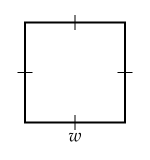
A square has side lengths of \(w\) units. The square's side lengths are then increased by \(3\) units on each side.
Square 1
Square 2
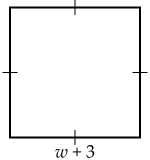
Let \(\Delta A\) represent the difference in the areas of the two squares (Square 2 minus Square 1).
For example, when \(w=2\), the area of Square 1 is \(2^2=4\).
Then, the side lengths of Square 2 are \(5\) units, and the area of this square is \(5^2=25\).
So, for \(w=2\), \(\Delta A = 25-4\) , or \(\Delta A = 21\).
Determine a simplified equation expressing \(\Delta A\) in terms of \(w\).
That is, find an equation that allows you to calculate the difference in areas directly from the original side length without having to find the two areas first.
Solution
The area of Square 1 is \(w \times w\), or \(w^2\).
The area of Square 2 is \((w+3)^2\).
Thus, we can express the difference in the areas as \(\Delta A = (w+3)^2 - w^2\).
This equation can be simplified by following order of operations. We will expand \((w+3)^2\) first, then subtract \(w^2\).
\(\begin{align*} \Delta A &= (w+3)^2 - w^2 \\ \Delta A &= w^2 + 6w + 9 - w^2 \\ \Delta A &= 6w+9 \end{align*}\)
Note that \(w^2-w^2\) simplified to \(0w^2\).
Our simplified equation relating the difference in area to the width is \(\Delta A = 6w+9 \).
We can substitute any width into this equation, and it will tell us how much the area of the square will increase if this width is increased by \(3\).
Check:
Earlier, we calculated \(\Delta A\) directly for \(w=2\), and arrived at an answer of \(\Delta A = 21\). Let's check if our new equation also gives this result.
Substitute \(w=2\) into \(\Delta A = 6w+9\):
\(\begin{align*} \Delta A &= 6(2)+9 \\ &= 12 + 9 \\ &= 21 \end{align*}\)
The result from the equation is consistent with our earlier calculation.
Example 10
Expand the following:
- \((2x-y)(x+3y)\)
- \((4x-5y)^2\)
Solution — Part A
Use the distributive property to multiply the two binomials.
Recall that \(x \times y = xy\). So, \((2x)(3y)=6xy\).
\(\begin{align*}(2x-y)(x+3y) &= 2x^2+6xy-xy-3y^2 \\ &= 2x^2+5xy-3y^2\end{align*}\)
Optional Table
| |
\(x\) |
\(3y\) |
| \(2x\) |
\(2x^2\) |
\(6xy\) |
| \(-y\) |
\(-xy\) |
\(-3y^2\) |
Solution — Part B
Use \((a+b)^2 = a^2+2ab+b^2 \) with \(a=4x\) and \(b=-5y\).
\(\begin{align*}(4x-5y)^2 &= (4x)^2+2(4x)(-5y) + (-5y)^2 \\ &= 16x^2-40xy+25y^2\end{align*}\)
Alternate solution: Write \((4x-5y)^2 = (4x-5y)(4x-5y)\) and expand using the distributive property.