Finding an Equation From a Graph


Finding the Equation of a Parabola From Its Graph

The equation of a quadratic relation can be written in three forms:

  • Standard Form: \(y=ax^2+bx+c\)
  • Factored Form: \(y=a(x-s)(x-t)\)
  • Vertex Form: \(y=a(x-h)^2+k\)

All three of these forms have something in common — the \(a\)-value. If all three forms represent the same quadratic relation, the value of \(a\) that appears in all three equations is the same.

It is possible to identify this \(a\)-value if we have a graph of the relation.

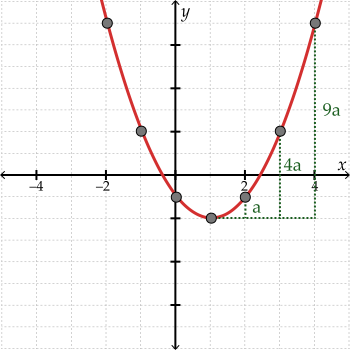
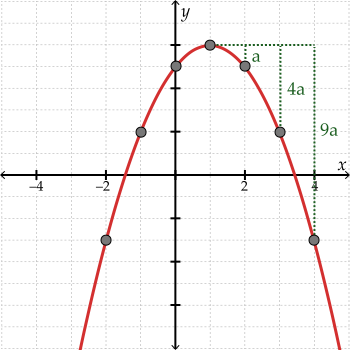
To relate the shape of the graph of a quadratic relation to the value of \(a\) in its equation, use the following:

  • If the parabola opens up, then \(a \gt 0\).
  • If the parabola opens down, then \(a \lt 0\).
Horizontal Distance from the Vertex Vertical Distance from the Vertex
\(1\) \(a\)
\(2\) \(4a\)
\(3\) \(9a\)

\(a \gt 0\)

Graphs with 'a' values greater than zero open upwards.

\(a \lt 0\)

Graphs with 'a' values less than zero open downwards.

Example 4

Question A

Identify the \(a\)-value for the following quadratic relation.
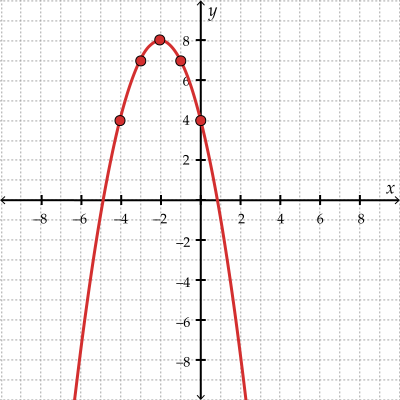
A parabola that opens downward with vertex at (negative 2, 8) and passes through points (negative 4, 4), (negative 3, 7), (negative 1, 7), (0, 4).

Solution A

This parabola opens down, so we know that \(a \lt 0\). 
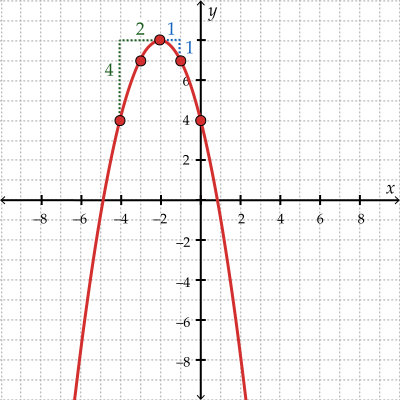
When a point moves 1 unit right from the vertex, it travels down 1 unit. When a point moves 2 units left from the vertex, it travels down 4 units.

The points that are horizontally \(1\) unit from the vertex are \(1\) unit below the vertex.  

The points that are horizontally \(2\) units from the vertex are \(4\) units below the vertex. 

This means that \(a=-1\) (since \(4a=-4\)). 

Note: It is possible to find the \(a\)-value using only one of the sets of points mentioned above. However, it is still advisable to check that the result is consistent for other points.

Question B

Identify the \(a\)-value for the equation of the following quadratic relation.
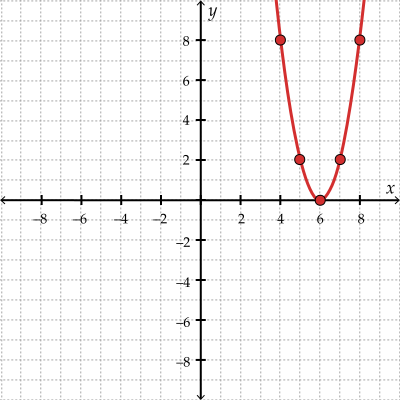
 A parabola that opens upward with vertex at (6, 0) and passes through points (4, 8), (5, 2), (7, 2), and (8, 8).

Solution B

This parabola opens up, so it will have \(a \gt 0\). 
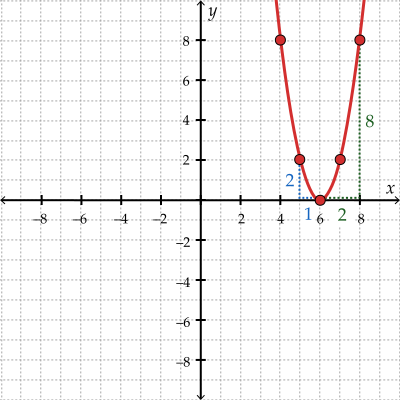
When a point moves 1 unit left from the vertex, it travels up 2 units. When a point moves 2 units right from the vertex, it travels up 8 units.

The points that are horizontally \(1\) unit from the vertex are \(2\) units above the vertex.  

This means that \(a=2\).

To be consistent with this \(a\)-value, the point that is \(2\) units to the right of the vertex should be \(8\) units above the vertex, since \(4a=8\).

Since it is, we can be confident the answer \(a=2\) is correct. 

Question C

Identify the \(a\)-value for the equation of the following quadratic relation.
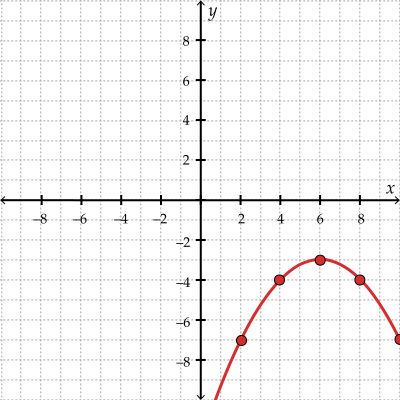
  A parabola that opens downward with vertex at (6, negative 3) and passes through points (2, negative 7), (4, negative 4), (8, negative 4), and (10, negative 7).

Solution C

This parabola opens down, so it will have \(a \lt 0\). 
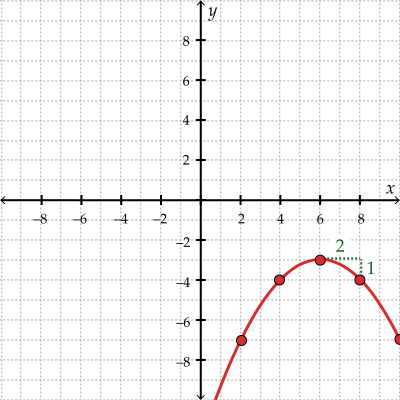
If the function travels 2 units right from the vertex, the function travels down 1 unit.

Consider the points horizontally \(1\) unit from the vertex. It is difficult to determine exactly where they lie, although they appear to be less than \(\dfrac12\) a unit below the vertex. This means that, for this graph, we need to check another point.

The point \(2\) units to the right of the vertex is \(1\) unit below the vertex. This means that \(4a=-1\), so for this quadratic relation, \(a= -\dfrac14\).  


Check Your Understanding 6


Now that we have explored how to identify the value of \(a\) from the graph of a quadratic relation, we can use this to identify the equation of a quadratic relation from a graph. 

If we can identify \(a\), as well as the vertex \((h, k)\), from the graph, we can write the equation of the relation in vertex form. 

Example 5

Question A

Write the equation of the quadratic relation in vertex form, \(y=a(x-h)^2+k\). 

A parabola that opens downwards and has vertex (5, negative 2). The other points on the parabola are (3, negative 14), (4, negative 5), (6, negative 5), and  (7, negative 14).

Solution A

The vertex is \((5, -2)\). 

The equation will be of the form \(y=a(x-5)^2-2\). Since the parabola opens down, \(a \lt 0\). 

The points that are horizontally \(1\) unit from vertex are \(3\) units below the vertex, so \(a=-3\).

If \(a=-3\), then \(4a=-12\).

We can double-check that the points \(2\) units to the left or right of the vertex are \(12\) units below the vertex. 

Therefore, the equation of the relation is \(y=-3(x-5)^2-2\). 

Question B

Write the equation of the quadratic relation in vertex form, \(y=a(x-h)^2+k\). 

A parabola that opens upwards and has vertex (negative 2, 1). The other points on the parabola are (negative 4, 4), and (0, 4).

Solution B

The vertex is \((-2, 1)\).

The equation will be of the form \(y=a(x+2)^2+1\) with \(a \gt 0\), since the parabola opens up. 

The points that are horizontally one unit from the vertex are less than one unit above the vertex. So far, this is not enough information to identify \(a\) exactly.

The points horizontally \(2\) units from the vertex are \(3\) units above the vertex.

So \(4a=3\) and \(a=\dfrac34\).

The equation of the relation is \(y=\dfrac34(x+2)^2+1\).


Check Your Understanding 7


Determine the equation of the following quadratic relation in vertex form, \(y=a(x-h)^2+k\). Remember to include both the left and right sides of the equation.

((((g)*(r))*(a))*(p))*(h)

Enter \(a^b\) as "\(a^{\wedge} b\)".

The equation of the quadratic relation in vertex form is There appears to be a syntax error in the question bank involving the question field of this question. The following error message may help correct the problem:

null

.

Try This Revisited

A projectile is launched upward from a roof, reaching a maximum height of \(20\) metres after \(1\) second. The projectile hits the ground \(3\) seconds after being launched.  

The relationship between the height \(h\), in metres and time \(t\), in seconds is quadratic.

  1. Find the equation of this relation.
  2. What is the initial height from which the projectile is launched?

Solution — Part A

Although there are multiple ways to solve this problem, one solution is to use some of the ideas discussed in this lesson. 

Start by drawing a rough sketch.

We know that the maximum \(h=20\) occurs at \(t=1\) seconds. The vertex is \((1, 20)\) and so the equation will be of the form \(h=a(t-1)^2+20\).

\(a \lt 0\) since the parabola opens down.

We only know one other point on the graph, but it is \(2\) units to the right of the vertex. It is also \(20\) units below the vertex. Since this point is below the vertex and it is supposed to have a vertical distance of \(4a\) units from the vertex, we know that \(4a=-20\). Thus, \(a=-5\). 

The equation of this relation is \(h=-5(t-1)^2+20\).

Solution — Part B

Now that we have an equation, we can use it to find the height from which the projectile is initially launched.  

This is the height when \(t=0\), or the \(h\)-intercept.

Sub \(t=0\) into the equation from part a):

\(\begin{align*}h &= -5(0-1)^2+20 \\ &= -5(-1)^2+20 \\ &= -5(1)+20 \\ &= -5+20 \\ &= 15\end{align*}\)

The initial height of the projectile is \(15\) m.

Math in Action

The height, \(h\), of a projectile after time, \(t\), can be represented by a quadratic relation of the form \(h=\dfrac12at^2+v_it+h_i\), where:

  • \(h_i\) is the initial, or starting, height of the projectile.
  • \(v_i\) is the projectile's initial vertical velocity.
  • \(a\) is the vertical acceleration of the projectile; typically acceleration due to gravity, which is \(a=-9.8\) m/son earth.