Factored Form Quick Facts
- As the name suggests, when a quadratic relation is written as a product of its factors (with all common factors removed), we say that the equation is written in factored form.
- For example, \(y=-4(3x-2)(7x+5)\) is written in factored form since the equation is written as a product.
- Zeros can be determined quickly from factored form. Since \(0\) multiplied by any number is still \(0\), the zeros of a parabola are the zeros of the factors in the factored form equation.
- For example, the factors of \(y=-3x(x-5)\) are \(-3\), \(x\), and \(x-5\) so that the zeros are \(x=0\) and \(x=5\).
- The axis of symmetry of a parabola can be found by averaging the zeros.
- For example, if the zeros of a parabola are \(-1\) and \(7\), the axis of symmetry is \(x=3\) since the average of \(-1\) and \(7\) is \(\dfrac{-1+7}{2}=3\).
- The axis of symmetry is a vertical line that passes through the vertex so the axis of symmetry gives the \(x\)-coordinate of the vertex.
- The \(y\)-coordinate of the vertex can be found by substituting the \(x\)-coordinate of the vertex into the equation of the parabola.
Example 1
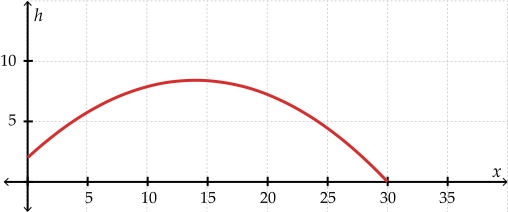
Joel is practising lacrosse. For one of his throws, the height of the ball above the ground, \(h\) (in metres), is modelled by \(h=\dfrac{-1}{30}(x+2)(x-30)\) where \(x\) is the horizontal distance, in metres, that the ball has travelled. A graph of the ball's motion is shown.
Determine the maximum height of the ball. Round your answer to one decimal place.
Solution
We can observe the following:
- \(h=\dfrac{-1}{30}(x+2)(x-30)\) is in factored form.
- The zeros are \(-2\) and \(30\).
- The average of the zeros is \(\dfrac{-2+30}{2}=14\).
- The axis of symmetry is \(x=14\).
Therefore, the vertex occurs when the ball has travelled \(14\) metres horizontally. The height at the vertex can be calculated using the equation:
\(\begin{align*} h &=\frac{-1}{30}(x+2)(x-30)\\ h_\text{vertex}&=\frac{-1}{30}(14+2)(14-30)\\ &=\frac{-1}{30}(-256)\\ &= \frac{128}{15}\\ &\approx 8.5 \end{align*}\)
The maximum height of the ball is approximately \(8.5\) metres.