Introduction to Transformations
A transformation is a rule that can be applied to an object to change its location, shape, size, or orientation.
We have names for both the initial object and the changed object.
- Pre-image: the initial object
- Image: the resulting object after the transformation is applied
- \(A'\): the image of \(A\)
Did You Know?
\(A'\) is read “A prime.”
Consider \(\triangle ABD\), as shown.
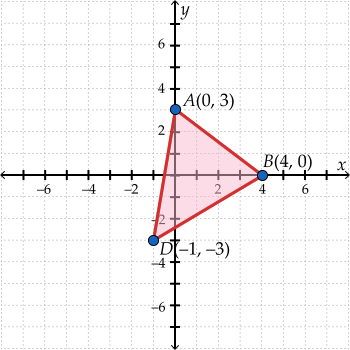
Let's transform \(\triangle ABD\) by sliding it \(2\) units to the left and \(1\) unit down.
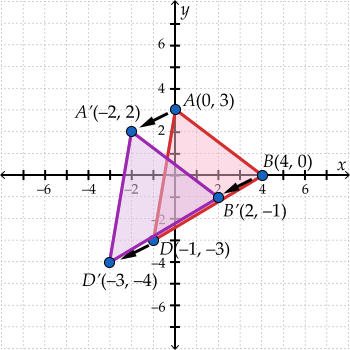
In general, a transformation can change an object's location, shape, size, or orientation.
In this particular transformation, we have changed the triangle's location, but not its shape or size.
As for orientation, notice that in \(\triangle ABD\), when we move from \(A\) to \(B\) to \(D\), we would say that it has a clockwise orientation. Likewise, \(\triangle A'B'D'\) also has a clockwise orientation.
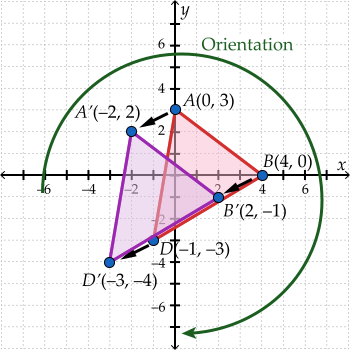
Thus, orientation is unchanged.
Summary of Translations
- Location: changed
- Shape: unchanged
- Size: unchanged
- Orientation: unchanged
Types of Transformations
The three types of transformations that we are going to investigate in this lesson are:
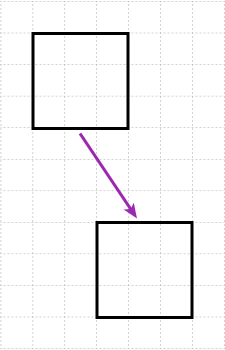
- Translations, where we shift the object to a different location.
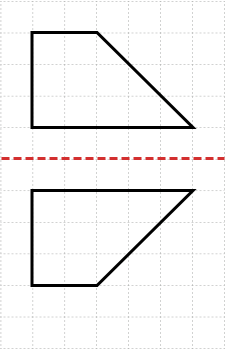
- Reflections, where we flip the object over a line of reflection.
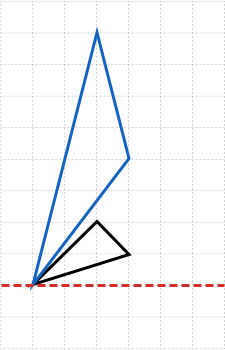
- Stretches, where we lengthen the object's distance from a fixed line using a stretch factor.
What Is a Translation?
Let's start with translations.
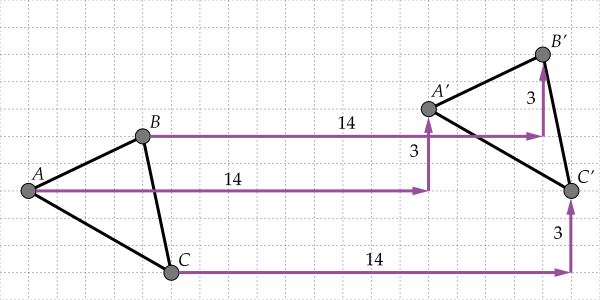
A translation is a transformation in which every point of an object moves in the same direction by the same distance.
A translation must always be specified by both a direction and a distance.
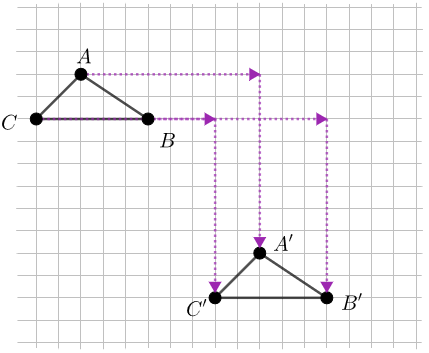
For example, here, \(\triangle ABC\) is translated or shifted \(14\) units right and \(3\) units up to form \(\triangle A'B'C'\).
Check Your Understanding 1
Question
Describe the translation for \(\triangle ABC\) using the number of units and the direction that \(\triangle ABC\) has be translated.
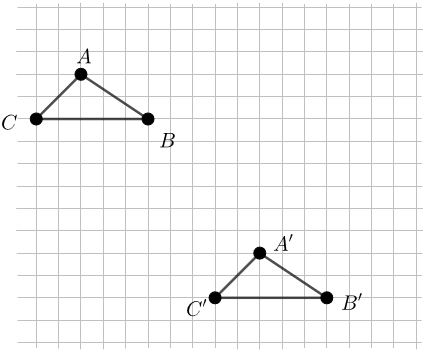
Created with GeoGebra. Author: University of Waterloo. CC BY-NC-SA 4.0. https://ggbm.at/gpbaszj6
Answer
\(\triangle ABC\) has been translated \(10\) units right and \(5\) units down to form \(\triangle A'B'C'\).
Feedback
The use arrows can help you to find the correct translations.
Interactive Version
Translations
What Is a Reflection?
Next, let's look at reflections.
A reflection is a transformation that "flips" an object over a line of reflection (also called a mirror line) such that the line of reflection is the perpendicular bisector of each pre-image point and its image point.
Let's consider an example.
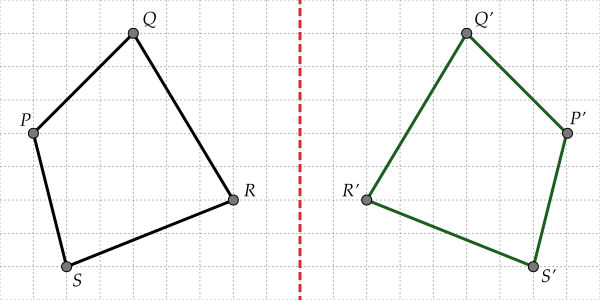
Quadrilateral \(PQRS\) is mapped onto \(P'Q'R'S'\), by being reflected in the dotted line.
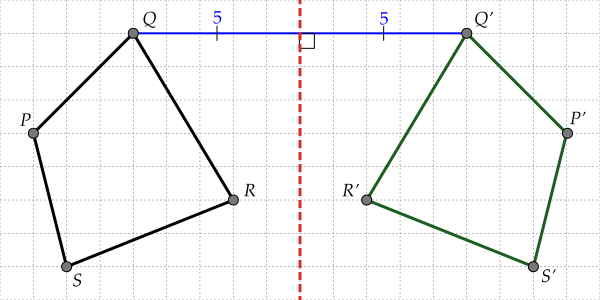
Consider \(Q'\), its exact position can be verified by forming line segment \(QQ'\) and ensuring that \(QQ'\) is perpendicular to the mirror line and that \(Q\) and \(Q'\) are the same perpendicular distance to the mirror line.
Notice that under a reflection, an object's shape and size remain unchanged.
The pre-image and the image are congruent. But the object's location and orientation may change.
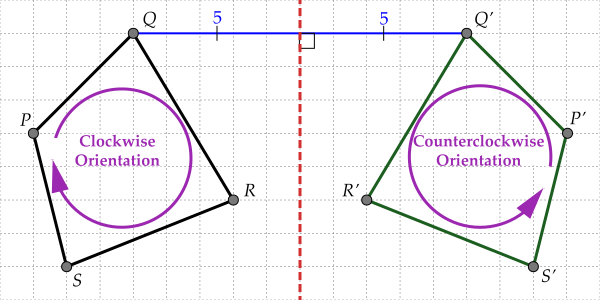
In terms of orientation, \(PQRS\) is labelled clockwise. Whereas the image, \(P'Q'R'S'\), is labelled counterclockwise.
Summary of Reflections
- Shape: unchanged
- Size: unchanged
- Location: changed
- Orientation: changed
Check Your Understanding 2
Question
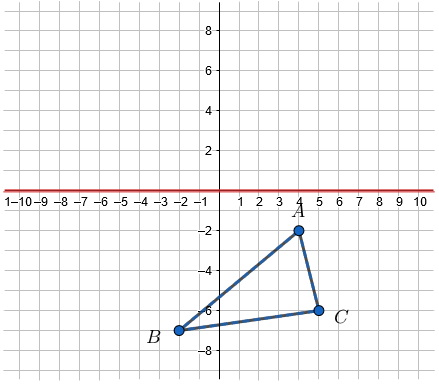
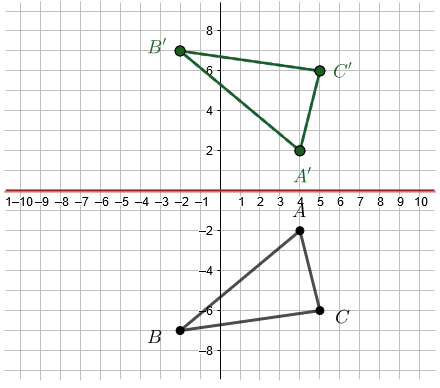
\(\triangle ABC\) has vertices \(A(4,-2)\), \(B(-2,-7)\), and \(C(5,-6)\).
What are the vertices of its reflection in the \(x\)-axis?
Answer
\(\triangle A'B'C'\) has vertices \(A'(4,2)\), \(B'(-2,7)\), and \(C'(5,6)\).
Created with GeoGebra. Author: University of Waterloo. CC BY-NC-SA 4.0.
Feedback
Remember that in a reflection, each point is the same distance from the reflection line as its image.
Interactive Version
Reflections
What Is a Stretch?
Finally, let's consider stretches.
A stretch is a transformation that increases the perpendicular distance of each point of an object from a fixed line by a given factor.
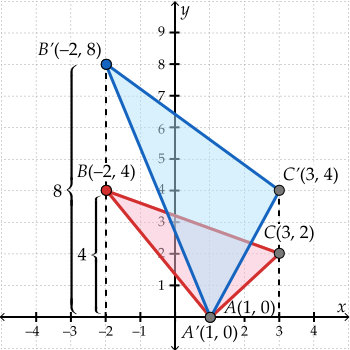
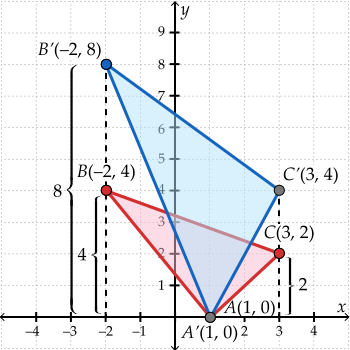
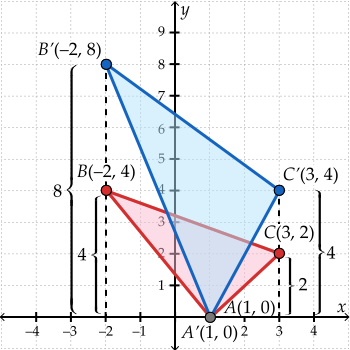
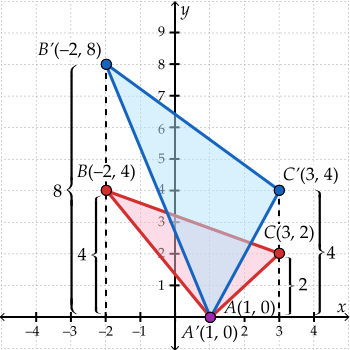
So here we have \(\triangle ABC\) and it's mapped onto \(\triangle A'B'C'\) by being vertically stretched by a factor of \(2\) about the \(x\)-axis.
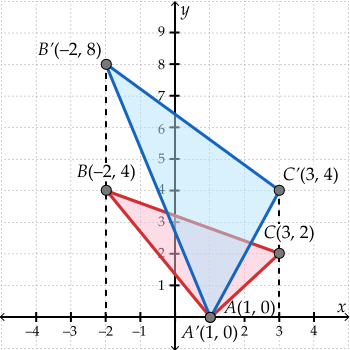
Take a look at point \(B(-2, 4)\). Notice that \(B\) is \(4\) units from the \(x\)-axis.
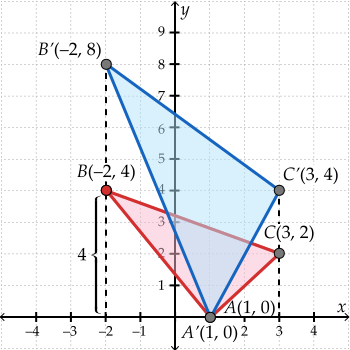
This perpendicular distance is stretched by a factor of \(2\) so that \(B'\) must be at the point \((-2, 8)\).
Similarly, point \(C(3,2)\) is \(2\) units from the \(x\)-axis.
So \(C'\) must be \(2 \times 2 = 4\) units from the \(x\)-axis.
And since \(A\) is right on the \(x\)-axis, \(A'\) remains unchanged.
Check Your Understanding 3
Question
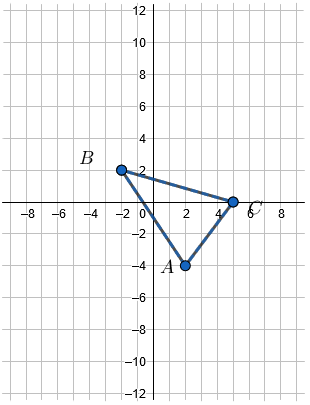
Find the image of \(\triangle ABC\) under a vertical stretch by a factor of \(3\).
Answer
The vertices of \(\triangle A'B'C'\) are located at
- \(A'(2,-12)\)
- \(B'(-2, 6)\)
- \(C'(5,0)\)
Feedback
Remember that in a vertical strech, the \(x\)-coordinate of each point remains the same, and the \(y\)-coordinate is multiplied by the stretch factor.
Interactive Version
Graphing Vertical Stretches
Transformations
Transformations are powerful tools used to manipulate graphs or images.
Math in Action
Transformations are used frequently in computer graphics. For instance, a video game character can be made to turn around and move in the opposite direction using a combination of translations and a reflection.