Example 2
Two cylindrical water tanks have exactly the same dimensions – a radius of \(11\) m and a height of \(25\) m.
One of the tanks starts out empty, and then water is added to it at a constant rate. The height of the water in this tank (\(h\), in metres) after \(t\) seconds is \(h=0.03t\).
The other tank starts out full, but water is leaking out of a large hole in the bottom of the tank. The height of the water in this tank is represented by \(h=0.0004t^2-0.2t+25\).
After how many seconds do the two tanks contain the same amount of water?
Solution
Since the dimensions of the tanks are exactly the same, they contain the same amount of water when the height of the water is the same in both tanks.
These times correspond to the point(s) of intersection of the two relations. One is linear and the other is quadratic.
We can find any points of intersection by graphing. Use a graphing calculator to graph both relations on the same axes.
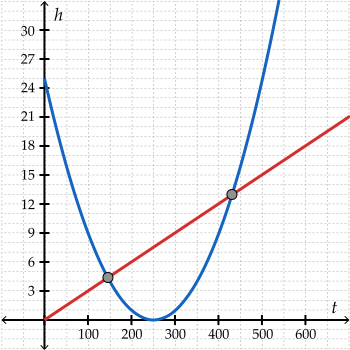
There are two points of intersection, or two points where the line and the parabola cross. However, the tank that is leaking won't start magically filling up again. We can see from the graph that this tank is totally empty after \(250\) seconds. We only need to consider the point of intersection that occurs before \(250\) seconds.
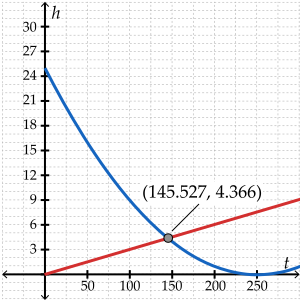
Using a graphing calculator, we can identify the coordinates of the points of intersection to a high degree of accuracy. The relevant point of intersection is approximately \((145.527, 4.366)\). This means that the amount of water in both tanks is the same when \(t \approx 145.527\) and \(h \approx 4.366\).
Therefore, the two tanks contain the same amount of water after approximately \(146\) seconds (\(2\) minutes and \(26\) seconds). The height of the water in both tanks at this time is approximately \(4.4\) metres.
Math in Action
The height of water in a tank that is leaking does not decrease at a constant rate. When there is more water remaining in the tank, the pressure is higher and the water leaks more quickly. When there is less water in the tank, the pressure is lower and the water does not leak as quickly. Thus, the relationship between the height of the water in a leaking tank and time is non-linear (and is, in fact, quadratic).