Solving Problems by Defining Relations


Slide Notes

Glossary

All Slides


Example 11


Example 11 Continued

A public transit agency is considering raising their bus fares. Currently, the fare is \($3.25\), and \(66~500\) passengers ride the bus each day. For every fare increase of \($0.25\), the number of daily passengers will decrease by \(3500\). What price would maximize the income from bus fares?

Solution

The maximum income is found at the vertex of  \(y=(0.25x+3.25)(-3500x+66~500)\).


Example 11 Continued

A public transit agency is considering raising their bus fares. Currently, the fare is \($3.25\), and \(66~500\) passengers ride the bus each day. For every fare increase of \($0.25\), the number of daily passengers will decrease by \(3500\). What price would maximize the income from bus fares?

Solution

The zeros of  \(y=(0.25x+3.25)(-3500x+66~500)\) are \(-13\) and \(19\). 

The \(x\)-coordinate of the vertex is halfway between, at \(x=3\).


Example 12

The field outside Marcelle's school is rectangular, \(80\) m long and \(65\) m wide. She would like to create a walking path around the inside edge of the field. Marcelle would like the walking path to be of uniform width (i.e., the same width all the way around) and to take up no more than \(15\%\) of the existing field space. What is the widest the path can be?

Example 12 Continued

 What is the widest the path can be?  

Solution

\(\begin{align*} 4420&=(80-2w)(65-2w) \\ \class{timed in1}{4420} &\;\class{timed in1}{= 5200-290w+4w^2} \\ \class{timed in2}{4w^2-290w+780} &\;\class{timed in2}{= 0} \\ \class{timed in3}{2(2w^2-145w+390)} &\;\class{timed in3}{=0} \\ \class{timed in4}{2w^2-145w+390} &\;\class{timed in4}{=0} \end{align*} \)

Paused Finished
Slide /

Before wrapping up this unit, here are two other contexts in which we need to generate a quadratic relation to solve a problem.

Example 13

A rectangle has an area of \(252\) m2. Its length is \(9\) m longer than its width. Determine the length and width of the rectangle.

Solution

Let the width of the rectangle be \(w\) (in m). Then the length is \(w+9\). 
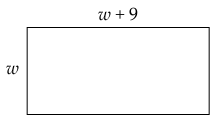
Let \(A\) be the area of the rectangle (in m2).

Then, \(A=w(w+9)\).

We know that \(A=252\).
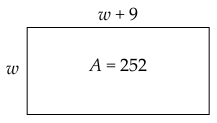
So \(252=w(w+9)\).  

To solve for \(w\), 

  • Expand

    \(252=w^2+9w\)

  • Re-arrange

    \(w^2+9w-252=0\)

  • Factor

    \((w+21)(w-12)=0\)

So \(w=-21\) or \(w=12\).

\(\)A width of \(-21\) is not possible. So the width must be \(12\) m.

Therefore, the width of this rectangle is \(12\) m and the length is \(21\) m (remember the length is \(w+9\)). 

Check your answer

\(12 \times 21 = 252\), so a rectangle with a width \(12\) m and length \(21\) m has the required area of \(252\) m2

Example 14

A dog kennel needs a fenced in area for the dogs to play in. They would like to create a rectangular area with three equal-sized partitions.
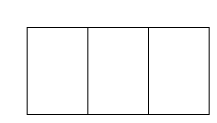
A rectangle is divided into 3 smaller rectangles of equal dimensions.

The kennel has \(200\) metres of fencing to use. What is the maximum area they can enclose?  

Solution:

Let \(A\) represent the fenced area (in m2).

Let \(w\) be the width of the fenced area (in m).   
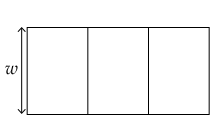
The fence has four sides of this length, or \(4w \). 

The amount of fencing left for the two longer sides is \(200-4w\).

So, the length of one of the longer sides is \(\dfrac{200-4w}{2}\), or \(100-2w\).  
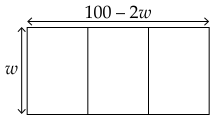
Therefore, \(A=w(100-2w)\). 

The maximum area occurs at the vertex.  Find the vertex by locating the zeros of the relation, when \(A=0\).

This occurs when 

\(w=0\)

or

\(\begin{align*} 100-2w&=0 \\ -2w &= -100 \\ w &= 50\end{align*}\)

The zeros are \(0\) and \(50\) and the maximum occurs at a width halfway between.

That is, the maximum area occurs when \(w=25 \).  

Substitute \(w=25\) into the relation to find the maximum area:

\(\begin{align*} A &= 25(100-2(25)) \\ &= 25(100-50) \\ &= 25 (50) \\ &= 1250 \end{align*}\)

Therefore, the maximum area they can enclose with \(200\) m of fencing is \(1250\) m2

Check your answer

If \(w=25\), here are all of the side lengths of the enclosure.  
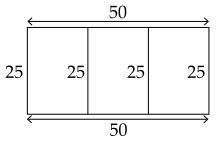
The enclosure has width 25 metres and length 50 metres.

Notice that there is a total of \(200\) m of fencing.  

The area is \(25 \times 50 = 1250\) m2, as predicted. 

If \(w=24\), the enclosure looks like this:
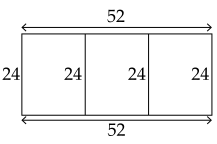
The enclosure has width 24 metres and length 52 metres.

There is still \(200\) m of fencing, but the area is \(24 \times 52=1248\).  

If \(w=26\), the enclosure looks like this: 
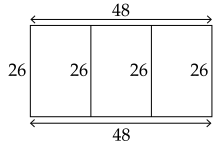
The enclosure has width 26 metres and length 48 metres.

There is still \(200\) m of fencing, but the area is \(26 \times 48=1248\).

This suggests that the maximum area occurs when \(w=25\), since widths that are slightly lower and slightly higher both produce smaller areas.


Check Your Understanding 5


For Finn's last concert, \(20~000\) tickets were sold for \($100\) each. He is considering changing the ticket price for his next concert. Every time the ticket price is reduced by \($10\), then \(5000\) more people will buy tickets.

  1. At what price should Finn sell tickets in order to maximize sales?
    Finn should sell tickets for \($\) in order to maximize sales.

  2. If he wants to keep the ticket price under \($75\), what would the price need to be to sell \($2~250~000\) worth of tickets? How many people would attend the concert at this price?
    The price would need to be \($\) and people would attend the concert.

  3. If he allows the ticket price to exceed \($75\), what other ticket price would generate \($2~250~000\) worth of sales? How many people would attend the concert at this price?
    Another price would be \($\) and people would attend the concert.