Let's move on to analyzing quadratic functions using function notation.
Example 9
A company sells mugs. The profit function for this company is \(P(x)=-2x^2+12x-10\) where \(P(x)\) is the profit (in thousands of dollars) when the mugs are sold for \(x\) dollars.
Using three different methods, determine the maximum profit.
Solution
To start, let's get a sense of what the graph looks like.
\(\begin{align*} P(0) &=-2(0)^2+12(0)-10\\ &= -10 \end{align*}\)
- giving mugs away for free
- no income; loss of \($10~000\)
- negative profit
So the graph has \(P\)-intercept of \(-10\).
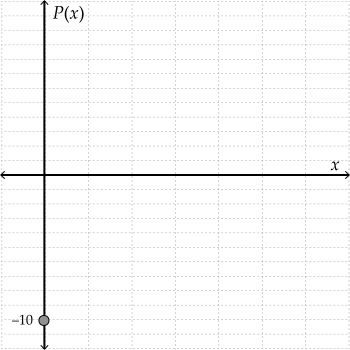
Because the coefficient of \(x^2\) is negative, \(-2\), the parabola opens down.
We'll sketch the parabola like this.
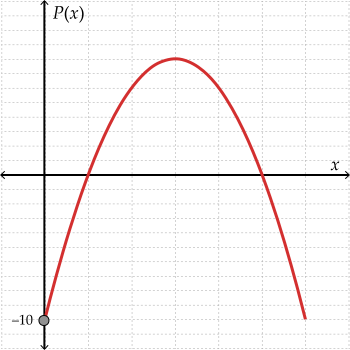
The maximum profit occurs at the vertex.
We don't actually know yet if the vertex is above or below the \(x\)-axis. Hopefully, for this company though, the vertex is above the \(x\)-axis because the maximum profit occurs at the vertex.
Three Methods:
- Change \(P(x)\) to factored form
- From there, we'll be able to use the zeros to help us find the maximum.
- Change \(P(x)\) to vertex form
- Use the vertex formula
- You may not remember this formula from previous lessons, nor should you really, as we will show how it can be quickly found from the quadratic formula.
Method 1: Change \(P(x)\) to factored form
Recall
Types of Factoring:
- Common factoring
- Factoring \(ax^2+bx+c\)
- Factoring difference of squares
- Factoring perfect squares
There are other types, but these are the four most common types of factoring.
Notice that \(P(x)=-2x^2+12x-10\) is of the form \(ax^2 + bx + c\).
Let's not jump straight away to the second type of factoring because we can also notice that there is a common factor of \(-2\).
\(\begin{align*} P(x) &=-2 x^{2}+12 x-10 \\ &=-2\left(x^{2}-6 x+5\right) \end{align*}\)
So whenever possible, remove common factors before applying the other types of factoring.
The remaining factor is of the form \(x^2 + bx + c\), which will lead us now to the second type of factoring.
\(P(x) =-2\left(x^{2}-6 x+5\right) \)
We require two integers that multiply to \(5\), and add to \(-6\).
The integers are \(-1\) and \(-5\).
\( P(x) =-2(x-1)(x-5) \)
Since we remove the common factor first, the expression we are factoring has an \(x^2\) coefficient of \(1\).
As a result, we avoid decomposition.
\(\begin{align*} P(x) &=-2 x^{2}+12 x-10 \\ &=-2\left(x^{2}-6 x+5\right) \\ &=-2(x-1)(x-5) \end{align*}\)
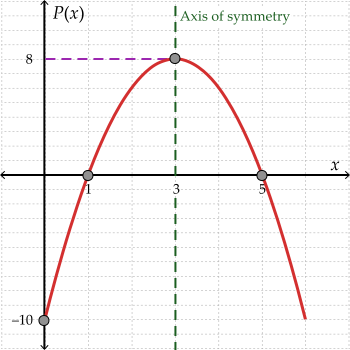
From this equation, we know that the zeros are \(1\) and \(5\).
Let's add this to our graph.
So from earlier, we know that the \(P\)-intercept is \(-10\). We now can add in the zeros are at \(1\) and \(5\).
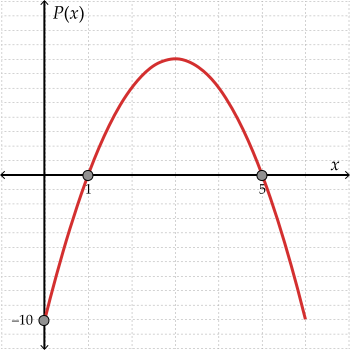
These are the two break even points, the prices for which the profit is \(0\).
Because a parabola is symmetric, we know that the axis of symmetry must lie here at \(x = 3\).
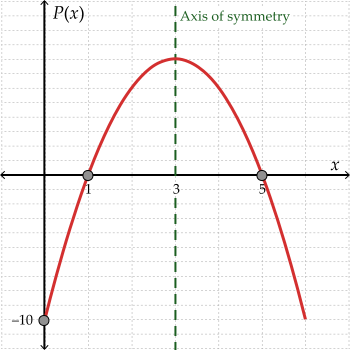
So the maximum occurs at the vertex. So that means the maximum must be \(P(3)\).
We'll use the standard form expression to calculate \(P(3)\), though we could have used the factored form expression.
\(\begin{align*} P(3) &\;= -2(3)^2+12(3)-10\\ &= 8 \end{align*}\)
Some arithmetic yields \(P(3) = 8\). And since \(P(x)\) is the profit in thousands of dollars, we find that the maximum profit is \($8,000\).
Method 2: Change \(P(x)\) to vertex form
Steps to complete the square
\(P(x)=-2x^2+12x-10\)
- Common factor \(a\) from first two terms.
\(P(x) =-2\left(x^{2}-6 x\right)-10 \)
- Add and subtract the value that completes the square. To determine this value, take half of the \(x\)-coefficient and square it.
\(P(x) =-2\left(x^{2}-6 x+9-9\right)-10 \)
- Factor the perfect square
\(P(x) =-2\left[(x-3)^{2}-9\right]-10 \)
- Distribute \(a\).
\(P(x) =-2(x-3)^{2}+18-10 \)
- Collect like terms.
\(P(x) =-2(x-3)^{2}+8 \)
Since this is now in vertex form, we can see that the vertex is \((3,8)\).
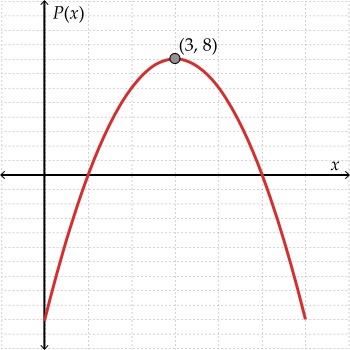
The maximum profit occurs at the vertex. Thus the maximum profit is \($8000\).
Method 3: Use the vertex formula
Recall
The zeros of \(y=ax^2+bx+c\) are
\(x = \dfrac{-b\pm \sqrt{b^2-4ac}}{2a}\)
Zeros are
\(\dfrac{-b}{2a} - \dfrac{\sqrt{b^2-4ac}}{2a}\)
\(\dfrac{-b}{2a} + \dfrac{\sqrt{b^2-4ac}}{2a}\)
Since the axis is halfway between the two zeros, it must then be that the axis of symmetry is \(x=\dfrac{-b}{2a}\).
So we have a formula for the axis of symmetry.
Since the vertex lies on the axis of symmetry, we can find the \(x\)-coordinate of the vertex.
Substituting our values into this formula,
\(\begin{align*} x_{\text { vertex }} &=\frac{-b}{2 a} \\ &=\frac{-12}{-2(2)} \\ &=3 \end{align*}\)
Then to determine the maximum, we evaluate \(P(3)\).
\(\begin{align*} P(3) &= -2(3)^2+12(3)-10\\ &= 8 \end{align*}\)
So we find the same graph as before, and we arrive at the same maximum profit.
The maximum profit is \($8000\).