Alternative Format — Lesson 3: Domain and Range

Let's Start Thinking

Three Different Functions?

Consider the function \(f(x)=6+1.5x\).

This function can arise in different contexts.

  • \(f(x)\) could be the cost of a pizza with \(x\) toppings.
    • The graph has \(y\)-intercept of \(6\) and every additional topping the graph goes up by \(1.5\). The graph would stop at some point depending on the number of toppings offered by the pizza store.
    • You cannot have a decimal number of types of toppings, the graph is a line of individual points.
    • You cannot have a negative number of toppings, so the graph starts at \(x = 0\).

      The graph of the integer points representing the function, f of x equals 6 plus 1.5x.

  • \(f(x)\) could be the cost of a taxi ride of \(x\) km.

    • Graph is a line with \(y\)-intercept \(6\) and slope \(1.5\).

    • Now the graph is drawn as a full line, not just a sequence of points lying on the line since \(x\) no longer has to be a whole number.
    • As before, though, the graph starts at \(x=0\) since you can't travel a negative number of kilometers.

      The graph of the continuous function, f of x equals 6 plus 1.5x starting at x equals zero and proceeding in the positive direction.

  • \(f(x)\) could be the price of a \($6\) item after \(x\) price adjustments of \($1.50\).

    • If the price can be adjusted by any amount, not just multiples of \($1.50\), then a line is drawn not individual points.
    • This time the graph can include negative \(x\)-values representing a price decrease.

      The graph of the continuous function, f of x equals 6 plus 1.5x starting at f of x equals zero and proceeding in the positive direction.

So for a given function, there is a set of allowable \(x\)-values or inputs that yield a set of possible \(y\)-values or outputs.

In this lesson, we will study these sets for a variety of functions.


Lesson Goals

  • Determine the domain and range of a function containing only a few points.
  • Use set notation to describe the domain and range of a given function.
  • Determine the domain and range of quadratic functions.

Domain and Range


Definition of Domain and Range

Throughout this lesson, we will make use of the following two definitions.

The domain of a function \(f(x)\) is the set of all values of the independent variable for which the function is defined.

The range of a function \(f(x)\) is the set of all values that the dependent variable can take.

In other words,

  • the domain is the set of all possible inputs into a function, and
  • the range is the set of all possible outputs of the function.

A function machine takes in an input and produces an output.

Here's an example of finding domain and range.

Example 1

The mapping diagram lists all ordered pairs belonging to a function \(g\).

  1. Explain why this is a function.
  2. Determine the domain of \(g\).
  3. Determine the range of \(g\).

Solution

The mapping diagram shows 0 mapping to 9, 1 mapping to 4, 2 mapping to 1, 3 mapping to 0, 4 mapping to 1, 5 mapping to 4, and 6 mapping to 9.

  1. Notice that each input has only one output.

    Therefore, \(g\) is a function.

  2. Domain: the set of all valid inputs

    \(D=\{0,~1,~2,~3,~4,~5,~6\}\)

    We write this list in curly brackets or braces to indicate that these numbers are elements of a set.

  3. Range: the set of all possible outputs

    \(R=\{0,~1,~4,~9\}\)


Example 2

Determine the domain and range of \(y=f(x)\).

A function consists of the points (negative 4, negative 3), (negative 2, 0), (negative 1, 1), (2, 3), and (3, negative 3).

Solution

The domain of a function is the set of all valid inputs.

  • In other words, the domain is the set of all \(x\)-values of the function.
  • This graph exists at these \(x\)-values: \(-4\), \(-2\), \(-1\), \(2\), and \(3\).

Therefore, the domain is \(D=\{-4,~{-2},~{-1},~2,~3\}\).

The range of a function is the set of all possible output values.

  • In other words, the range is the set of all \(y\)-values of the function.
  • This graph has points with \(y\)-values \(-3\), \(0\), \(1\), and \(3\).

Therefore, the range is \(R=\{-3,~0,~1,~3\}\).

Note that, while the \(y\)-value of \(-3\) appears twice on the graph, we list it only once when writing the range.

Further, we normally list the elements in increasing order, though that is not a requirement when listing the elements of a set.


Check Your Understanding 1

Question — Version 1

Determine the domain and range of \(y = f(x)\).

\(x\) \(y\)
\(-2\) \(-4\)
\(0\) \(4\)
\(1\) \(-5\)
\(2\) \(-1\)
\(3\) \(-6\)

Answer — Version 1

\(D = \{-2, 0, 1, 2, 3\}\)

\(R = \{-6, -5, -4, -1, 4\}\)

Feedback — Version 1

The domain of a function is the set of all valid input values.

The only valid \(x\)-values of this function are: \(-2\), \(0\), \(1\), \(2\), \(3\).

Therefore, \(D = \{-2, 0, 1, 2, 3\}\).

The range of a function is the set of all possible output values.

The only valid \(y\)-values of this function are: \(-6\), \(-5\), \(-4\), \(-1\), \(4\).

Therefore, the range is \(R = \{-6, -5, -4, -1, 4\}\).

Question — Version 2

Determine the domain and range of \(y = f(x)\).

The mapping diagram shows the independent variable negative 6 point to the dependent variable 2, the independent variable negative 4 point to the dependent variable negative 3, the independent variable negative 2 point to the dependent variable 3, the independent variable 4 point to the dependent variable 0, and the independent variable 6 point to the dependent variable 2.

Answer — Version 2

\(D = \{-6, -4, -2, 4, 6\}\)

\(R = \{-3, 0, 2, 3\}\)

Feedback — Version 2

The domain of a function is the set of all valid input values.

The only valid \(x\)-values of this function are: \(-6\), \(-4\), \(-2\), \(4\), \(6\).

Therefore, \(D = \{-6, -2, 0, 4, 5\}\).

The range of a function is the set of all possible output values.

The only valid \(y\)-values of this function are: \(-3\), \(0\), \(2\), \(3\).

Therefore, the range is \(R = \{-3, 0, 2, 3\}\).

Question — Version 3

Determine the domain and range of \(y = f(x)\).

The function has the points (negative 5, negative 5), (negative 3, 5), (negative 2, negative 2), (0, 2), and (3, 4).

Answer — Version 3

\(D = \{-5, -3, -2, 0, 3\}\)

\(R = \{-5, -2, 2, 4, 5\}\)

Feedback — Version 3

The domain of a function is the set of all valid input values.

The only valid \(x\)-values of this function are: \(-5\), \(-3\), \(-2\), \(0\), \(3\).

Therefore, \(D = \{-5, -3, -2, 0, 3\}\).

The range of a function is the set of all possible output values.

The only valid \(y\)-values of this function are: \(-5\), \(-2\), \(2\), \(4\), \(5\).

Therefore, the range is \(R = \{-5, -2, 2, 4, 5\}\).

Interactive Version

Domain and Range


Revisiting Several Definitions

Recall

A relation is a set of ordered pairs.

Previously, you may have encountered definitions of function, one-to-one, and many-to-one. These terms can be defined using the terms domain and range.

A function is a relation in which each element of the domain corresponds to exactly one element of the range.

A function is one-to-one if each element of the range corresponds to exactly one element of the domain.

A function is many-to-one if there exists at least one element in the range that corresponds to different elements in the domain.

For example, \(f(x)=x^2\) is a many-to-one function but \(f(x)=x^3\) is a one-to-one function:

The quadratic function y equals x squared has two x values, 2 and negative 2, which result in a y value of 4.

\(f(x)=x^2\) is many-to-one since there exists an element of the range that corresponds to different elements in the domain. For instance, \(y=4\) corresponds to two different input values, namely, \(x=2\) and \(x=-2\).

The cubic function y equals x to the exponent 3 has a unique x value for every value of y.

\(f(x)=x^3\) is one-to-one since each element of the range corresponds to exactly one element of the domain. There are no \(y\)-values that correspond to more than one \(x\)-value.


Set Notation


The Number System

The numbers used thus far in your study of mathematics can be categorized into several sets of numbers: natural, whole, integer, rational, irrational and real.

Did You Know?

In the time of Pythagoras, mathematicians thought that all numbers could be written as a ratio of two whole numbers (or, as rational numbers); the discovery of the irrational numbers necessitated a change to their known number system.

A similar development happened in the 1600s. The discovery of the complex numbers, a set that includes the square roots of negative numbers, necessitated a change to the known number system at that time. Numbers other than the real numbers existed.

In this part of the courseware, we will limit our analysis to the real numbers. 

Previously you may have been introduced to these sets:

Natural numbers: \(\{1,~2,~3,~4,~5, \ldots\}\)
The natural numbers are the counting numbers.
The set of natural numbers is denoted by \(\mathbb{N}\).
Some definitions include \(0\) as a natural number; in this courseware, we will use the definition given here.
Whole Numbers: \(\{0,~1,~2,~3,~4, \ldots\}\)
The whole numbers are all the natural numbers together with \(0\).
The set of whole numbers is denoted by \(\mathbb{W}\).
Integers: \(\{\ldots,~{-4},~{-3},~{-2},~{-1},~0,~1,~2,~3,~4, \ldots\}\)
The integers are all the natural numbers and their negatives, as well as \(0\).
The set of integers is denoted by \(\mathbb{Z}\) or \(\mathbb{I}\). The most common notation, and the one we will use, is \(\mathbb{Z}\).
Rational numbers
The rational numbers are numbers that can be written as fractions of two integers. These are numbers whose decimal form is either terminating or periodic (repeating).
This includes all integers since integers can be written as fractions using a denominator of \(1\).
The set of rational numbers is denoted by \(\mathbb{Q}\).
Irrational numbers
The irrational numbers are numbers that cannot be written as a fraction of two integers. These are numbers whose decimal form is non-terminating and non-repeating.
Examples include \(\pi\) and \(\sqrt{5}\).
The set of irrational numbers is denoted by \(\mathbb{\bar{Q}}\), a symbol that stands for "not \(\mathbb{Q}\)."
Real numbers
The real numbers consist of any number that is either rational or irrational.
The set of real numbers is denoted by \(\mathbb{R}\).

This Venn diagram gives a visual representation of how these number sets relate.

See adjacent image description.

A Venn diagram showing that the real numbers are made up of the irrational and rational numbers. The rational numbers include all integers. Integers include all whole numbers. Whole numbers include all natural numbers.

Did You Know?

The use of the symbol "\(\mathbb{Z}\)" for the set of the integers seems to date back to the 1930s when it was used because of the German word "Zahlen", meaning "numbers." 

The symbol "\(\mathbb{Q}\)" is used for the set of rational numbers because of the word "quotient", the result of a ratio of two integers.


Set Notation

A set is a collection of distinct items.

When the elements of a set can be listed, there will be no repeated elements and the order of the list does not matter. The elements of a set are listed inside braces, \(\{ ~ \}\), often called "curly brackets".

E.g., the set of single digit prime numbers is \(\{2,~3,~5,~7\}\).

Things become trickier when there is no clear way to list the elements of a set.

Consider,

  • the set of real numbers between \(0\) and \(1\), or
  • the set of rational numbers, \(\mathbb{Q}\).

It is not obvious to see how to list the elements of these sets, and, in fact, for one of these sets it is not even possible to do so.

How do you describe a set without listing its elements?

It is often possible to describe a set without listing its elements directly using mathematical symbols.

Here are some of those symbols and what they represent.

  • \(\{ ~ \} ~ \rightarrow\) stands for "The set of all …"
  • \(\in ~\rightarrow \) stands for "is an element of"
  • ​​\(\mid ~ \rightarrow\) stands for "such that"

Using these symbols, we can describe sets like,

  • the set of real numbers between \(0\) and \(1\), and
  • the set of rational numbers.

Let \(A\) be the set of real numbers between \(0\) and \(1\), not including \(0\) or \(1\).

Using these symbols, we can now describe this set.

We start by writing

\(A = \{\)

This is read "\(A\) is the set of all."

Next, we want to describe a list of numbers. We need a variable.

We write an \(x\), though any letter other than \(A\) could be used.

\(A = \{x\)

Then we need to say what types of numbers are included. In this case, we want all real numbers.

So we put the "element of" symbol followed by the symbol for real numbers.

\(A = \{x \in \mathbb{R}\)

We now have \(A\) is the set of all \(x\) that are elements of the real numbers.

Next we need to describe which of the real numbers we want to include.

We use the vertical bar for such that and then we write and \(0 \lt x \lt 1\).

\(A = \{x \in \mathbb{R} \mid 0 \lt x \lt 1 \)

Finally indicate that this is the complete description of the set by writing the closing brace.

\(A = \{x \in \mathbb{R} \mid 0 \lt x \lt 1\} \)

So we have written \(A\) is the set of all \(x\) that are elements of the real numbers, such that \(0\) is less than \(x\), which is less than \(1\).

One thing to note is that the element of symbol, \(\in\), is often read just as "in" or "are" depending on the readability of the sentence.

The set of rational numbers, \(\mathbb{Q}\) (i.e., all numbers that can be written as fractions of integers):

\(\mathbb{Q}=\Big\{\dfrac{a}{b}\mid a,b \in \mathbb{Z}, b \ne 0\Big\}\)

\(\mathbb{Q}\) is the set of all \(a\) over \(b\) such that \(a\) and \(b\) are integers and \(b\) is not equal to \(0\).


Check Your Understanding 2

Question

Determine which of the following is the correct set notation to describe the set of points indicated on the number line.

A number line has points at 5, 6, and 7.

  1. \(y = \{n \in \mathbb{Z} \mid 5 \le n \le 7\}\)
  2. \(y = \{n \in \mathbb{R} \mid 5 \le n \le 7\}\)
  3. \(y = \{n \in \mathbb{Z} \mid 4 \lt n \lt 7\}\)

Answer

\(y = \{n \in \mathbb{Z} \mid 5 \le n \le 7\}\) is the only correct solution.

Feedback

  • \(y = \{n \in \mathbb{Z} \mid 5 \le n \le 7\}\) is correct set notation for this example.
  • \(y = \{n \in \mathbb{R} \mid 5 \le n \le 7\}\) is incorrect set notation for this example since it includes real numbers, including decimal values.
  • \(y = \{n \in \mathbb{Z} \mid 4 \lt n \lt 7\}\) is incorrect set notation for this example since the inequality symbols are not correct. The correct notation would have been \(y = \{n \in \mathbb{Z} \mid 4 \lt n \le 7\}\).

Example 3

Doyle owns a summer company aerating lawns. He charges customers based on the size of their lawn:

  • Less than \(650\) m2: \($25\).
  • From \(650\) m2 up to, but not including, \(900\) m2: \($30\).
  • From \(900\) m2 to \(1200\) m2, inclusive: \($35\).
  • He charges a non-refundable deposit of \($25\) for any advanced bookings.

Larger equipment is needed for large lawns, so Doyle does not aerate any lawns over \(1200\) m2.

  1. Why should the relationship between lawn size and cost be a function?
  2. Graph the function.
  3. Determine the domain.
  4. Determine the range.

Solution — Part A

Recall part a): Why should the relationship between lawn size and cost be a function?

A function is a relation in which each input has exactly one output.

In this case, the inputs are the lawn sizes.

Two customers with the same size lawn should be charged the same amount, so this relationship is a function.

Solution — Part B

Recall part b): Graph the function.

Let \(l\) be the lawn size in square metres.

Let \(C\) be the customer's cost, in dollars, to have their lawn aerated by Doyle.

Doyle's pricing:

  • Non-refundable deposit of \($25\).
  • Less than \(650\) m2: \($25\).
  • From \(650\) m2 up to, but not including, \(900\) m2: \($30\).
  • From \(900\) m2 to \(1200\) m2, inclusive: \($35\).

According to Doyle's pricing, the graph will start at \(L = 0\) and \(C = 25\).

Recall when graphing:

  • Closed dot \(\implies\) point is included in the function.
  • Open dot \(\implies\) point is not included in the function.

While a lawn of \(0\) m2 may seem unreasonable to include, we include it because it represents the times that Doyle collects his non-refundable deposit.

The point (0, 25) is a closed point on this function.

From \(0\) to \(650\) m2, the line stays at cost \($25\).

A horizontal line runs from the point (0, 25) to the point (650, 25).

Then we draw an open dot at \((650, 25)\) to indicate that this point is not included.

An open dot lies at the point (625, 25).

Instead, when a lawn is \(650\) m2, Doyle charges \($30\). So there is a closed dot here.

A closed dot lies at the point (625, 30).

Then a horizontal line at \(C = 30\) with an open circle at \(900\).

A horizontal line runs from the closed dot at (650, 30) to the open dot at (900, 30).

Finally, a line from \(900\) to \(1200\) at cost \(35\) and two closed circles are used because both \(900\) and \(1200\) m2 lawns cost \($35\) to aerate.

The graph of this piecewise function has a closed dot (0, 25) with a horizontal line connecting an open dot at (650, 25). The next piece has a closed dot at (650, 30) with a horizontal line to an open dot at (900, 30). The last piece of the function has a horizontal line connecting closed dots at (900, 35) and (1200, 35).

Solution — Part C

Recall part c): Determine the domain.

Recall

The domain is the set of all values of the independent variable for which the function is defined.

The independent variable for this function is \(l\), the lawn size in m2.

The graph of this piecewise function has a closed dot (0, 25) with a horizontal line connecting an open dot at (650, 25). The next piece has a closed dot at (650, 30) with a horizontal line to an open dot at (900, 30). The last piece of the function has a horizontal line connecting closed dots at (900, 35) and (1200, 35).

The function is defined for all \(l \in \mathbb{R}\) from \(0\) to \(1200\) inclusive.

Therefore, the domain is \(D=\{l\in\mathbb{R} \mid 0 \le l \le 1200 \}\).

Solution — Part D

Recall part d): Determine the range.

Recall

The range is the set of all values that the dependent variable can take.

The dependent variable for this function is \(C\), the cost in \($\).

From the graph, we can notice that \(C\) can only equal \(25\), \(30\), or \(35\).

The graph of this piecewise function has a closed dot (0, 25) with a horizontal line connecting an open dot at (650, 25). The next piece has a closed dot at (650, 30) with a horizontal line to an open dot at (900, 30). The last piece of the function has a horizontal line connecting closed dots at (900, 35) and (1200, 35).

Therefore, the range is \(R=\{25,~30,~35\}\).


Domain and Range of Linear and Quadratic Functions


Let's take a look at the domain and range of some linear functions and some quadratic functions.

Domain and Range of \(f(x)=x\) and \(f(x)=x^2\)
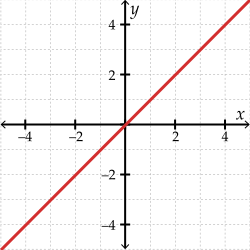
The graph of the linear function f of x equals x.

From the graph, we note that for \(f(x)=x\):

  • \(f(x)\) is defined for all \(x \in \mathbb{R}\)
    • \(\)Therefore, the domain is \(\{x \mid x\in\mathbb{R}\}\). Alternatively, we can write: the domain is \(\mathbb{R}\).
  • Every real number is an ouput of \(f(x)\)
    • Therefore, the range is \(\mathbb{R}\).
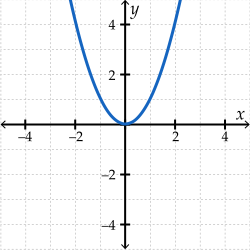
The graph of the quadratic function f of x equals x squared.

From the graph, we note that for \(f(x)=x^2\):

  • \(f(x)\) is defined for all \(x \in \mathbb{R}\)
    • \(\)Therefore, the domain is \(\mathbb{R}\). 
  • Every real number greater than or equal to \(0\) is an output of \(f(x)\)
    • Therefore, the range is \(\{y\in\mathbb{R} \mid y\ge0\}\).

Recall

The set \(\{y\in\mathbb{R} \mid y\ge0\}\) is read as: "The set of all \(y\) in \(\mathbb{R}\) such that \(y\) is greater than or equal to \(0\)".

Example 4

Determine the domain and range.

  1. \(f(x)=-3x(x-2)\)
  2. \(g(x)=-\dfrac{3}{4}(x-5)^2-1\)
  3. \(h(x)=3x^2-3x-18\)

Solution — Part A

Determine the domain and range of \(f(x)=-3x(x-2)\).

Since this quadratic function is written in factored form, we can note that:

  • The zeros are \(0\) and \(2\).
  • The axis of symmetry, which lies halfway between the zeros, is \(x=1\).
  • The \(y\)-coordinate of the vertex is \(f(1)=-3(1)(1-2)=3\).

The graph of this parabola is:
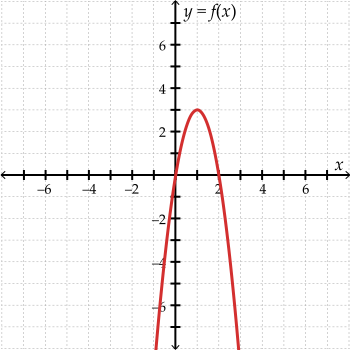
The graph of the function y equals negative 3x times open bracket x minus 2 close bracket.

We note from the graph that

  • \(f(x)\) is defined for all \(x \in \mathbb{R}\), and
  • all possible \(y\)-values are \(y\le 3\).

Therefore,

  • \(D=\mathbb{R}\) (since the domain is all real numbers), and
  • \(R=\{y\in\mathbb{R} \mid y\le3\}\).

Solution — Part B

Determine the domain and range of \(g(x)=-\dfrac{3}{4}(x-5)^2-1\).

Since this quadratic function is written in vertex form, we can note that:

  • The vertex is \((5,-1)\).
  • The parabola opens down since \(a=-\dfrac{3}{4}\) is negative.
  • The parabola has a maximum \(y\)-value since it opens down.
  • The maximum, which occurs at the vertex, is \(y=-1\).

The graph verifies these details.
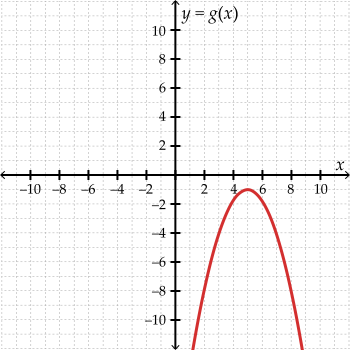
We note that

  • \(g(x)\) is defined for all \(x \in \mathbb{R}\), and
  • all possible \(y\)-values are \(y\le -1\).

Therefore,

  • \(D=\mathbb{R}\), and
  • \(R=\{y\in\mathbb{R}|y\le-1\}\).

Solution — Part C

Determine the domain and range of \(h(x)=3x^2-3x-18\).

You may have begun to gather from the other parts in this example that

  • the domain of a quadratic function is \(\mathbb{R}\) since quadratic functions are defined for all \(x\in\mathbb{R}\), and
  • the range of a quadratic function is determined by the \(y\)-coordinate of the vertex and whether the parabola opens up or down.

We require the vertex of \(\)\(h(x)=3x^2-3x-18\).

Method 1: Find the vertex by first factoring

\(\begin{align*} h(x) &= 3x^2-3x-18 \\ &= 3(x^2-x-6) &\text{Remove a common factor of}~3\\ &= 3(x-3)(x+2) &\text{Determine a pair of integers with product}~{-6}~\text{and sum}~{-1}\\ \end{align*}\)

Since this quadratic relation is written in factored form, we can note that:

  • The zeros are \(3\) and \(-2\).
  • The axis of symmetry, which lies halfway between the zeros, is \(x=\dfrac{1}{2}\).
  • The \(y\)-coordinate of the vertex is \(h\left(\dfrac{1}{2}\right)=3\left(\dfrac{1}{2}-3\right)\left(\dfrac{1}{2}+2\right)=\dfrac{-75}{4}\).

Therefore, the vertex is \(\left(\dfrac{1}{2}, \dfrac{-75}{4}\right)\).

Method 2: Find the vertex by first completing the square

\(\begin{align*} h(x) &= 3x^2-3x-18 \\[.5em] &= \class{hl1}{3}(x^2-x)-18 &\text{Common factor the}~a\text{-value from the first two terms.} \\ &= 3\left(x^2-x\class{hl2}{+\dfrac{1}{4}-\dfrac{1}{4}}\right)-18 &\text{Find the value that creates a perfect square} \\[.5em] &&\text{(take half of the}~x\text{-coefficient and square it).} \\ &&\text{Add and subtract that value.} \\[.5em] &= 3\left[\class{hl3}{\left(x-\dfrac{1}{2}\right)^2}-\dfrac{1}{4}\right]-18 &\text{Factor the perfect square.} \\[.5em] &= 3\left(x-\dfrac{1}{2}\right)^2\class{hl4}{-\dfrac{3}{4}}-18 &\text{Distribute the}~a\text{-value.} \\[.5em] &= 3\left(x-\dfrac{1}{2}\right)^2\class{hl1}{-\dfrac{75}{4}} &\text{Combine the remaining constants.} \end{align*}\)

Therefore, the vertex is \(\left(\dfrac{1}{2}, \dfrac{-75}{4}\right)\).

Method 3: Find the vertex by determining and applying a formula

Recall

The zeros of \(y=ax^2+bx+c\), where \(a \ne 0\), are given by

\(x = \dfrac{-b \pm \sqrt{b^2-4ac}}{2a}\)

Recall how we can use this formula to remember the vertex formula, \(x_\text{vertex}=-\dfrac{b}{2a}\):

  • The zeros are \(\dfrac{-b}{2a} + \dfrac{\sqrt{b^2-4ac}}{2a}\) and \(\dfrac{-b}{2a} - \dfrac{\sqrt{b^2-4ac}}{2a}\).
  • The \(x\)-coordinate of the vertex is halfway between the two zeros.
  • Since the zeros are of the form \(\dfrac{-b}{2a}+k\) and \(\dfrac{-b}{2a}-k\), halfway between the two zeros is \(\dfrac{-b}{2a}\).

Therefore, a formula for the \(x\)-coordinate of the vertex is \(x_\text{vertex}=\dfrac{-b}{2a}\).

Applying this formula to find the \(x\)-coordinate of the vertex of \(h(x)=3x^2-3x-18\):

\(\begin{align*} x_\text{vertex} &= \dfrac{-b}{2a}\\ &= \dfrac{3}{2(3)}\\ &= \dfrac{1}{2} \end{align*}\)

Therefore, the \(y\)-coordinate of the vertex is \(h\left(\dfrac{1}{2}\right)=3\left(\dfrac{1}{2}\right)^2 -3\left(\dfrac{1}{2}\right) -18=\dfrac{-75}{4}\).

Therefore, the vertex is \(\left(\dfrac{1}{2}, \dfrac{-75}{4}\right)\). 

Method 4: Find the vertex by partial factoring

Step 1: Partially Factor

\(\begin{align*} h(x)&=3x^2-3x-18\\ &=3x(x-1)-18 \end{align*} \)

Step 2: Identify two points with the same \(y\)-coordinate

If we set each factored part equal to \(0\)\(\), we will find the input values that have output \(-18\):

\(\begin{align*} x = 0 && \text{ or } && x-1=0\\ &&&& x=1 \end{align*}\)

So the points \((0,-18)\) and \((1,-18)\) satisfy the relation.

Step 3: Determine the \(x\)-coordinate of the vertex

Since the points found in Step 2 share the same \(y\)-coordinate, the \(x\)-coordinate of the vertex is halfway between \(0\) and \(1\), at \(x=\dfrac{1}{2}\).

Step 4: Determine the \(y\)-coordinate of the vertex

Therefore, the \(y\)-coordinate of the vertex is \(h\left(\dfrac{1}{2}\right)=3\left(\dfrac{1}{2}\right)^2 -3\left(\dfrac{1}{2}\right) -18=\dfrac{-75}{4}\).

Determine the domain and range

We can observe that:

  • Each method determined that the vertex is \(\left(\dfrac{1}{2}, \dfrac{-75}{4}\right)\).
  • The parabola opens up since \(a=3\) is positive.
  • The parabola has a minimum \(y\)-value since it opens up.
  • The minimum, which occurs at the vertex, is \(y=\dfrac{-75}{4}\).

The graph verifies these details.
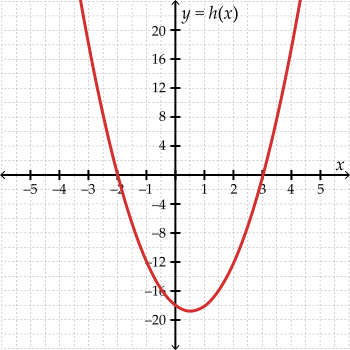
We note that

  • \(h(x)\) is defined for all \(x \in \mathbb{R}\), and
  • all possible \(y\)-values are \(y\ge \dfrac{-75}{4}\).

Therefore, for \(h(x)=3x^2-3x-18\),

  • \(D=\mathbb{R}\), and
  • \(R=\left\{y\in\mathbb{R} \mid y\ge \dfrac{-75}{4}\right\}\).

Remarks about Notation

In this question, when calculating the range of \(f(x)\), \(g(x)\), and \(h(x)\), we used \(y\) to represent each function without formally letting \(y\) equal the function. In this courseware, \(y\) always represents the output of a function unless \(y\) is explicitly defined in some other way. 

Further, we will use \(D\) and \(R\) to denote the domain and range of a function, respectively.

Domain and Range of a Quadratic Function Defined for all \(x\in\mathbb{R}\)

Suppose a quadratic function \(f(x)=ax^2+bx+c\), where \(a \ne 0\), defined for all \(x \in\mathbb{R}\) has vertex \((h,k)\). Then,

  • the domain is \(D=\mathbb{R}\), and
  • the range is 
    • \(R=\{y\in\mathbb{R} \mid y \ge k\}\) if \(a \gt 0\), and 
    • \(R=\{y\in\mathbb{R} \mid y \le k\}\) if \(a \lt 0\). 

To determine the range of a parabola, the vertex needs to be found. The method to find the vertex of a parabola differs depending on the given form:

  • Vertex Form: \(f(x)=a(x-h)^2+k\) has vertex \((h,k)\).
  • Factored Form: Determine the zeros, then the axis of symmetry (halfway between the zeros) and then the \(y\)-coordinate of the vertex.
  • Standard Form: Determine the vertex in one of four ways:
    • Change to factored form by factoring.
    • Change to vertex form by completing the square.
    • Use the formula \(x_\text{vertex}=\dfrac{-b}{2a}\) and then use the function to determine the \(y\)-coordinate of the vertex.
    • Partially factor to determine a pair of points symmetric about the axis of symmetry.

Check Your Understanding 3

Question — Version 1

Find the domain and range of \(f(x) = \dfrac{4}{3}(x-4)(x+2)\).

Answer — Version 1

The domain is \(D = \mathbb{R}\).

The range is \(R = \{y \in \mathbb{R} \mid y \ge -12\}\).

Feedback — Version 1

An upward facing parabola with the vertex at the point (1, negative 12).

Because this is a quadratic function, the domain is \(D = \mathbb{R}\).

Since this quadratic function is written in factored form we note that:

The zeros are \(-2\) and \(4\).

The \(x\)-coordinate of the vertex is \(\dfrac{-2 + 4}{2} = 1\).

The \(y\)-coordinate of the vertex is \(f(1) = -12\).

There is a minimum \(y\)-value since the parabola opens up.

The minimum, which occurs at the vertex, is \(y = -12\).

Therefore, the range is \(R = \{y \in \mathbb{R} \mid y \ge -12\}\).

Question — Version 2

Find the domain and range of \(f(x) = -x^2 + 2x + 15\).

Answer — Version 2

The domain is \(D = \mathbb{R}\).

The range is \(R = \{y \in \mathbb{R} \mid y \le 16\}\).

Feedback — Version 2

A downward facing parabola with the vertex at the point (1, 16).

Because this is a quadratic function, the domain is \(D = \mathbb{R}\).

Since this quadratic function is written in standard form, find the zeros by factoring, completing the square, or using the quadratic formula.

The zeros are \(-3\) and \(5\).

The \(x\)-coordinate of the vertex is \(\dfrac{-3 + 5}{2} = 1\).

The \(y\)-coordinate of the vertex is \(f(1) = 16\).

The parabola opens down since the \(a\)-value is negative.

There is a maximum \(y\)-value since the parabola opens down.

The maximum, which occurs at the vertex, is \(y = 16\).

Therefore, the range is \(R = \{y \in \mathbb{R} \mid y \le 16\}\).

Interactive Version

Finding Domain and Range


Example 5

At a basketball game, promotional T-shirts are given away by launching them into stands from a specially designed air cannon. The flight of a T-shirt is given by \(h(t)=-5(t-3)^2+47\) where \(h(t)\) is the height of the T-shirt above the ground, in metres, at \(t \) seconds.

Determine

  1. the height from which the T-shirt is launched.
  2. the domain and range if the T-shirt is in the air for exactly \(4\) seconds.
  3. the domain and range if the T-shirt is in the air for exactly \(1\) second.

Solution — Part A

Determine the height from which the T-shirt was launched.

The starting height of the T-shirt is the height when \(t=0\):

\(\begin{align*} h (t) &= -5(t-3)^2+47\\ h(0) &= -5(0-3)^2+47\\ &= 2 \end{align*}\)

Therefore, the T-shirt is launched from a height of \(2\) metres.

Solution — Part B

Determine the domain and range if the T-shirt is in the air for exactly \(4\) seconds.

To determine the domain, note that

  • \(t \ge 0\) since we cannot have negative time, and
  • \(t \le 4\) since the T-shirt lands or is caught at \(4\) seconds.

Therefore, the domain is \(D=\{t\in\mathbb{R} \mid 0 \le t \le 4 \}\).

A graph of the flight of this T-shirt is:

The function has endpoints (0, 2) and (4, 42) with the vertex occurring at the point (3, 47).

Notice that the graph has an endpoint at \((4,42)\) since

  • the largest value of \(t\) is \(t=4\), and
  • \(h(4)=-5(4-3)^2+47=42\).

To determine the range, note that:

  • the smallest \(y\)-value for this domain is \(2\), and
  • the largest \(y\)-value for this domain is \(47\) as it occurs at the vertex (since the parabola opens down and the \(x\)-coordinate of the vertex is in the domain).

Therefore, the range is \(R = \{y\in\mathbb{R} \mid 2 \le y \le 47 \}\).

Solution — Part C

Determine the domain and range if the T-shirt is in the air for exactly \(1\) second.

To determine the domain, note that

  • \(t \ge 0\) since we cannot have negative time, and
  • \(t \le 1\) since the T-shirt lands or is caught at \(1\) second.

Therefore, the domain is \(D=\{t\in\mathbb{R} \mid 0 \le t \le 1 \}\).

A graph of the flight of this T-shirt is:

The function has endpoints (0, 2) and (1, 27).

Notice that the graph has an endpoint at \((1,27)\) since

  • the largest value of \(t\) is \(t=1\), and
  • \(h(1)=-5(1-3)^2+47=27\).

To determine the range, note that:

  • the smallest \(y\)-value for this domain is \(2\), and
  • the largest \(y\)-value for this domain is \(27\) since the T-shirt is caught or lands before it reaches its maximum potential height (the graph does not continue all the way to the vertex).

Therefore, the range is \(R = \{y\in\mathbb{R}\mid 2 \le y \le 27 \}\).

Domain and Range of a Quadratic Function with a Restricted Domain

Suppose a quadratic function \(f(x)=ax^2+bx+c\), where \(a \ne 0\), defined on the domain \(D=\{x\in\mathbb{R} \mid p \le x \le q \}\) has vertex \((h,k)\). To determine the range, first determine if the domain contains the vertex of the parabola and then sketch the parabola. From your sketch, determine the range.

For example, consider parabolas that open up.

A parabola that opens up. It has start point (p, f of p), vertex (h, k) and end point (q, f of q).

For this parabola that opens up:

  • Since the domain contains the vertex, the range will contain \(y \ge k\).
  • The upper bound of the range will be the larger of \(f(p)\) and \(f(q)\).

A parabola that opens up. It has start point (p, f of p), and an end point (q, f of q).

For this parabola that opens up:

  • Since the domain does not contain the vertex, the range is all \(y\in\mathbb{R}\) with \(y\) between \(f(p)\) and \(f(q)\) inclusive.

Similar reasoning can be performed to determine the range when the parabola opens down.


Check Your Understanding 4

Question — Version 1

Find the range of \(y = 2x^2\) on the domain \(D = \{x \in \mathbb{R} \mid -4 \le x \le 2\}\).

Answer — Version 1

\(R = \{y \in \mathbb{R} \mid 0 \le y \le 32\}\)

Feedback — Version 1

The vertex of the parabola is \((0,0)\).

Note that the vertex is in the domain.

The \(y\)-coordinate of the endpoints of the domain are \(f(-4) = 32\) and \(f(2) = 8\).

Therefore, the range of the function is \(R = \{y \in \mathbb{R} \mid 0 \le y \le 32\}\).

Question — Version 2

Find the range of \(y = -2(x+1)^2-2\) on the domain \(D = \{x \in \mathbb{R} \mid -5 \le x \le -3\}\).

Answer — Version 2

\(R = \{y \in \mathbb{R} \mid 0 \le y \le 32\}\)

Feedback — Version 2

The vertex of the parabola is \((-1,-2)\).

Note that the vertex is not in the domain.

The \(y\)-coordinate of the endpoints of the domain are \(f(-5) = -34\) and \(f(-3) = -10\).

Therefore, the range of the function is \(R = \{y \in \mathbb{R} \mid -34 \le y \le -10\}\).

Interactive Version

Finding Range when Domain Restricted


Wrap-Up


Lesson Summary

In this lesson, we were introduced to the ideas of domain and range.

  • The domain of a function \(f(x)\) is the set of all values of the independent variable for which the function is defined.
  • The range of a function \(f(x)\) is the set of all values that the dependent variable can take.
  • Set notation is used to describe domain and range. The symbols are:
    • \(\{ ~ \} ~ \rightarrow\) "The set of all …
    • \(\in ~ \rightarrow\) "is an element of" or "in"
    • \(\mid ~ \rightarrow\) "such that"
  • To determine the range of a quadratic function, first visualize the graph by considering:

    • the endpoints (if there are any) and vertex of the parabola, and

    • whether the parabola opens up or down. 

Take It With You

In this lesson, we saw that the domain of a quadratic function is all real numbers, unless otherwise stated or demanded by the context. There are some functions that never have all real numbers as their domains, regardless of the context. Can you think of an example of such a function?