Answers


    1. Reflection in the \(x\)-axis and vertical stretch by a factor of \(5\) 
    2. Vertical compression by a factor of \(3\)
    3. Reflection in the \(x\)-axis (or reflection in the \(y\)-axis) and vertical compression by a factor of \(2\) (or horizontal compression by a factor of \(2\)) 
    4. Vertical stretch by a factor of \(3\), reflection in the \(y\)-axis and horizontal compression by a factor of \(2\) 
    5. Reflection in the \(x\)-axis, vertcial stretch by a factor of \(4\) and horizontal stretch by a factor of \(7\) 
    1. \(g(x)=-\dfrac4x\)
    2. \(g(x)=\dfrac12\sqrt x\)
    3. \(g(x)=\dfrac12\sqrt{-x}\)
    4. \(g(x)=\dfrac3x\)
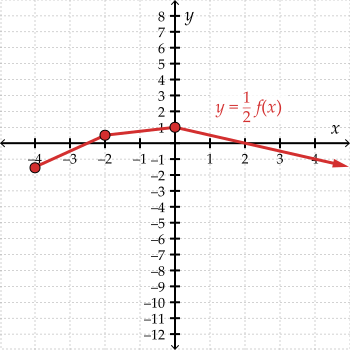
    1. y = one-half f of x is composed of line segments connecting points (negative 4, 1.5), (negative 2, 0.5), and (0, 1). The function then becomes a line starting at (0, 1) passing through (2, 0).

      The domain is \(\{x \in \mathbb{R} \mid x \ge -4 \}\). The range is \(\{y \in \mathbb{R} \mid y \le 1 \}\).
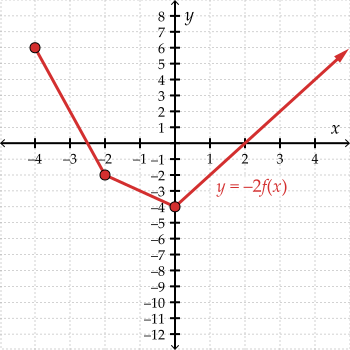
    2. y = negative 2 f of x is composed of line segments connecting points (negative 4, negative 6), (negative 2, negative 2), and (0, negative 4). The function then becomes a line starting at (0, negative 4) passing through (2, 0).

      The domain is \(\{x \in \mathbb{R} \mid x \ge -4 \}\). The range is \(\{y \in \mathbb{R} \mid y \ge -4 \}\).
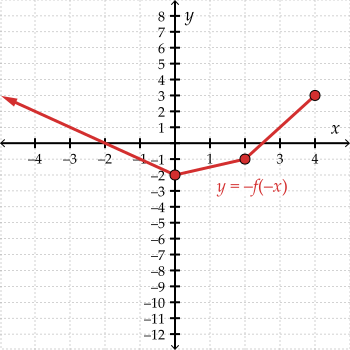
    3. y = negative f of negative x is a line passing through points (negative 2, 0) ending at (0, negative 2). The function is then composed on line segments connecting points (0, negative 2), (2, negative 1), and (4, 3).

      The domain is \(\{x \in \mathbb{R} \mid x \le 4 \}\). The range is \(\{y \in \mathbb{R} \mid y \ge -2 \}\).
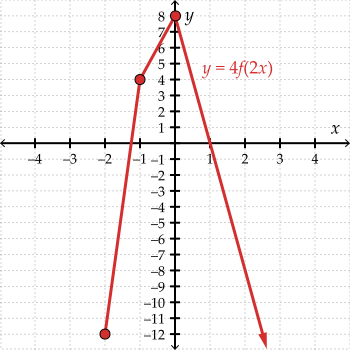
    4. y = 4 f of 2x is composed of line segments connecting points (negative 2, negative 12), (negative 1, 4), and (0, 8). The function then becomes a line starting at (0, 8) passing through (1, 0).

      The domain is \(\{x \in \mathbb{R} \mid x \ge -2 \}\). The range is \(\{y \in \mathbb{R} \mid y \le 8 \}\).

    1. f of x = 5 times square root x has points marked at x = 0, 1, 4, and 9.
    2. f of x = negative 4 over x has points marked at x= negative 2, negative 1, negative 0.5, 0.5, 1, and 2. Asymptotes are marked on the x and y axes.
    3. g of x = 3 x squared has points marked at x = negative 2, negative 1, 0, 1, and 2.
    4. h of x = negative 4 times the square root of quantity one-half x has points marked at x = 0, 2, 8, and 18.
    1. Domain: \(\{x \in \mathbb{R} \mid -6 \le x \lt 4 \}\); Range: \(\{ y \in \mathbb{R} \mid -12 \le y \lt 3\}\)
    2. Domain: \(\{x \in \mathbb{R} \mid -4 \lt x \le 6 \}\); Range: \(\{ y \in \mathbb{R} \mid -0.5 \lt y \le 2\}\)
    3. Domain: \(\{x \in \mathbb{R} \mid -3 \le x \lt 2 \}\); Range: \(\{ y \in \mathbb{R} \mid -20 \le y \lt 5\}\)
    4. Domain: \(\{x \in \mathbb{R} \mid -6 \lt x \le 9 \}\); Range: \(\{ y \in \mathbb{R} \mid -0.75 \lt y \le 3\}\)
    1. \(g(x)=-\dfrac14f(x)\) and \(f(x)=-4g(x)\)
    2. \(g(x)=2f(-2x)\) and \(f(x)=\dfrac12g\left(-\dfrac12x\right)\) 
    1. \((-3, -8)\)
    2. \((18, 60)\)
    1. The function y equals negative 2 times f of negative x is a downward facing parabola that passes through the points (negative 3, 2), (negative 2, 5), (negative 1, 6), (0, 5), and (1, 2).
    2. Domain: \(\mathbb{R}\); Range: \(\{y \in \mathbb{R} \mid y \le 6 \}\)
    3. \(y=-(x+1)^2+6\)
    1. y = 2 times f of negative 4x is a line passing through points (0, 6) and (1, 2).
    2. \(y=-4x+6\)
    1. \(b=2\) or \(b=-2\)
    2. \(b=81\)
    3. \(a=\dfrac14\)
    1. The reflections do not produce the same image. 
    2. The reflections do produce the same image. 
    3. The reflections do not produce the same image.
    4. The reflections do produce the same image. 
    1. \(a=2\) and \(b = \dfrac12 \)
    2. \(a= \dfrac23\) and \(b=\dfrac92\)
    3. \(g(x)=2 \sqrt{\dfrac12x}\) and \(g(x)=\dfrac23\sqrt{\dfrac92x}\) . These two functions are equivalent. 
    4. Vertical compression by a factor of \(2\) 
    5. Horizontal stretch by a factor of \(8\) 
    6. \(b = \dfrac2{a^2}\), or \(a = \sqrt{\dfrac2b}\)