The Reciprocal Function
Let's sketch the graph of another common function.
The function \(f(x)=\dfrac1x\) is called the reciprocal function.
The output, \(\dfrac1x\), is the reciprocal of the input, \(x\).
Math in Action
The function \(f(x)=\dfrac1x\) can be used to represent the time (in minutes) that it takes to walk \(1\) km at a speed of \(x\) km/min.
As with other functions, it is possible to graph this function by creating a table of values.
Graphing the Reciprocal Function
To create a table, we select various values of \(x\) and evaluate the function at these values.
Let's start with the integer values \(-3\), \(-2\), \(-1\), \(0\), \(1\), \(2\), and \(3\).
| \(x\) |
\(f(x)=\dfrac1x\) |
| \(-3\) |
|
| \(-2\) |
|
| \(-1\) |
|
| \(0\) |
|
| \(1\) |
|
| \(2\) |
|
| \(3\) |
|
\(f(-3) = -\dfrac{1}{3}\), since the reciprocal of \(-3\) is \(-\dfrac{1}{3}\), or because \(1 \div -3 = -\dfrac{1}{3}\).
Similarly, the reciprocal of \(-2\) is \(-\dfrac{1}{2}\) and the reciprocal of \(-1\) is \(-1\), since \(1 \div -1 = -1\).
When we come to \(x = 0\), the reciprocal is undefined, since it's not possible to divide \(1\) by \(0\).
This means that the graph will not contain any points with an \(x\)-coordinate of \(0\).
| \(x\) |
\(f(x)=\dfrac1x\) |
| \(-3\) |
\(-\frac13 \) |
| \(-2\) |
\(-\frac12\) |
| \(-1\) |
\(-1\) |
| \(0\) |
undefined |
| \(1\) |
|
| \(2\) |
|
| \(3\) |
|
Moving on, we can find that the reciprocal of \(1\) is \(1\), the reciprocal of \(2\) is \(\dfrac{1}{2}\), and the reciprocal of \(3\) is \(\dfrac{1}{3}\).
There are now \(6\) points that we can plot from the values in the table.
| \(x\) |
\(f(x)=\dfrac1x\) |
| \(-3\) |
\(-\frac13 \) |
| \(-2\) |
\(-\frac12\) |
| \(-1\) |
\(-1\) |
| \(0\) |
undefined |
| \(1\) |
\(1\) |
| \(2\) |
\(\frac12\) |
| \(3\) |
\(\frac13 \) |
It appears that the graph of this function is in two pieces.
So let's join the three points in quadrant \(\text{I}\) and join the three points in quadrant \(\text{III}\).
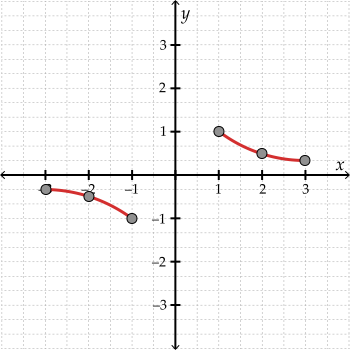
At this point, we still don't have a great sense of what this function truly looks like. It will help to consider two more \(x\)-values, \(-\dfrac{1}{2}\) and \(\dfrac{1}{2}\).
Since the reciprocal of \(-2\) is \(-\dfrac{1}{2}\). The reciprocal of \(-\dfrac{1}{2}\) is \(-2\).
That is \(f\left(-\dfrac{1}{2}\right) = -2\).
Similarly, \(f\left(\dfrac{1}{2}\right) = 2\).
| \(x\) |
\(f(x)=\dfrac1x\) |
| \(-3\) |
\(-\frac13 \) |
| \(-2\) |
\(-\frac12\) |
| \(-1\) |
\(-1\) |
| \(-\frac12\) |
\(-2\) |
| \(0\) |
undefined |
| \(\frac12\) |
\(2\) |
| \(1\) |
\(1\) |
| \(2\) |
\(\frac12\) |
| \(3\) |
\(\frac13 \) |
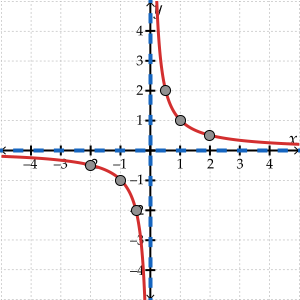
If we add these two points to our graph and extend the curves to join, the shape of the function becomes a little more clear.
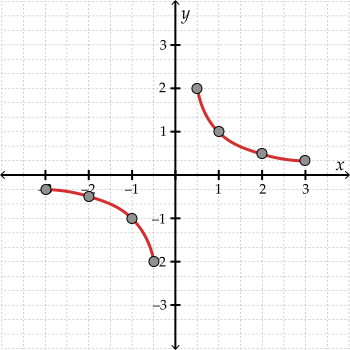
However, we still need to investigate what happens at large positive and large negative \(x\)-values as well as what happens for \(x\)-values close to \(0\). That is, points that are closer to the \(y\)-axis.
Let's start by considering larger positive \(x\)-values.
We can add to our existing points by finding \(f(4)\), \(f(5)\), and \(f(10)\).
- \(f(4) = \dfrac{1}{4}\)
- \(f(5) = \dfrac{1}{5}\)
- \(f(10) = \dfrac{1}{10}\)
If we plot these three additional points, we can see that they are getting closer and closer to the \(x\)-axis, but are not quite touching it.
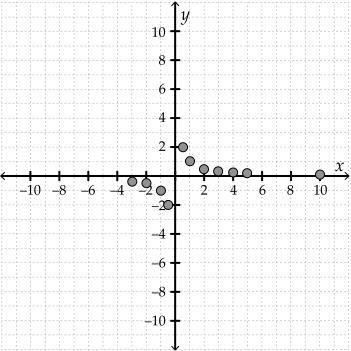
This pattern continues for even larger values of \(x\).
\(f(100) = \dfrac{1}{100}\), which is still not quite zero.
| \(x\) |
\(f(x)=\dfrac1x\) |
| \(\frac12\) |
\(2\) |
| \(1\) |
\(1\) |
| \(2\) |
\(\frac12\) |
| \(3\) |
\(\frac13 \) |
| \(4\) |
\(\frac14\) |
| \(5\) |
\(\frac15\) |
| \(\vdots\) |
\(\vdots\) |
| \(10\) |
\(\frac1{10}\) |
| \(\vdots\) |
\(\vdots\) |
| \(100\) |
\(\frac1{100}\) |
Even if we have \(x = 1~000~000\), the output of the function will be \(\dfrac{1}{1~000~000} = 0.000001\). Much closer, but still not equal to zero.
No matter how large of a positive \(x\)-value we input, the output of the function will not exactly equal zero.
So this portion of the graph will not cross the \(x\)-axis. Since all of the values for \(f(x)\) are positive here, the curve will stay above the \(x\)-axis and get closer and closer to it, without ever touching it.
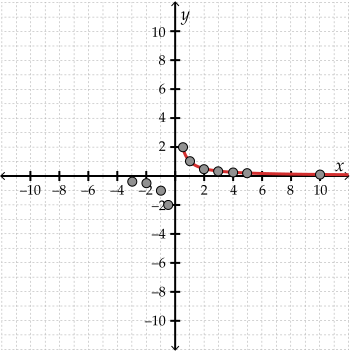
We find a similar result for larger negative \(x\)-values such \(f(-4)\), \(f(-5)\), and \(f(-10)\).
If we add them to the graph, we can see that these points are also getting closer to the \(x\)-axis, although this time they are below the axis.
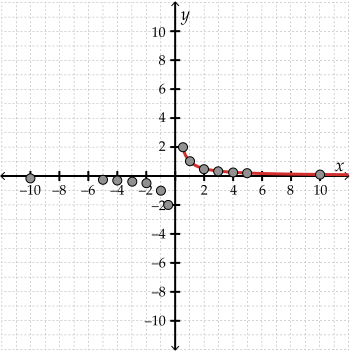
\(f(-100) = - \dfrac{1}{100}\), which is closer to zero, but still not quite there.
| \(x\) |
\(f(x)=\dfrac1x\) |
| \(-\frac12\) |
\(-2\) |
| \(-1\) |
\(-1\) |
| \(-2\) |
\(-\frac12\) |
| \(-3\) |
\(-\frac13 \) |
| \(-4\) |
\(-\frac14\) |
| \(-5\) |
\(-\frac15\) |
| \(\vdots\) |
\(\vdots\) |
| \(-10\) |
\(-\frac1{10}\) |
| \(\vdots\) |
\(\vdots\) |
| \(-100\) |
\(-\frac1{100}\) |
As the \(x\)-coordinate of the points on this portion of the graph get more and more negative, \(f(x)\) gets closer and closer to zero, but will not equal zero exactly.
So this portion of the curve doesn't touch the \(x\)-axis, either. It stays below the \(x\)-axis.
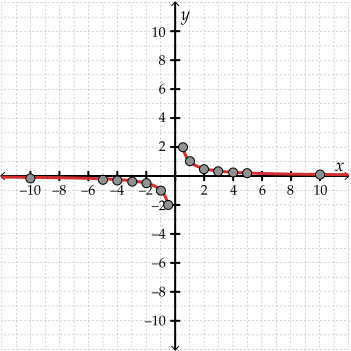
It turns out that there are no points on the function \(f(x) = \dfrac{1}{x}\) that touch the \(x\)-axis.
Now, let's look at some \(x\)-values that are closer to zero.
Starting with positive \(x\)-values, we find that
- \(f\left(\dfrac{1}{3}\right) = 3\), since \(\dfrac{1}{3}\) and \(3\) are reciprocals,
- \(f\left(\dfrac{1}{4}\right) = 4\), and
- \(f\left(\dfrac{1}{5}\right) = 5\).
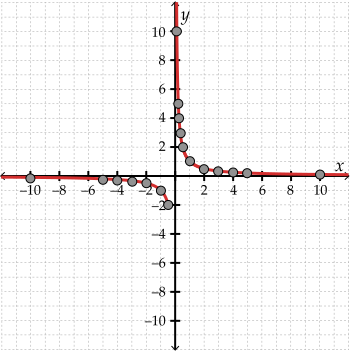
Adding these points to the graph, we can see that the output of the function or \(y\)-value is getting significantly larger as the \(x\)-values get closer to zero.
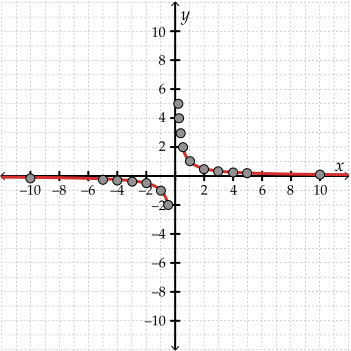
This is confirmed when we check the value of \(f\left(\dfrac{1}{10}\right)\), which is \(10\).
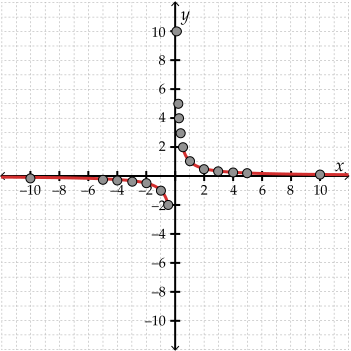
This pattern would continue, \(f\left(\dfrac{1}{100}\right) = 100\). So that point would have a \(y\)-coordinate of \(100\). The value, \(f(x)\), becomes a larger and larger positive number as \(x\) gets closer to zero on the positive side. However, we know that the graph will not touch the \(y\)-axis since \(f(0)\) is undefined.
Something similar happens for negative \(x\)-values.
- \(f\left(-\dfrac{1}{3}\right) = -3\)
- \(f\left(-\dfrac{1}{4}\right) = 4\)
- \(f\left(-\dfrac{1}{5}\right) = -5\), and
- \(f\left(-\dfrac{1}{10}\right) = -10\).
The output of the function becomes a larger and larger negative number, the closer the \(x\)-value gets to zero on the negative side. However this portion of the graph doesn't touch the \(y\)-axis either.
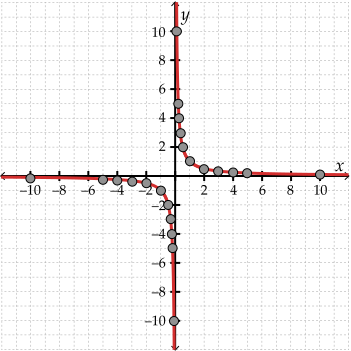
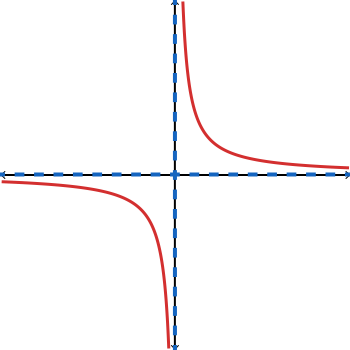
We now have a much better sense of the shape of this curve. The graph of the function \(f(x) = \dfrac{1}{x}\) consists of two parts or branches. It never crosses the \(x\)-axis or the \(y\)-axis, although the curve does get quite close to both.
Asymptotes
One important feature of the reciprocal function is that it has what are known as asymptotes.
A line is called an asymptote if, as a function \(y=f(x)\) heads towards infinity, the function continually gets closer to (but does not touch) that line.
There are three kinds of asymptote: horizontal, vertical, and slant/oblique.
A slant/oblique asymptote refers to a line that is not vertical or horizontal, but we will not be seeing any of those in this lesson.
Note: A function can cross an asymptote.
For the functions that we typically consider in high school, such asymptote crossings (if they occur) usually happen a finite number of times (and for values of \(x\) that aren’t too far from zero).
More complicated functions exist that do cross their asymptote(s) an infinite number of times.
For the function \(f(x)=\dfrac1x\) has two asymptotes,
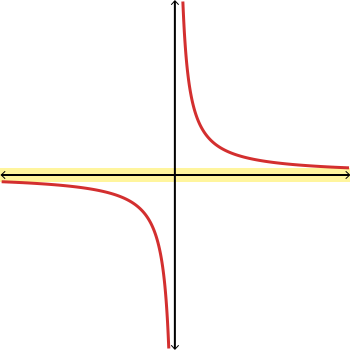
- The graph of \(y=f(x)\) approaches but does not touch the \(x\)-axis (the line \(y=0\)). So there is a horizontal asymptote at \(y=0\).
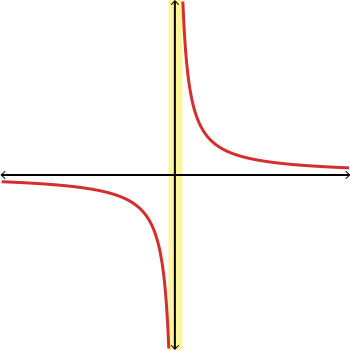
- The graph of \(y=f(x)\) approaches but does not touch the \(y\)-axis (the line \(x=0\)). So there is a vertical asymptote at \(x=0\).
These asymptotes are features that we will want to include when sketching the graph.
Drawing Asymptotes
Did You Know?
When graphing the reciprocal function \(f(x)=\dfrac1x\) by hand, the asymptotes should be drawn with dotted lines (since they are not actually part of the curve).
This differentiates the asymptotes from the function, which is drawn as a solid curve.
A Sketch of the Reciprocal Function
In our exploration of the graph of the reciprocal function, we found the coordinates of many different points on the function.
When sketching a graph of this function by hand, it isn't necessary to include this many points.
Instead we can use the asymptotes to help us correctly approximate the shape of the curve.
Here are some recommended steps for graphing by hand.
To sketch \(y=f(x)\) for \(f(x)=\dfrac1x\):
Domain and Range
Now, that we have become more familiar with the reciprocal function and its graph, let's discuss its domain and range.
Recall
The domain of \(f(x) = \dfrac1x\) is \(\{x \in \mathbb{R} \mid x \neq 0\}\).
We know this for two reasons.
- \(1\) divided by \(0\) is undefined. So \(0\) is not a possible input for the function. In fact, it is the only input that doesn't work.
- The graph does not cross the \(y\)-axis. So there are no points with \(x = 0\).
Recall
The range of \(f(x) = \dfrac 1x\) is \(\{y \in \mathbb{R} \mid y \neq 0 \}\).
Again, there are two reasons for this.
- \(1\) divided by any real value of \(x\) can never equal \(0\). So the output of the function can never be \(0\).
- The graph doesn't touch the \(x\)-axis so there are no points with \(y = 0\).