Recall that functions can be represented in multiple ways. For instance, the function, \(h\), that approximately converts Celsius temperatures to Fahrenheit temperatures can be represented in the following ways. The variables \(c\) and \(f\) stand for the approximated Celsius and Fahrenheit temperatures, respectively.
The inverse of a function is the relation which undoes the work of the function.
Notes:
\(f^{-1}(x)\) is read as '\(f\) inverse of \(x\)' or '\(f\) inverse at \(x\)'.
That is, it is typically not true that \(f^{-1}(x)=\dfrac{1}{f(x)}\).
The function \(f(x)\) relates femur lengths to heights, both in centimetres, for humans.
Determine the inverse of \(f(x)\) and determine if the inverse of \(f(x)\) is a function.
\(f(x)\)
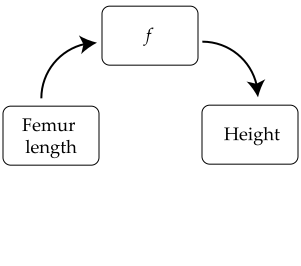
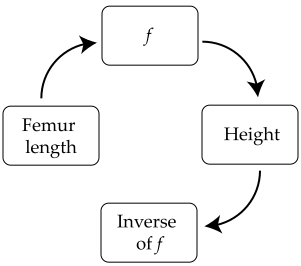
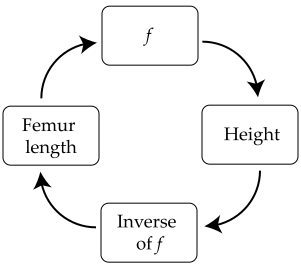
\(f\): femur length maps to height.
Inverse of \(f\): height maps to femur length.
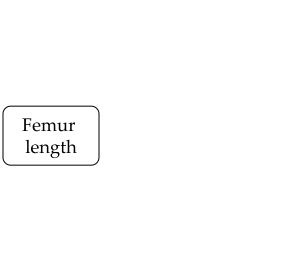
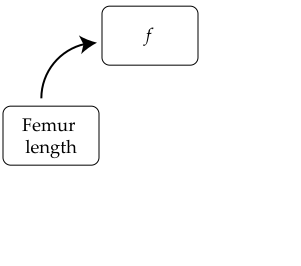
As a picture, here is the relationship between the function and its inverse:
To determine the inverse of \(f\), we interchange the independent and dependent variables.
Inverse of \(f(x)\), \(\class{hl2}{f^{-1}(x)}\)
For this set of data, the inverse of \(f(x)\) has a unique output for each input; therefore, it is a function.
In summary, note the following:
For the given function \(f(x)\), determine the inverse of \(f(x)\) and determine if the inverse is a function.
Pictorially, the relationship between \(f\) and the inverse of \(f\) for the last row of the table is:
To determine the inverse of \(f(x)\), interchange the independent and dependent variables.
To interchange the independent and dependent variables, we interchange the columns of the table. In this way, inputs into \(f(x)\) become outputs of the inverse; outputs of \(f(x)\) become inputs into the inverse.
Notice that when \(x=5\) is the input into the inverse of \(f(x)\), there are two possible output values, \(-2\) or \(1\). Therefore, the inverse is not a function.
You will notice that when the columns were interchanged, the column titles did not simply interchange. The independent variable is \(x\) for both the original function and the inverse relation; the dependent variable is either the output of the original function or the output of the inverse relation, depending on the table.
Since, in this example, the inverse is not a function, the notation \(f^{-1}(x)\) was not used; rather, the inverse is referred to as "the inverse of \(f(x)\)".
The table shows all values of the function \(f\). The inverse of \(f\) is also a function. Determine
\(f(4)\) is the output of \(f\) when the input is \(4\).
Therefore, \( f(4)=9\).
\(f^{-1}(7)\) is the input into \(f(x)\) that produces the output \(7\).
Therefore, \( f^{-1}(7)=0\).
\(\begin{align*} f(\class{timed add1-hl2 remove3-hl2}{{f^{-1}(\class{timed add11-hl2}{-2})}})&\; \class{timed in3}{= f(2)}\\ &\; \class{timed in5}{= \class{timed add11-hl2}{-2} } \end{align*}\)
\(\begin{align*} f^{-1}(f(\class{timed add11-hl2}{1}))& \; \class{timed in8}{=f^{-1}(-5)}\\ &\; \class{timed in9}{= \class{timed add11-hl2}{1}} \end{align*}\)
As expected, \(f\) and \(f^{-1}\) undo one another.