Let's look at determining the inverse of a linear function algebraically.
Example 1
The inverse of \(f(x)=5x+2\) is a function. Determine \(f^{-1}(x)\).
Solution
Recall
To determine the inverse of \(f(x)\), interchange the independent and dependent variables.
This is true regardless of the way the function is represented.
In a table, we interchange the \(x\) and \(y\) columns.
In a graph, we interchange the \(x\) and \(y\)-coordinates.
Here we will interchange \(x\) and \(y\) as well.
Except right now the function doesn't have a \(y\).
So the first order of business is to write this function with a \(y\).
We replace \(f(x)\) with \(y\),
\(\begin{aligned} f(x) &=5 x+2 \\ y &=5 x+2 \end{aligned}\)
Here, \(y=f(x)\).
To determine \(f^{-1}(x)\), interchange \(x\) and \(y\).
\( x =5 y+2 \)
But this new equation no longer describes the original function.
From this point forward, \(y=f^{-1}(x)\).
The change in the meaning of \(y\) happened when we interchange \(x\) and \(y\).
To determine an expression for the inverse, we rearranged the equation to isolate for \(y\).
\( x = 5 y+2 \)
First, we subtract \(2\) from both sides.
\( 5 y =x-2 \)
Then divide both sides by \(5\).
\( y =\dfrac{x-2}{5} \)
In this part of the solution, \(y = f^{-1}(x)\).
Therefore, \(f^{-1}(x) = \dfrac{x-2}{5}\).
Compare \(f(x)\) and \(f^{-1}(x)\)
So we've completed this question already, but let's take a moment to compare \(f(x)\) and \(f^{-1}(x)\).
First, let's compare their operations and their order of operations.
Operations to Evaluate \(f(x)\)
\( f(x)= 5x+2 \)
- Multiply by \(5\).
- Add \(2\).
Operations to Evaluate \(f^{-1}(x)\)
\(f^{-1}(x) = \dfrac{x-2}{5}\)
- Subtract \(2\).
- Divide by \(5\).
The operations and the order in which they are applied are opposites.
Where we used to have a multiply by \(5\), we now have a divide by \(5\). Where we used to have add \(2\), we now have subtract \(2\) and whereas the multiply by \(5\) used to come first, now it's the subtract \(2\) that comes first.
Compare the Graphs of \(y=f(x)\) and \(y=f^{-1}(x)\)
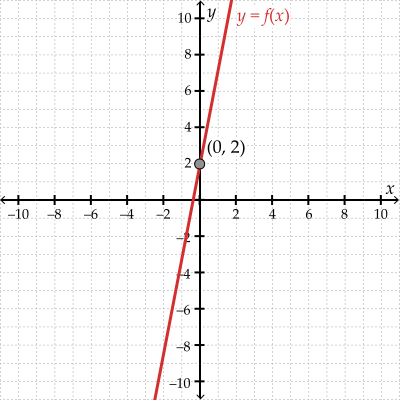
First, we'll graph \(y=f(x)\).
It is a linear function with slope \(5\) and \(y\)-intercept \(2\).
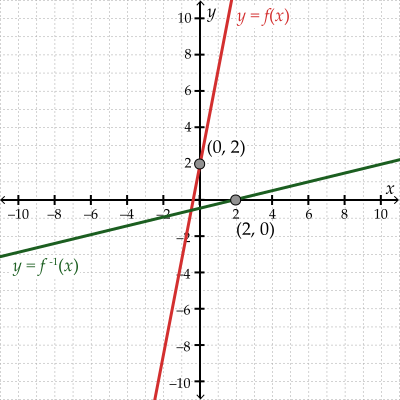
We can write \(f^{-1}(x)\) in \(y = mx + b\) form as well.
\(\begin{aligned} f^{-1}(x) &=\frac{x-2}{5} \\ &=\frac{1}{5} x-\frac{2}{5} \end{aligned}\)
\(f^{-1}(x)\) is a linear function with slope \(\dfrac{1}{5}\) and \(y\)-intercept \(-\dfrac{2}{5}\).
Here is its graph.
Now if we add the line \(y = x\) to this graph, we see something that you might recall from a previous lesson, the graph of \(y = f(x)\) and the graph of its inverse are reflections in the line \(y = x\).
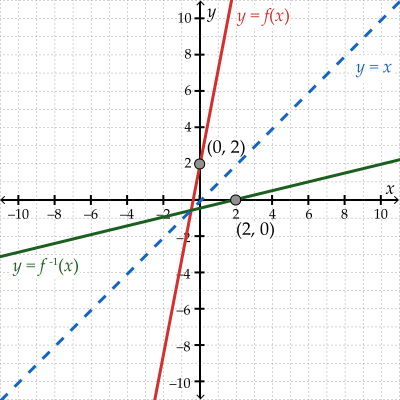
We also see that the inverse is a function as indicated in the question.
So the use of function notation for the inverse throughout this question was indeed justified.
Solution Revisited
Let's make one final comment about this example, this time about the solution itself.
Here is the solution again as presented earlier.
Here, \(y=f(x)\).
\(\begin{aligned} f(x) &=5 x+2 \\ y &=5 x+2 \end{aligned}\)
To determine \(f^{-1}(x)\), interchange \(x\) and \(y\).
\( x =5 y+2 \)
From this point forward, \(y=f^{-1}(x)\).
\(\begin{align*} 5 y &=x-2 \\ y &=\frac{x-2}{5} \end{align*}\)
Therefore, \(f^{-1}(x) = \dfrac{x-2}{5}\).
Notice the phrase to determine \(f^{-1}(x)\) interchange \(x\) and \(y\) included here in the solution.
This phrase is necessary for the solution.
Interchanging \(x\) and \(y\) changes the function.
The algebra shown on this page is about two different functions.
The first lines are about \(f(x)\) and the remainder is about \(f^{-1}(x)\).