As we move on to restricting the domain of a quadratic function so that the inverse is a function, let's revisit the Try This problem presented at the beginning of this lesson.
Try This Revisited
The inverse of \(f(x) = -2(x-4)^2+7\) is not a function. However, it is possible to restrict the domain of \(f(x)\) so that its inverse is a function. Determine a way to restrict the domain of \(f(x)\) so that the inverse of \(f(x)\) is a function.
Solution
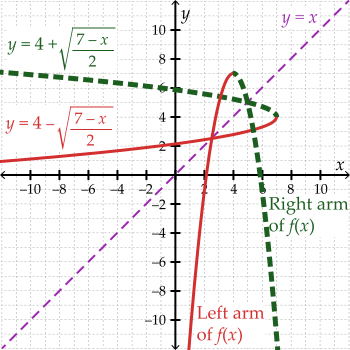
In a previous example, we found this graph of \(y = f(x)\) and its inverse.
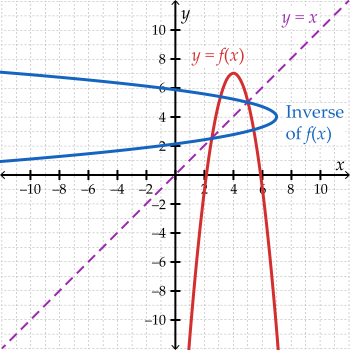
The inverse of \(f(x)\) is not a function since it fails the Vertical Line Test.
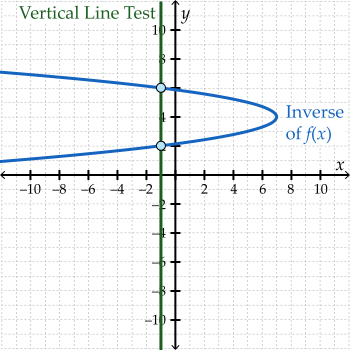
For example, the points \((-1,2)\) and \((-1,6)\) both satisfy the inverse relation.
We found earlier that an equation for the inverse is \(y=4\pm\sqrt{\dfrac{7-x}{2}}\).
We also see from the equation that this relation is not a function. The \(\pm\) gives two different outputs for many inputs.
This relation is the union of two separate functions
\(\class{hl4}{y=4 + \sqrt{\dfrac{7-x}{2}}}\)
\(\class{hl2}{y=4 - \sqrt{\dfrac{7-x}{2}}}\)
The equation with the plus sign corresponds to the upper arm of the parabola, and the equation with the minus sign generates the lower arm of the parabola.
You can check this by substituting \(x = -1\) into each equation to see which equation generates \(2\), and which equation generates \(6\).
Now remember the goal of this try this.
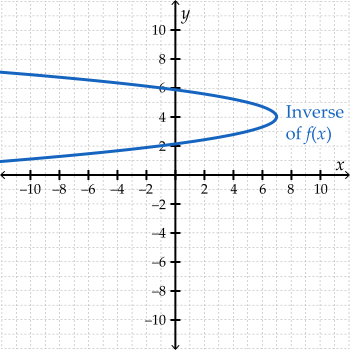
We're trying to find a restricted domain of the original function, so that the inverse function is indeed a function.
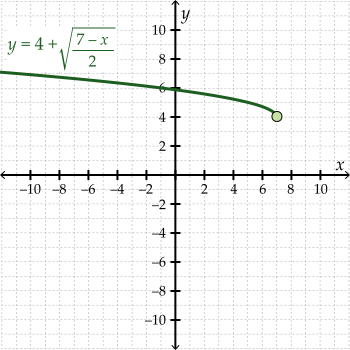
So if we were to only have this part of the inverse, then the inverse would be a function. So let's reverse engineer that to see which section of \(y = f(x)\) corresponds to this part of the inverse.
If we reflect this upper arm in the line \(y = x\), then we arrive at the right arm of \(y = f(x)\).
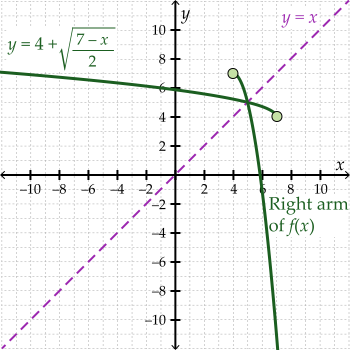
Therefore, if we restrict the domain of \(f(x)\) to include only the right arm, then the inverse consists only of the upper arm, so that it is a function.
The domain that generates the right arm of \(y = f(x)\) is \(D=\{x\in \mathbb{R} \mid x\ge 4 \}\).
Alternatively, we could also plan to restricted domain on \(f(x)\), so that only the lower arm of the inverse relation parabola remains.
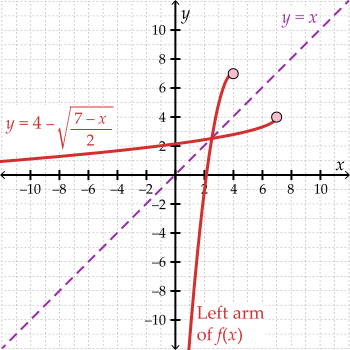
This corresponds to the domain that retains only the left arm of \(f(x)\).
In that case, \(D= \{x\in \mathbb{R} \mid x\le 4 \}\).
Thus, we have two possible restricted domains of \(f(x)\), that ensure that the inverse is a function.
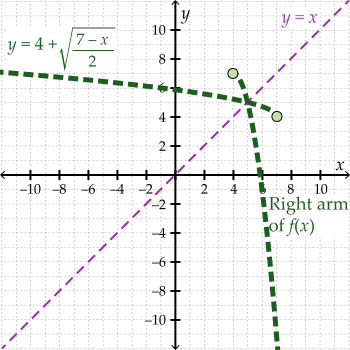
This restricted domain corresponds to the right arm of \(f(x)\) in the upper arm of the inverse. So if \(f(x)\) is restricted or limited to this domain, then its inverse is a function.
Notice that, as we have seen previously the domain of \(f(x)\), is the range of the inverse of \(f(x)\).
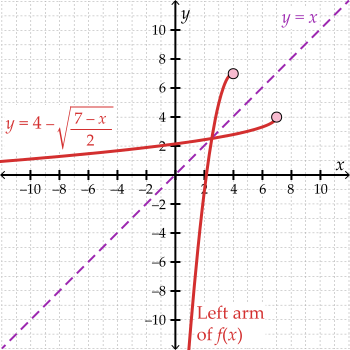
Likewise, this domain corresponds to the left arm of \(f(x)\) and the lower arm of the inverse.
Again, the domain of \(f(x)\) is the same as the range of the inverse.
There are other restricted domains that ensure that the inverse is a function but these are the only two that retain one complete arm of the parabola.
By ensuring that one complete arm of the inverse is retained, we keep as many key features of the parabola as possible, while also ensuring that the inverse is a function.
This will always be the intention in these questions.