Alternative Format: Lesson 1 — Solving Single-Variable Inequalities

Let's Start Thinking

Equation vs. Inequalities

In math, we spend a fair amount of time solving equations. This can be useful, especially for trying to determine one or two specific values.

Here's an example of where this might come up.

\(f(x)=-14\,000x^2+108\,500x\) represents a bus company's revenue in dollars, when the price of a single fare is \(x\) dollars.

We might be interested in knowing what price(s) will produce a revenue of exactly \($200\,000\)? 

In this case, we set \(f(x) = 200~000\) and solve the quadratic equation

\(-14\,000x^2+108\,500x=200\,000\)

However, if we're interested in making a revenue of \($200~000\), any revenue higher than that would likely work as well.

So it might be more useful to find out what range of prices produces a revenue of at least \($200\,000\)?

To do this, we need to solve the inequality:

\(-14\,000x^2+108\,500x \ge 200\,000\)

Although the quadratic equation and the inequality look pretty similar to each other, their solutions, as well as the techniques for solving them, are quite different.

In this lesson, we will discuss how to solve linear and quadratic inequalities.

In particular, we'll focus on single variable inequalities, which are inequalities, like the ones shown previously, that contain only one variable.


Lesson Goals

  • Express a set of real numbers using interval notation.
  • Solve linear inequalities, including compound or simultaneous inequalities, using inverse operations.
  • Use different strategies to solve quadratic inequalities, such as graphing, case analysis, or sign analysis.
  • Solve applications involving linear and quadratic inequalities.

Try This

A yoga studio has three different pricing schemes.

If you have no membership, you pay \($22\) for each class that you attend.

If you have a Silver membership, you pay a flat fee of \($100\) each year, plus \($17\) for each class.

If you have a Gold membership, you pay a flat fee of \($150\) each year, plus \($15\) for each class.

For how many classes in one year is the Silver membership the best value?  


Introduction to Interval Notation


Interval notation is used to represent the set of all real numbers between two endpoints. The two endpoints are listed within a set of brackets. 

Square brackets \([ \: ]\), or just "brackets," are used to indicate closed intervals (intervals that include both endpoints). Rounded brackets \(( \: )\), or "parentheses," are used for open intervals (intervals that do not include either endpoint). An interval can also be half-closed or half-open, if it contains one of the endpoints but not the other. This would be indicated with one square bracket and one rounded bracket.

For sets of real numbers with no upper boundary, the upper endpoint is written as \(\infty\) (infinity) with a rounded bracket in interval notation. For sets of real numbers with no lower boundary, the lower endpoint is written as \(-\infty\) (negative infinity). 

Here are some examples of intervals illustrated as inequalities, number lines, and interval notation. Remember that on a number line, a solid dot means that the number is part of the interval, while an open dot means that it is not.  

Inequality Number Line Interval Notation
\(0 \leq x \leq 4\) A number line with a line drawn from 0 to 4. A closed dot is drawn at both 0 and 4. \(x \in [0, 4]\)
\(-3 \lt x \lt 3\) A number line with a line drawn from negative 3 to positive 3. An open dot is drawn at both negative 3 and positive 3. \(x \in (-3, 3)\)
\(-4 \leq x \lt 1\) A number line with a line drawn from negative 4 to positive 1. A closed dot is drawn at negative 4 and an open dot is drawn at positive 1. \(x \in [-4, 1)\)
\(-1 \lt x \leq 2\) A number line with a line drawn from negative 1 to positive 2. An open dot is drawn at negative 2 and a closed dot is drawn at positive 2. \(x \in (-1, 2]\)
\(x \lt 0\) A number line with an open dot at 0 with an arrow to the left, in the negative direction. \(x \in (-\infty, 0)\)
\(x \leq -3\) A number line with a closed dot at negative 3 with an arrow to the left, in the negative direction. \(x \in (-\infty, -3]\)
\(x \gt 1\) A number line with an open dot at 1 with an arrow to the right, in the positive direction. \(x \in (1, \infty)\)
\(x \ge -2\) A number line with a closed dot at negative 2 with an arrow to the right, in the positive direction. \(x \in [-2, \infty)\)
\(x \in \mathbb{R}\) (\(x\) is any real number) A number line with arrows pointing in both directions. \(x \in (-\infty, \infty)\)

Notice that \(-\infty\) or \(\infty\) are always listed with rounded brackets, since these are not defined endpoints. Also note that the symbol \(\in\) means "belongs to", so the notation \(x \in [0, 4]\)means that \(x\) belongs to (or is part of) the interval \( [0, 4]\). 

Sometimes we need to describe a set of numbers that consists of two or more distinct intervals.  

In this situation, we can use interval notation in combination with the \(\cup\) symbol (the symbol for the union of two sets).

Here are some examples: 

Inequality Number Line Interval Notation
\(x \lt 0\) or \(x \geq 2\) A number line with an open dot at 0 with an arrow to the left and a closed dot at 2 with an arrow to the right. \(x \in (-\infty, 0)\cup [2, \infty)\)
\(x \in \mathbb{R}, x \neq -1\) (i.e., \(x\) is any real number except \(-1\)) A number line with arrows pointing in both directions and an open dot at negative 1. \(x \in (-\infty, -1)\cup(-1, \infty)\)

Interval notation can be useful when solving inequalities. It can be used to express the solutions to inequalities (which often consist of a range or set of numbers) and will appear occasionally throughout the rest of this lesson.


Check Your Understanding 1

Question — Version 1

Below are three different representations of sets of numbers.

Inequality

\(-4 \lt x \le 2\)

Number Line

There are open dots at negative 4 and 2. A line is drawn between them.

Interval Notation

\(x \in (-4, 2)\)

Which two representations are of the same set?

  1. Inequality and Number Line
  2. Inequality and Interval Notation
  3. Number Line and Interval Notation

Answer — Version 1

  1. Number Line and Interval Notation

Feedback — Version 1

The inequality includes \(2\) but the number line and interval notation do not include \(2\).

Therefore, the number line and interval notation are of the same set.

Question — Version 2

Below are three different representations of sets of numbers.

Inequality

\(x \lt -2 \ \ \text{or} \ \ x \ge 4\)

Number Line

There is a closed dot at negative 2 with an arrow to the left and a closed dot at positive 4 with an arrow to the right

Interval Notation

\(x \in (-\infty, -2) \cup [4, \infty) \)

Which two representations are of the same set?

  1. Inequality and Number Line
  2. Inequality and Interval Notation
  3. Number Line and Interval Notation

Answer — Version 2

  1. Inequality and Interval Notation

Feedback — Version 2

The number line includes \(-2\) but the inequality and interval notation do not include \(-2\).

Therefore, the inequality and interval notation are of the same set.

Question — Version 3

Below are three different representations of sets of numbers.

Inequality

\(x \gt -4\)

Number Line

The is an open dot at negative 4 attached to an arrow pointing in the positive direction.

Interval Notation

\(x \in [-4, \infty)\)

Which two representations are of the same set?

  1. Inequality and Number Line
  2. Inequality and Interval Notation
  3. Number Line and Interval Notation

Answer — Version 3

  1. Inequality and Number Line

Feedback — Version 3

The interval notation includes \(-4\) but the inequality and number line do not include \(-4\).

Therefore, the inequality and number line are of the same set.


Solving Linear Single-Variable Inequalities


What Is an Inequality? 

Inequalities indicate the relationship between two expressions that are not necessarily equal.

The inequalities that we are going to discuss in this lesson will involve one of the following symbols:

  • \(\geq\)
  • \(\gt\)
  • \(\leq\)
  • \(\lt\)

Did You Know?

An inequality can also involve the symbol \(\ne\), as in the example \(x+1 \ne 5\). This inequality can be solved exactly as you would solve an equation.

The solution to an inequality is often a range of values, consisting of the set of all numbers that satisfy the inequality.

For example, here is the graph of \(y=f(x)\).

The graph shows a function with a negative slope that crosses the y-axis at y equals 3 and crosses the x-axis at x equals 6.

The solution to the inequality \(f(x) \ge 0\) is \(x \leq 6\), since we can see on the graph that the output of \(f(x)\) is non-negative for all \(x\)-values less than or equal to \(6\).

This can also be represented using a number line.

A number line with a closed dot at 6 and an arrow pointing left, in the negative direction.

We have a closed dot at \(6\), since \(x=6\) is part of the solution.

Considering the same graph, the solution to the inequality \(f(x) \lt 4\) is \(x \gt -2\). On the graph, we can see that the point \((-2, 4)\) lies on the function and that the output of \(f(x)\) is less than \(4\) for all \(x\)-values greater than \(-2\). (Note that \(f(-2)=4\) which is not less than \(4\), so we do not include \(-2\) in the solution.)

Here is this interval on a number line: \(\)

A number line with a open dot at negative 2 and an arrow pointing right, in the positive direction.

We have an open dot at \(-2\), since \(x=-2\) is not part of the solution. 

Recall that it is also possible to express the solutions to inequalities in interval notation. 

In interval notation, the solution \(x \le 6\) is written as \(x \in (-\infty, 6]\) and the solution \(x \gt -2 \) is written as \(x \in (-2, \infty)\).

Inequalities and Operations

It is possible to perform the following operations on an inequality without affecting the inequality:

  • Adding the same value to both sides.
  • Subtracting the same value from both sides.
  • Multiplying both sides by the same positive number.
  • Dividing both sides by the same positive number.

Multiplying or dividing both sides of an inequality by a negative number produces a false inequality. For example, while \(3 \gt 1\), \(-12 \not \gt -4\).

To make the inequality true after multiplying or dividing by a negative number, reverse the direction of the inequality symbol.

These operations can all be used in the process of solving inequalities. 

The inequalities in the following example are known as linear inequalities. Linear inequalities are similar to linear equations; however, the \(=\) symbol is replaced with one of the inequality symbols.

It is possible to solve single-variable linear inequalities by applying inverse operations, as you would to solve a linear equation. 

Example 1

Solve each inequality.

  1. \(7x +8 \geq 5x-1\)
  2. \(-4(x-5) \gt 0 \)
  3. \(\dfrac{x-4}3\leq \dfrac{x-10}6\)

Solution — Part A

 \(7x+8 \geq 5x -1\)

Subtract \(5x\) from each side:

\(2x+8 \geq -1\)

Subtract \(8\) from each side: 

\(2x \geq -9\)

Divide both sides by \(2\): 

\(x \geq -\dfrac92\)

Therefore, \(7x+8 \geq 5x -1\) when \(x \geq -\dfrac92\). 

This solution can be represented using a number line: 

A number line with a closed dot at negative 4.5 and an arrow pointing right, in the positive direction.

In interval notation, this solution can be written as \(x \in \left[-\dfrac92, \infty\right)\). 

Solution — Part B

\(-4(x-5) \gt 0 \)

Divide both sides by \(-4\).

Since this is a negative number, remember to reverse the sign of the inequality!

\(x-5 \lt 0 \)

Add \(5\) to both sides:

\(x \lt 5 \)

Therefore, \(-4(x-5) \gt 0 \) when \(x \lt 5 \). 

Here is the number line representation of this solution:

A number line with a open dot at 5 and an arrow pointing left, in the negative direction.

In interval notation, this solution can be written as \(x \in (-\infty, 5)\). 

Solution — Part C

\(\dfrac{x-4}3\leq \dfrac{x-10}6\)

Multiplying both sides by \(6\) will clear the fractions. Then apply operations to both sides as in parts a) and b). 

\(\begin{align*} \dfrac{6(x-4)}3 &\leq \dfrac{6(x-10)}6 \\ 2(x-4) &\leq x-10 \\ 2x-8 &\leq x -10 \\ x - 8 &\leq -10 \\ x &\leq -2 \end{align*} \)

Therefore, \(\dfrac{x-4}3\leq \dfrac{x-10}6\) when \(x \le -2\). 

Here is the number line representation of this solution: 

A number line with a closed dot at negative 2 and an arrow pointing left, in the negative direction.

In interval notation, this solution can be written as \(x \in (-\infty, -2]\).

In the next examples, we will look at compound inequalities (sometimes called simultaneous inequalities).


Compound Inequalities

A compound inequality consists of  two or more inequalities together.

If the inequalities are joined by the word 'and,' the solution must satisfy all of the individual inequalities.

That is, it must make all of the individual inequalities true

Consider the compound inequality \(x \gt -1\) and \(x \lt 7\)

A number line with an open dot at 7 and an arrow in the negative direction to the left and an open dot at negative 1 with an arrow to the right in the positive direction.

A solution here has to satisfy both of the inequalities.

The area covered by both number lines is a number line with an open dot at negative 1 connected to an open dot at 7.

The solution is \(-1 \lt x \lt 7\), or \(x \in (-1, 7)\). 

If the inequalities are joined by the word 'or,' the solution only needs to satisfy one of the inequalities. 

Now consider the compound inequality \(x \gt -1\) or \(x \lt 7\)

A number line with an open dot at negative 1 with an arrow to the right and an open dot at 7 with an arrow to the left, in the negative direction. Together the two domains cover all possible values.

Any solution only has to satisfy one of these inequalities.

So it includes all numbers greater than \(-1\), as well as all numbers less than \(7\).

A number line with an arrow across the entire number line, spanning both left and right

The solution is all real numbers, or \(x \in \mathbb{R}\). 

Intervals with open endpoints look like an ordered pair

i.e., The point \((-1, 7)\) looks very similar to the interval \(x \in (-1, 7)\).

The context of the question, and the notation \(x \in (-1, 7)\), indicate that a solution is a set of \(x\) values, not a point. 

Here's an example of a more complicated compound inequality to solve.

Example 2

Solve \(30-x \lt x+20 \lt 5x+8\). 

Solution

This is an example of a double inequality.

To solve it, we can split it into two simpler inequalities, 

\(30-x \lt x + 20\) and \(x+20 \lt 5x+8\)

Note that these two inequalities imply that \(30-x \lt 5x+8 \), which also needs to be true.

If a value satisfies both of these inequalities, it is part of the solution to the original inequality.

Inequality 1:

\( 30-x \lt x+20 \)

Add \(x\) to both sides of the inequality,

\( 30 \lt 2 x+20 \)

Subtract \(20\) from both sides,

\( 10 \lt 2 x \)

Divide everything by \(2\),

\(\begin{align*} 5 &\lt x \\ x &\gt 5 \end{align*}\)

Inequality 2:

\( x+20 \lt 5 x+8 \)

Subtract \(5x\) from each side,

\( -4 x+20 \lt 8 \)

Subtract \(20\) from each side,

\( -4 x \lt -12 \)

Divide both sides of the inequality by \(-4\),

\( x \gt 3 \)

Note: we need to reverse the direction of the inequality when we divide by a negative value.

The set of solutions for \(x\) must satisfy both \(x \gt 5\) and \(x \gt 3\).

Here's a number line illustrating \(x \gt 5\):

A number line with an open dot at 5 and an arrow pointing to the right, in the positive direction.

Here's a number line illustrating \(x \gt 3\): 

A number line with an open dot at 3 and an arrow pointing to the right, in the positive direction.

The solution to our original inequality needs to be a part of both of these number lines. That is, it is found where both of these number lines overlap.

Any number greater than \(5\) satisfies both inequalities. 

Here's another way of thinking of this. When a number is greater than \(5\), it must also be greater than \(3\). Whereas if a number is greater than \(3\), it's not necessarily greater than \(5\), so the solution is \(x \gt 5\).

Now let's revisit the Try This problem from the beginning of the lesson.

Try This Revisited

A yoga studio has three different pricing schemes.

If you have no membership, you pay \($22\) for each class that you attend.

If you have a Silver membership, you pay a flat fee of \($100\) for the year, plus \($17\) for each class.

If you have a Gold membership, you pay a flat fee of \($150\) for the year, plus \($15\) for each class.  

For how many classes in one year is the Silver membership the best value?   

Solution

Let \(x\) represent the number of classes attended in one year.

Then, we can write expressions for the cost of each pricing scheme.

Cost with no membership: \(22x\)

Cost with Silver membership: \(17x+100\) 

Cost with Gold membership: \(15x+150\)

For the Silver membership to be the best value,

  • \(17x+100 \lt 22x\) (having the Silver membership costs less than no membership), and 
  • \(17x + 100 \lt 15x + 150\) (having the Silver membership costs less than having the Gold membership).

Now that we have two inequalities joined by the word and, we can solve them each individually and then determine which values satisfy both.

Inequality 1:

\(\begin{align*} 17 x+100 &\lt 22 x \\ 100 &\lt 5 x \\ 20 &\lt x \\ x &\gt 20 \end{align*}\)

So the Silver membership is a better value compared to no membership if you're going to attend more than \(20\) classes.

Inequality 2:

\(\begin{align*} 17 x+100 &\lt 15 x+150 \\ 2 x+100 &\lt 150 \\ 2x &\lt 50 \\ x &\lt 25 \end{align*}\)

So the Silver membership is better value compared to the Gold membership if you're going to attend less than \(25\) classes.

To satisfy both inequalities, we need \(20 \lt x \lt 25\). 

A Silver membership is the best value for between \(20\) and \(25\) classes.

In other words, it's the best value for \(21\), \(22\), \(23\), or \(24\) classes.

To visualize this problem with a graph, consider the linear functions, \(y=22x\), \(y=17x+100\), and \(y=15x+150\), where \(y\) represents the yearly cost to attend \(x\) classes.

Examine the graph of these three lines. You might notice that each pair of lines intersects at some point, although in this graph it's hard to tell exactly where that is.

A graph of the functions y equals 22x, y equals 17x plus 100, and y equals 15x pluss 150.

If we zoom in, we can see things a little more clearly.

The line representing the Silver membership, or \(y=17x+100\), has the lowest cost between, but not including \(x = 20\) and \(x = 25\).

Between x equals 20 and x equals 25 the function y equals 17x plus 100 has the lowest y value.

In this range, both of the other lines have higher \(y\)-values, or higher costs.

This confirms the range of \(x\)-values we found algebraically.


Check Your Understanding 2

Question — Version 1

Solve \(-\dfrac{x}{2}+3 \lt 3x-4 \le 4x-9\).

  1. \(x \lt 2\)
  2. \(x \gt 2\)
  3. \(2 \lt x \le 5\)
  4. \(x \ge 5\)

Answer — Version 1

  1. \(x \ge 5\)

Feedback — Version 1

Inequality 1:

\(\begin{align*} -\dfrac{x}{2}+3 &\lt 3x-4 \\ -x+6 &\lt 6x-8 \\ 6+8 &\lt 6x+x \\ 14 &\lt 7x \\ 2 &\lt x \\ x &\gt 2 \end{align*}\)

Inequality 2:

\(\begin{align*} 3x-4 &\le 4x-9 \\ -4+9 &\le 4x-3x \\ 5 &\le x \\ x &\ge 5 \end{align*}\)

The set of solutions for \(x\) must satisfy both \(x \gt 2\) and \(x \ge 5\). These intervals overlap when \(x \ge 5\).

Therefore, the solution to the inequality is \(x \ge 5\).

Question — Version 2

Solve \(x+1 \le \dfrac{1}{3}x+7 \lt 6x-10\).

  1. \(x \le 3\)
  2. \(x \gt 3\)
  3. \(3 \lt x \le 9\)
  4. \(x \le 9\)

Answer — Version 2

  1. \(3 \lt x \le 9\)

Feedback — Version 2

Inequality 1:

\(\begin{align*} x+1 &\le \dfrac{1}{3}x+7 \\ 3x+3 &\le x+21 \\ 3x-x &\le 21-3 \\ 2x &\le 18 \\ x &\le 9 \end{align*}\)

Inequality 2:

\(\begin{align*} \dfrac{1}{3}x+7 &\lt 6x-10 \\ x+21 &\lt 18x-30 \\ 21+30 &\lt 18x-x \\ 51 &\lt 17x \\ 3 &\lt x \\ x &\gt 3 \end{align*}\)

The set of solutions for \(x\) must satisfy both \(x \le 9\) and \(x \gt 3\). These intervals overlap when \(3 \lt x \le 9\).

Therefore, the solution to the inequality is \(3 \lt x \le 9\).

Question — Version 3

Solve \(2x+9 \gt 3-x\) and \(2x+9 \gt 4x+3\).

  1. \(x \gt -2\)
  2. \(-2 \lt x \lt 3\)
  3. \(x \lt 3\)
  4. \(x \gt 3\)

Answer — Version 3

  1. \(-2 \lt x \lt 3\)

Feedback — Version 3

Inequality 1:

\(\begin{align*} 2x+9 &\gt 3-x \\ 2x+x &\gt 3-9 \\ 3x &\gt -6 \\ x &\gt -2 \end{align*}\)

Inequality 2:

\(\begin{align*} 2x+9 &\gt 4x+3 \\ 9-3 &\gt 4x-2x \\ 6 &\gt 2x \\ 3 &\gt x \\ x &\lt 3 \end{align*}\)

The set of solutions for \(x\) must satisfy both \(x \gt -2\) and \(x \lt 3\). These intervals overlap when \(-2 \lt x \lt 3\).

Therefore, the solution to the inequality is \(-2 \lt x \lt 3\).

Question — Version 4

Solve \(\dfrac{1}{4}x-1 \le -x+4\) and \(\dfrac{1}{4}x-1 \le -5x-22\).

  1. \(x \le -4\)
  2. \(x \ge -4\)
  3. \(-4 \le x \le 4\)
  4. \(x \le 4\)

Answer — Version 4

  1. \(x \le -4\)

Feedback — Version 4

Inequality 1:

\(\begin{align*} \dfrac{1}{4}x-1 &\le -x+4 \\ x-4 &\le -4x+16 \\ x+4x &\le 16+4 \\ 5x &\le 20 \\ x &\le 4 \end{align*}\)

Inequality 2:

\(\begin{align*} \dfrac{1}{4}x-1 &\le -5x-22 \\ x-4 &\le -20x-88 \\ x+20x &\le -88+4 \\ 21x &\le -84 \\ x &\le -4 \end{align*}\)

The set of solutions for \(x\) must satisfy both \(x \le 4\) and \(x \le -4\). These intervals overlap when \(x \le -4\).

Therefore, the solution to the inequality is \(x \le -4\).


Solving Quadratic Single-Variable Inequalities


A quadratic inequality is similar to a quadratic equation; however, the \(=\) symbol is replaced by an inequality symbol.

We have seen in previous lessons that solving a quadratic equation is more complicated than solving a linear equation. Similarly, solving a quadratic inequality is more complicated than solving a linear inequality. Different algebraic techniques will need to be used. It is also possible to solve a quadratic inequality by graphing.


Example 3

Solve each inequality by graphing.

  1. \(4(x-5)(x-1) \ge 0\)
  2. \(-3(x+2)^2+14 \gt 2\)

Solution — Part A

Let \(f(x)=4(x-5)(x-1) \). 

This is a quadratic function in factored form.

  • So we can identify the zeros as \(5\) and \(1\).
  • We can also tell that the parabola opens up since the coefficient in front of the factors is positive.

This information allows us to quickly draw a sketch of \(y = f(x)\).

An upward opening parabola with zeros at 1 and 5 is above the x-axis when x is less than 0 or x is greater than 5 and is below the x-axis when x is between 1 and 5.

On the sketch we can see that \(y \ge 0\) when \(x \le 1 \) or \(x \ge 5\). 

So, \(4(x-5)(x-1) \ge 0\) when \(x \le 1 \) or \(x \ge 5\).

This is the solution to the inequality.

In interval notation, this is written as \(x \in (-\infty, 1] \cup [5, \infty)\)

Solution — Part B

Recall part b): Solve the inequality \(-3(x+2)^2+14 \gt 2\) by graphing.

Let \(g(x)=-3(x+2)^2+14 \). 

This is another quadratic function, although this time it's in vertex form. We know that

  • the vertex is at \((-2, 14)\), and
  • the parabola opens down.  

This allows us to draw a rough sketch of \(y=g(x)\): 

An downward facing parabola with vertex at the point (negative 2, 14) is above the x-axis between the two zeros.

However, to solve this inequality, we need to find what set of \(x\)-values on this parabola produces \(y\)-values above \(2\).

This interval isn't easy to identify from this graph, although it is possible.

Instead, let's rearrange the inequality a bit before we return to the idea of making a sketch.

The solution in part a) was easier to identify, partly because we were able to use the zeros.

So let's rewrite the inequality so that one side equals \(0\). Subtracting \(2\) from each side,

\(\begin{align*} -3(x+2)^2+14 &\gt 2 \\ -3(x+2)^2+12 &\gt 0 \end{align*}\)

The solutions to this inequality will be the same as the solutions to the original.

Let a different function, \(h(x)=-3(x+2)^2+12\).

The solution to the inequality is related to the zeros of this function.

We could try to sketch \(h(x)\) from vertex form, but we want the zeros to be part of the sketch.

So let's write the equation of \(h(x)\) in factored form.

\(\begin{align*} h(x) &=-3(x+2)^2+12 \\ &\;= -3(x^2+4x+4) +12 \\ &\;= -3x^2-12x-12+12 \\ &\;= -3x^2-12x \end{align*}\)

After expanding and simplifying the equation, we find that \(h(x) = -3x^2-12x\).

This can be common factored as

\(h(x)= -3x(x+4) \)

So the zeros are \(0\), and \(-4\), and the parabola opens down.

This is enough information to draw a rough sketch of \(y=h(x)\): 

A graph y equals h of x shows a downward facing parabola with zeros at negative 4 and 0.

If we look at the rewritten inequality, we see that we need to find where \(h(x) \gt 0\).

On the sketch, we can see that the \(y\)-coordinates of the parabola are greater than \(0\) when \(-4 \lt x \lt 0\).

h of x is above the x-axis between negative 4 and 0.

So the solution to both the rewritten and original inequalities is \(-4 \lt x \lt 0\). 

In interval notation, this is written as \(x \in (-4, 0)\). 


Check Your Understanding 3

Question — Version 1

Here is the graph of \(f(x)=-2(x+2)(x-2)\).

The graph of f of x is a downward facing parabola with zeros at negative 2 and 2.

Use the graph to solve \(-2(x+2)(x-2) \le 0\) by determining if each set of numbers is part of the solution.

  1. \(x \lt -2\)
  2. \(x = -2\)
  3. \(-2 \lt x \lt 2\)
  4. \(x = 2\)
  5. \(x \gt 2\)

Answer — Version 1

  1. Yes
  2. Yes
  3. No
  4. Yes
  5. Yes

Feedback — Version 1

To solve \(-2(x+2)(x-2) \le 0\), find the \(x\)-values of points on \(f(x) = -2(x+2)(x-2)\) that are below or on the \(x\)-axis.

The solution to the inequality is \(x \le -2\) or \(x \ge 2\). Note that the zeros are part of the solution.

Question — Version 2

Here is the graph of \(f(x)=\dfrac{1}{2}(x-1)(x-6)\).

The graph of f of x is an upward facing parabola with zeros at 1 and 6.

Use the graph to solve \(\dfrac{1}{2}(x-1)(x-6) \le 0\) by determining if each set of numbers is part of the solution.

  1. \(x \lt 1\)
  2. \(x = 1\)
  3. \(1 \lt x \lt 6\)
  4. \(x = 6\)
  5. \(x \gt 6\)

Answer — Version 2

  1. No
  2. Yes
  3. Yes
  4. Yes
  5. No

Feedback — Version 2

To solve \(\dfrac{1}{2}(x-1)(x-6) \le 0\), find the \(x\)-values of points on \(f(x)=\dfrac{1}{2}(x-1)(x-6)\) that are below or on the \(x\)-axis.

The solution to the inequality is \(1 \le x \le 6\) or \(x \ge 2\). Note that the zeros are part of the solution.


Solving by Graphing

From the work we did in a previous example, we found that solving a quadratic inequality by graphing works best when we can use the zeros as points of reference on the graph.

To find and use the zeros, one side of the inequality should be \(0\) and the other side should be factored.

This idea extends to solving a quadratic inequality algebraically. 

For an algebraic solution, the recommended strategy is the same. Ensure that one side of the inequality equals \(0\), and factor the other side.

Let's look at some examples of this now.

Example 4

Solve each inequality algebraically.

  1. \(x^2+3x \lt 18\)
  2. \(-5x^2 +45x \leq 0\)

Solution — Part A

We're going to discuss two algebraic methods, a case analysis and a sign analysis.

Both of these methods require us to rewrite the inequality with \(0\) on one side and a factored expression on the other.

Re-write the inequality \(x^2 + 3x \lt 18\).

\( x^{2}+3 x \lt 18 \)

Subtract \(18\) from both sides of the inequality.

\( x^{2}+3 x-18 \lt 0\)

We can then factor the inequality.

\( (x+6)(x-3) \lt 0 \)

Let's begin with the first method, case analysis.

Method 1: Case Analysis

The inequality states that the result of multiplying the factor \((x + 6)(x - 3)\) needs to be negative.

To achieve this result, one of the factors needs to be negative while the other is positive.

There are, thus, two cases that we need to consider.

Case 1: \( x+6 \lt 0 \) and \(x-3 \gt 0 \)

\(\begin{align*} x+6 &\lt 0 \\ x &\;\lt -6 \end{align*}\)

and

\(\begin{align*} x-3 &\gt 0 \\ x &\;\gt 3 \end{align*}\)

A numberline showing the open intervasl x less than negative 6 and x greater than 3.

There are no numbers that meet both of these conditions at the same time!  

A number can't be simultaneously less than \(-6\) and greater than \(3\).

So case one leads to no solutions.

Case 2: \(x + 6 \gt 0\) and \(x - 3 \lt 0\)

\(\begin{align*} x+6 &\gt 0 \\ x &\;\gt -6 \end{align*}\)

and

\(\begin{align*} x-3 &\lt 0 \\ x &\;\lt 3 \end{align*}\)

A number line showing the open intervals x greater than negative 6 and x less than 3.

The set of real numbers between \(-6\) and \(3\) meets both of these conditions.

The solution is \(-6 \lt x \lt 3\).

This method worked fairly well, but it might be nice to avoid having to check a case that leads to no solutions. The second algebraic method called sign analysis allows us to do this.

Let's solve the inequality again using the method called sign analysis.

Method 2: Sign Analysis

We will again use the rewritten version of the inequality, \( (x+6)(x-3) \lt 0 \), which has the same solutions as \(x^2 + 3x \lt 18\).

Let \(f(x)=(x+6)(x-3)\).

For the method known as sign analysis, we use the zeros of this function to divide the real number line into three intervals.

Here the zeros are \(-6\) and \(3\).

So our intervals will be \(x\)-values that are less than \(-6\), \(x\)-values between \(-6\) and \(3\), and \(x\)-values that are greater than \(3\).

The number line highlights these three distinct intervals.

For each of these intervals, we're going to consider each of the factors, \((x - 3)\) and \((x + 6)\).

Note that it doesn't matter which order you list these factors in the table.

I tend to list whichever factor has a lower constant first.

In completing sign analysis, we want to know whether a particular factor will be positive or negative for \(x\)-values in each interval.

We can summarize this in a table.

Start with the factor \(x - 3\).

  \(x \lt -6\) \(-6 \lt x \lt 3\) \(x \gt 3\)
\(x-3\)      
\(x+6\)      
       

For any \(x \lt -6\), this factor will be negative.

You can test this by picking a representative \(x\)-value in the interval, such as \(-10\).

When \(x = -10\), \(x - 3 = 13\).

For \(-6 \lt x \lt 3\), the factor \(x - 3\) will still be negative.

Again, pick a representative \(x\)-value like \(0\) to check this.

Finally, for \(x \gt 3\), the factor \(x - 3\) will be positive.

We can check that this is true for a value like \(x = 4\).

  \(x \lt -6\) \(-6 \lt x \lt 3\) \(x \gt 3\)
\(x-3\) \(-\) \(-\) \(+\)
\(x+6\)      
       

Completing a similar sign analysis for \(x + 6\), we find that this factor is

  • negative for \(x \lt -6\),
  • positive for \(-6 \lt x \lt 3\), and
  • positive for \(x \gt 3\).
  \(x \lt -6\) \(-6 \lt x \lt 3\) \(x \gt 3\)
\(x-3\) \(-\) \(-\) \(+\)
\(x+6\) \(-\) \(+\) \(+\)
       

Take a moment to convince yourself that each of these signs makes sense.

Now let's consider the whole expression, \((x + 6)(x - 3)\).

  \(x \lt -6\) \(-6 \lt x \lt 3\) \(x \gt 3\)
\(x-3\) \(-\) \(-\) \(+\)
\(x+6\) \(-\) \(+\) \(+\)
\((x+6)(x-3)\)      

The sign of this expression depends on the signs of each individual factor.

  • For \(x \lt -6\), a negative factor multiplies another negative factor, which will give a positive result.
  • For \(-6 \lt x \lt 3\), a negative factor multiplies a positive factor, which will give a negative result.
  • For \(x \gt 3\), a positive factor multiplies a positive factor, which gives a positive result.
  \(x \lt -6\) \(-6 \lt x \lt 3\) \(x \gt 3\)
\(x-3\) \(-\) \(-\) \(+\)
\(x+6\) \(-\) \(+\) \(+\)
\((x+6)(x-3)\) \(+\) \(-\) \(+\)

So from this table, we can see that \((x+6)(x-3) \lt 0\) for \(-6 \lt x \lt 3\). 

Therefore, the solution to \(x^2+3x \lt 18\) is the same interval, \(-6 \lt x \lt 3\).

Although this method took a bit of time to explain, it becomes quite efficient with practice. 

Let's take a moment to check our solution to part a).

Any \(x\)-value in the range, \(-6 \lt x \lt 3\), should make the inequality true.

So we can pick any such \(x\)-value and evaluate both sides of the inequality.

When \(x=0\), the inequality should be true.

\(\begin{align*} 0^2+3(0) \lt 18 \\ 0 \lt 18 \end{align*}\)

Conversely, any \(x\)-value outside of the solution interval should make the inequality false.

When \(x=5\), the inequality should be false. An \(x\)-value of \(5\) is too high to be in the interval.

\(\begin{align*} 5^2+3(5) \not \lt 18 \\ 40 \not \lt 18 \end{align*}\)

When we substituted \(5\) for \(x\), the inequality is false., \(40 \not \lt 18\) 

Similarly, an \(x\)-value of \(-7\) is too low to be part of the interval.

When \(x=-7\), the inequality should be false.

\(\begin{align*} (-7)^2+3(-7) \not \lt 18 \\ 28 \not \lt 18 \end{align*}\)

When we substitute \(-7\) for \(x\) the inequality is also false, \(28 \not \lt 18\).

As you may have figured out, this is not a complete check. But the fact that these three values gave us the expected result is a good sign.

Solution — Part B

Recall part b): Solve the inequality \(-5x^2 +45x \leq 0\) algebraically.

One side of the inequality is already \(0\), so we just need to factor the left hand side.

This common factors to \(-5x(x-9) \leq 0\).

In this example, we're going to use sign analysis in two different ways to solve the inequality.

Method 1: Sign Analysis

Let's start with the inequality as written.

\(-5x(x-9) \leq 0\)

This is a little different from the previous example in that there are actually three values being multiplied together, \(-5\), \(x\), and \(x - 9\).

We need to consider all three of these in our sign table.

To determine the intervals we need to check, define the function \(f(x)=-5x(x-9)\).

This function has zeros of \(0\) and \(9\).

So our three intervals will be \(x \lt 0\), \(0 \lt x \lt 9\), and \(x \gt 9\).

For each of these intervals, we need to decide whether the factor is \(-5\), \(x - 9\), and \(x\) will be positive or negative.

We will summarize our findings in a table.

  \(x \lt 0\) \(0 \lt x \lt 9\) \(x \gt 9\)
\(-5\)      
\(x-9\)      
\(x\)      
       

The factor \(-5\) doesn't depend on \(x\) in any way. So it will always be negative, no matter what the interval.

  \(x \lt 0\) \(0 \lt x \lt 9\) \(x \gt 9\)
\(-5\) \(-\) \(-\) \(-\)
\(x-9\)      
\(x\)      
       

Now, let's look of \(x - 9\).

  • When \(x \lt 0\), this factor is negative. We can check this by substituting in a value of less than \(0\), like \(-1\).
  • When \(0 \lt x \lt 9\), this factor is negative. Check this by verifying what happens when \(x = 5\).
  • When \(x \gt 9\), this factor will be positive.
  \(x \lt 0\) \(0 \lt x \lt 9\) \(x \gt 9\)
\(-5\) \(-\) \(-\) \(-\)
\(x-9\) \(-\) \(-\) \(+\)
\(x\)      
       

We can complete a similar analysis for the factor \(x\). It is

  • negative for \(x \lt 0\),
  • positive for \(0 \lt x \lt 9\), and
  • positive for \(x \gt 9\).
  \(x \lt 0\) \(0 \lt x \lt 9\) \(x \gt 9\)
\(-5\) \(-\) \(-\) \(-\)
\(x-9\) \(-\) \(-\) \(+\)
\(x\) \(-\) \(+\) \(+\)
       

We're now ready to determine the sign of the whole expression, \(-5x(x-9)\).

  • For \(x \lt 0\), we need to multiply three negative factors together, which will give a negative result.
  • For \(0 \lt x \lt 9\), have two negative factors multiplied with one positive factor for a positive result.
  • for \(x \gt 9\), it's two positive factors and one negative factor, which multiply to a negative result.
  \(x \lt 0\) \(0 \lt x \lt 9\) \(x \gt 9\)
\(-5\) \(-\) \(-\) \(-\)
\(x-9\) \(-\) \(-\) \(+\)
\(x\) \(-\) \(+\) \(+\)
\(-5x(x-9)\) \(-\) \(+\) \(-\)

So from this table, we can see that \(-5x(x-9) \lt 0\) when \(x \lt 0\) or \(x \gt 9\).

We also know that \(-5x(x-9)=0\) when ​​​\(x=0\) or \(x=9\).

Therefore, \(-5x^2+45x \le 0\) when \(x \le 0\) or \(x \ge 9\). 

There's also a slightly different way we could perform sign analysis on this inequality.

After factoring to \(-5x(x-9) \leq 0\), we could divide both sides of the inequality by \(-5\), which produces the new inequality \(x(x-9) \geq 0\). 

This changes the sign analysis just a little bit.

Method 2: Sign Analysis on \(x(x-9) \geq 0\)

The function we need to consider is \(g(x)=x(x-9)\).

This function still has zeros of \(0\) and \(9\).

So we can use the same intervals as we did in the previous table. 

However, there aren't quite as many factories to check, just \(x\) and \(x - 9\).

  \(x \lt 0\) \(0 \lt x \lt 9\) \(x \gt 9\)
\(x-9\)      
\(x\)      
\(\phantom{x(x-9)}\)      

Take a moment to consider how you would complete the sign analysis in this table.

  \(x \lt 0\) \(0 \lt x \lt 9\) \(x \gt 9\)
\(x-9\) \(-\) \(-\) \(+\)
\(x\) \(-\) \(+\) \(+\)
\(x(x-9)\) \(+\) \(-\) \(+\)

In this case, we're looking for intervals that produce positive results.

From the table, we can see that \(x(x-9) \gt 0\) when \(x \lt 0\) or  \(x \gt 9\). 

We also know that ​​​​​​\(x(x-9)=0\) when ​​​​​​\(x=0\) or \(x=9\). 

Therefore, \(-5x^2+45x \le 0\) when \(x \le 0\) or \(x \ge 9\).

So we get the same solution to the inequality.

Graphing is an alternate way to solve an inequality, and it is also a way that we can verify our answers.

Let's sketch the function \(f(x)=-5x(x-9)\), which was part of our first solution to part b).
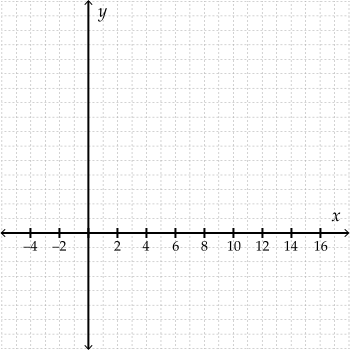
We've already identified the zeros, which are \(0\) and \(9\).

The graph has the zeros of 0 and 9 marked.

The coefficient \(-5\) indicates that the parabola opens down.

This is enough to create a rough sketch.

The graph shows a rough sketch of a downward facing parabola with zeros at 0 and 9.

From the sketch, we can see that \(y \le 0\) when \(x \le 0\) or when \(x \ge 9\).
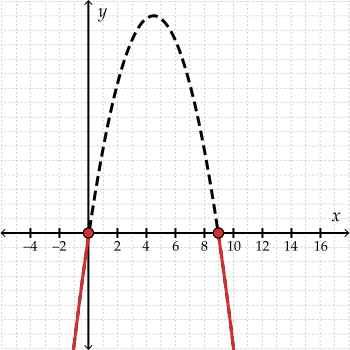
This confirms our solution, \(-5x^2 +45x \leq 0\), when \(x \leq 0\) or \(x \geq 9\).

Summary — Solving Quadratic Inequalities

To solve a quadratic inequality:

  1. Ensure that one side of the inequality equals \(0\). 
  2. Factor the other side. 
  3. Choose one of the following methods:
    • Sketch a graph.
    • Analyze the different cases that arise from the factors.
    • Complete a sign analysis (i.e., with a table).

If the resulting quadratic expression in the inequality is not factorable, it's still possible to complete a sign analysis if you can find the zeros some other way. For example, by using the quadratic formula.

If there aren't any zeros, the inequality can be solved quite quickly with a graph.


Check Your Understanding 4

Question — Version 1

Solve \(x^2-11x+18 \gt 0\) algebraically. Determine if each set of numbers is part of the solution.

  1. \(x \lt 2\)
  2. \(x = 2\)
  3. \( 2 \lt x \lt 9\)
  4. \(x = 9\)
  5. \(x \gt 9\)

Answer — Version 1

  1. Yes
  2. No
  3. No
  4. No
  5. Yes

Feedback — Version 1

To solve \(x^2-11x+18 \gt 0\), first factor the inequality to \((x-2)(x-9) \gt 0\).

Using sign analysis we get the following table:

  \(x \lt 2\) \(2 \lt x \lt 9\) \(x \gt 9\)
\(x-2\) \(-\) \(+\) \(+\)
\(x-9\) \(-\) \(-\) \(+\)
\((x-2)(x-9)\) \(+\) \(-\) \(+\)

Therefore, \((x-2)(x-9) \gt 0\) when \(x \lt 2\) or when \(x \gt 9\).

Question — Version 2

Solve \(-3x^2-21x-18 \gt 0\) algebraically. Determine if each set of numbers is part of the solution.

  1. \(x \lt -6\)
  2. \(x = -6\)
  3. \(-6 \lt x \lt -1\)
  4. \(x = -1\)
  5. \(x \gt -1\)

Answer — Version 2

  1. No
  2. No
  3. Yes
  4. No
  5. No

Feedback — Version 2

To solve \(-3x^2-21x-18 \gt 0\), first factor the inequality to \(-3(x+6)(x+1) \gt 0\).

Using sign analysis we get the following table:

  \(x \lt -6\) \(-6 \lt x \lt -1\) \(x \gt -1\)
\(-3\) \(-\) \(-\) \(-\)
\(x+6\) \(-\) \(+\) \(+\)
\(x+1\) \(-\) \(-\) \(+\)
\(-3(x+6)(x+1)\) \(-\) \(+\) \(-\)

Therefore, \(-3(x+6)(x+1) \gt 0\) when \(-6 \lt x \lt -1\).

Question — Version 3

Solve \(2x^2 \ge -10x\) algebraically. Determine if each set of numbers is part of the solution.

  1. \(x \lt -5\)
  2. \(x = -5\)
  3. \(-5 \lt x \lt 0\)
  4. \(x = 0\)
  5. \(x \gt 0\)

Answer — Version 3

  1. Yes
  2. Yes
  3. No
  4. Yes
  5. Yes

Feedback — Version 3

To solve \(2x^2 \ge -10x\), first rearrange the inequality to \(2x^2+10x \ge 0\) and then factor to \(2x(x+5) \ge 0\).

Using sign analysis we get the following table:

  \(x \lt -5\) \(-5 \lt x \lt 0\) \(x \gt 0\)
\(2x\) \(-\) \(-\) \(+\)
\(x+5\) \(-\) \(+\) \(+\)
\(2x(x+5)\) \(+\) \(-\) \(+\)

Therefore, \(2x(x+5) \gt 0\) when \(x \lt -5\) or when \(x \gt 0\). In addition, \(2x(x+5)=0\) when \(x=-5\) or when \(x=0\).

So the solution to the inequality is \(x \le -5\) or \(x \ge 0\).

Question — Version 4

Solve \(x^2-3x \le 28\) algebraically. Determine if each set of numbers is part of the solution.

  1. \(x \lt -4\)
  2. \(x = -4\)
  3. \(-4 \lt x \lt 7\)
  4. \(x = 7\)
  5. \(x \gt 7\)

Answer — Version 4

  1. No
  2. Yes
  3. Yes
  4. Yes
  5. No

Feedback — Version 4

To solve \(x^2-3x \le 28\), first rearrange the inequality to \(x^2-3x-28 \le 0\) and then factor to \((x+4)(x-7) \le 0\).

Using sign analysis we get the following table:

  \(x \lt -4\) \(-4 \lt x \lt 7\) \(x \gt 7\)
\(x+4\) \(-\) \(+\) \(+\)
\(x-7\) \(-\) \(-\) \(+\)
\((x+4)(x-7)\) \(+\) \(-\) \(+\)

Therefore, \((x+4)(x-7) \lt 0\) when \(-4 \lt x \lt 7\). In addition, \((x+4)(x-7)=0\) when \(x=-4\) or when \(x=7\).

So the solution to the inequality is \(-4 \le x \le 7\).


Special Cases of Quadratic Inequalities

Now let's look at some special cases of quadratic inequalities.

If \(x\) and \(h\) both represent real numbers, then it is always true that \((x+h)^2 \geq 0\) (since squaring any real number results in a non-negative real number).  

Conversely, the inequality \((x+h)^2 \lt 0\) will have no real solutions.

For example, \((x-7)^2 \lt 0\) has no real solutions. Let's visualize this with a graph.  

Here is the graph of \(f(x)=(x-7)^2\). The only zero is at \(7\), and the parabola opens up.  

We can see that there are no points on the curve with \(y \lt 0\).

Thus, \((x-7)^2 \lt 0\) has no real solutions. 

Example 5

Solve each of the following inequalities.

  1. \(x^2+16 \leq 8x\)
  2. \(-2(x+5)(x+7) \leq 2\)
  3. \(x^2-6x+4 \gt -5\)

Solution — Part A

Make one side of the inequality \(0\), and factor:

\(\begin{align*} x^2+16 &\leq 8x \\ x^2-8x+16 &\leq 0 \\ (x-4)^2 &\leq 0\end{align*}\)

We can never have \((x-4)^2 \lt 0\), so the only possible solution is when \((x-4)^2=0\), or when \(x=4\). 

Solution — Part B

Divide both sides by \(-2\), and remember to reverse the direction of the inequality:

\(\begin{align*} -2(x+5)(x+7) &\leq 2 \\ (x+5)(x+7) &\geq -1\end{align*} \)

Expand, make one side of the inequality \(0\), then factor: 

\(\begin{align*} x^2 + 12x + 35 &\geq -1 \\ x^2 + 12x + 36 &\geq 0 \\ (x+6)^2 &\geq 0 \end{align*}\)

This statement will be true no matter what \(x\) is, so the solution to the inequality is \(x \in \mathbb{R}\) (any real number). 

Solution — Part C

Make one side of the inequality \(0\), and factor:

\(\begin{align*}x^2-6x+4 &\gt -5 \\ x^2 -6x +9 &\gt 0 \\ (x-3)^2 &\gt 0\end{align*}\)

We know that \((x-3)^2 \geq 0\) for any value of \(x\). However, we need to exclude the case where \((x-3)^2 =0\), which happens when \(x=3\).  

So \((x-3)^2 \gt 0\) for any real value of \(x\) except for \(3\). The solution to this inequality is \(x \neq 3\), \(x \in \mathbb{R}\). 

Here is the number line representation of this solution.

A number line with a open dot at 3 and arrows extending in both directions.


Applying Quadratic Inequalities


Example 6

Sumaya is making T-shirts. The cost per T-shirt in dollars is a function of the number of T-shirts she makes: \(C(x)=0.005x^2-0.9x+50\), where \(x\) is the number of T-shirts she makes each week.

Sumaya would like to keep the cost per T-shirt below \($22\). How many T-shirts should she make in a week?

Solution

If we want the cost to be less than \($22\), we need \(C(x) \lt 22\) or \(0.005x^2-0.9x+50 \lt 22\). 

Make one side of the inequality \(0\), divide both sides by \(0.005\) and then factor:

\(\begin{align*} 0.005x^2-0.9x+28 &\lt 0 \\ x^2 - 180x+5600 &\lt 0 \\ (x-40)(x-140) &\lt 0 \end{align*} \)

Complete a sign analysis:

  \(x \lt 40\) \(40 \lt x \lt 140\) \(x \gt 140\)
\(x-140\) \(-\) \(-\) \(+\)
\(x-40\) \(-\) \(+\) \(+\)
\((x-40)(x-140)\) \(+\) \(-\) \(+\)

\((x-40)(x-140)\lt 0\) when \(40 \lt x \lt 140\).

So \(C(x) \lt 22\) when \(40 \lt x \lt 140\).

Sumaya should make more than \(40\) but less than \(140\) T-shirts each week. 

Example 7

An object is free-falling towards the ground. Until it hits the ground, its height above the ground, \(h\) in metres, is modelled by the function \(h(t)=-5t^2+12~500\), where \(t\) represents the number of seconds after the object is dropped. 

  1. Identify any restrictions on \(t\) based on the context.
  2. For how long is the object at a height of \(4500\) metres or less?

Solution — Part A

In this context, time can't be negative, so one restriction is \(t \geq 0\). 

Similarly, the height can't be negative, so \(h(t) \geq 0\).

This gives us an inequality that we can solve for \(t\): \(-5t^2+12\,500 \geq 0\).

Divide both sides by \(-5\) and then factor:

\(\begin{align*} t^2-2500 &\leq 0 \\ (t+50)(t-50) &\leq 0 \end{align*}\)

Complete a sign analysis:

  \(t \lt -50\) \(-50 \lt t \lt 50\) \(t \gt 50\)
\(t-50\) \(-\) \(-\) \(+\)
\(t+50\) \(-\) \(+\) \(+\)
\((t+50)(t-50)\) \(+\) \(-\) \(+\)

\((t+50)(t-50) \lt 0\) when \(-50 \lt t \lt 50\), and \((t+50)(t-50)=0\) when \(t=-50\) or \(t=50\).

The solution to \((t+50)(t-50) \le 0\) is equivalent to the solution to \(h(t) \ge 0\).

So \(h(t) \geq 0\) when \(-50 \leq t \leq 50\).

Combined with the restriction that \(t \geq 0\), overall we need to have \(0 \leq t \leq 50\).

Solution — Part B

A height of \(4500\) metres or less corresponds to \(h(t) \leq 4500\). 

This means that \(-5t^2+12500 \leq 4500\).

Make one side of the inequality \(0\), divide both sides by \(-5\), then factor:

\(\begin{align*} -5t^2+8000 &\leq 0 \\ t^2 - 1600 &\geq 0 \\ (t+40)(t-40) & \geq 0 \end{align*}\)

After performing a sign analysis, or considering the graph of \(f(x)=(x+40)(x-40)\), we find that

\((t+40)(t-40) \ge 0\) when \(t \le -40\) or \(t \ge 40\). 

So \(h(t) \leq 4500\) when \(t \leq -40\) or \(t \geq 40\). 

Combined with the restriction that \(0 \leq t \leq 50\), this means that \(40 \leq t \leq 50\). This is a range of \(10\) seconds. 

Therefore, the object is at a height of \(4500\) metres or less for \(10\) seconds. 


Wrap-Up


Lesson Summary

  • Interval notation is used to represent the set of all real numbers between two endpoints. The two endpoints are listed within a set of brackets. 
    • A square bracket, \([\) or \(]\), indicates that the endpoint is included in the interval.
    • A rounded bracket, \((\) or \()\), indicates that the endpoint is not included in the interval.
  • When solving an inequality, operations such as addition, subtraction, multiplication, and division can be applied to both sides of the inequality.  
    • However, when multiplying or dividing both sides of an inequality by a negative number, the direction of the inequality must be reversed.  
  • In a compound inequality where two or more inequalities are joined by the word "and," the solution must satisfy all of the individual inequalities. When two or more inequalities are joined by the word "or," the solution only needs to satisfy one of the individual inequalities. 
  • To solve a quadratic inequality in a single variable:
    1. Ensure that one side of the inequality equals \(0\). 
    2. Factor the other side. 
    3. Choose one of the following methods:
      • Sketch a graph
      • Analyze the different cases that arise from the factors
      • Complete a sign analysis (i.e., with a table) 

Take It With You

Use sign analysis to solve the inequality \(-2(x-1)^2(x+2)(x-5) \gt 0\).