Alternative Format — Lesson 1: The Pythagorean Theorem

Let's Start Thinking

What Is an Aspect Ratio?

The shape of a screen depends on the aspect ratio.

Aspect ratio is the ratio of the width to the height of an image or a screen.

The two most common aspect ratios are widescreen, with a width to height ratio of \(16:9\), and full screen, with a ratio of \(4:3\).

Wide screen computer monitor with ratio 16 to 9.

Full screen computer monitor with 4 to 3 ratio.

The \(4:3\) ratio was the standard for filming early movies, an influence in manufacturing of television and computers. The current standard for high-definition television is the \(16:9\) ratio.


Lesson Goals

  • Recognize the connections between the geometric and algebraic representations of the Pythagorean Theorem.
  • Solve for the missing length of a right triangle.
  • Develop and apply the converse of the Pythagorean Theorem.

Try This: Comparing Computer Monitors

In an electronics store, two computer monitors are both described to have a ‌\(19\) inch screen, but their rectangular shapes are not congruent. The width of Monitor 1 is \(16.4\) inches and its height is \(9.2\) inches. Monitor 2 has a width of \(15.2\) inches and a height of \(11.4\) inches.

Monitor 1

Monitor with width 16.4 inches and height 9.2 inches.

Monitor 2

Monitor with width 15.2 inches and height 11.4 inches.

  1. Retailers list the sizes of computer monitors and televisions as a single number. How are the sizes of computer monitors and televisions determined?
  2. How would you calculate the size of each monitor using the given dimensions?

The Pythagorean Relationship


Right Triangle Terminology

A triangle that contains a right angle is called a right triangle.

Recall that the sum of the three angles in any triangle must be \(180^\circ\).

So consider a right triangle \(ABC\). If \(\angle A = 90^{\circ}\), which of the following is always true about \(\angle B\):

  1. less than \(90^{\circ}\)
  2. equal to \(90^{\circ}\)
  3. greater than \(90^{\circ}\)

Solution 

Since the sum of the three angles must be \(180^{\circ}\), and since \(\angle A = 90^{\circ}\), we know that the sum of the remaining two angles must be \(90^\circ\). So, 

\(\angle B + \angle C = 90^\circ\)

We conclude that both \(\angle B\) and \(\angle C\) must always be less than \(90^\circ\). 

What this tells us is that in a right triangle, the \(90^\circ\) angle is the largest angle.

You might remember from an earlier geometry lesson that the largest side of a triangle is always opposite to the largest angle. And so we call the largest side of a right triangle the hypotenuse. The other two sides of the triangle are called legs. The two legs meet at the \(90^\circ\) angle.

Squares on the Sides of Right Triangles

Many thousands of years ago, a Greek mathematician named Pythagoras drew squares on the sides of a right triangle to examine the relationship between the side lengths of the triangle.

He drew these squares so that one side of the largest square is the hypotenuse of the right triangle, one side of the smallest square is the smallest side of the right triangle, and one side of the remaining square is the remaining side of the right triangle.

Pythagoras discovered that the areas of these three squares were related.

Use the following investigation to explore the relationship between the areas of the squares drawn on the three sides of a right triangle.

Explore This 1

Description

How does the sum of the areas of the two smaller squares relate to the area of the larger square?
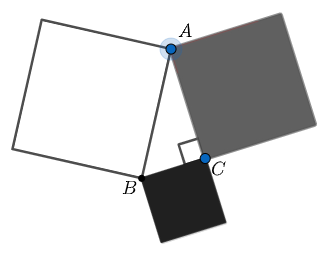
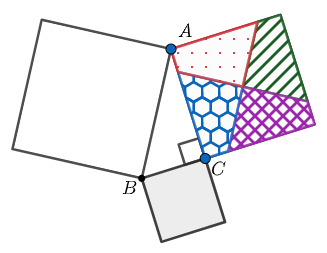
Triangle ABC has a right angle at C. Squares are drawn on each leg of the triangle. The side lengths of the squares are the same lengths as the corresponding triangle leg.

Observe the following steps.

Step 1

The square of the longest non-hypotenuse leg is divided into four congruent quadrilaterals.

Step 2

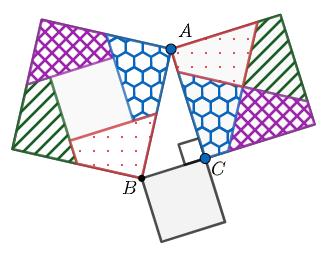
The four quadrilaterals and the smallest square are rearranged to fill the square of the hypotenuse.

Interactive Version

Explore Pythagorean Theorem

The Pythagorean Relationship

Did you notice that the five pieces that made up the smaller two squares also fit perfectly inside the larger square?
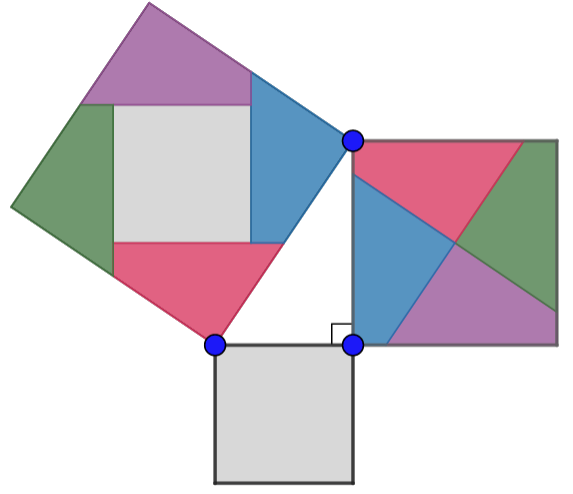
This tells us that the area of the large square must be equal to the sum of the areas of the two smaller squares. This important property of right triangles is called the Pythagorean Relationship.

The Pythagorean Relationship

For a right triangle: 

The area of the square on the hypotenuse is equal to the sum of the areas of the squares on the other two sides.

Example 1

The areas of the squares on two legs of a right triangle are \(8\) cm2 and \(12\) cm2.

What is the area of the square on the hypotenuse?

Solution

Let's start by letting \(A\) represent the area of the square on the hypotenuse of the right triangle. 

By the Pythagorean Relationship, the area of the square on the hypotenuse is equal to the sum of the areas of the squares on the two legs. The result is

\[\begin{align*} A &= 8+12 \\ &= 20 \end{align*}\]

Therefore, the area of the square on the hypotenuse is \(20\) cm2.

Example 2

The square on the hypotenuse of a right triangle has an area of \(34\) cm2.
The square on one leg has an area of \(16\) cm2.

What is the area of the square on the remaining leg of the right triangle?

Solution

Let's start by letting \(A\) represent the area of the square on the remaining leg of the right triangle.

By the Pythagorean Relationship, the area of the square on the hypotenuse is equal to the sum of the areas of the squares on the two legs. The result is

\[34 = A + 16\]

Notice that this time, the unknown area is on the right side of the equation, and so finding the missing area is less straightforward than in our previous example.

But for us, this is not a problem, because we know how to solve for \(A\). We can subtract \(16\) from both sides of the equation.

\[\begin{align*} 34 \class{hl2}{-16} &= A + 16 \class{hl2}{-16} \\ 18 &= A \end{align*}\]

Therefore, the area of the square on the remaining leg is \(18\) cm2.

Check Your Understanding 1

Question — Version 1

The square on the hypotenuse of a right triangle has an area of \(106\) m2. The square on one leg has an area of \(39\) m2. What is the area of the square on the remaining leg of the triangle?

Answer — Version 1

\(67\) m2

Feedback — Version 1

We will start by letting \(A\) represent the area of the square on the remaining leg.

The Pythagorean relationship tell us the area of the square on the hypotenuse is equal to the sum of the areas of the squares on the two legs. So,

\[\begin{align*} 106 &= A + 39 \\ 106 - 39 &= A + 39 - 39 \\ 67 &= A\end{align*}\]

Therefore, the area of the square on the remaining leg is \(67\) m2.

Question — Version 2

The square on one leg of a right triangle has an area of \(18\) cm2. The square on the other leg has an area of \(64\) cm2. What is the area of the square on the hypotenuse of the right triangle?

Answer — Version 2

\(82\) cm2

Feedback — Version 2

We will start by letting \(C\) represent the area of the square on the hypotenuse.

The Pythagorean relationship tell us the area of the square on the hypotenuse is equal to the sum of the areas of the squares on the two legs. So,

\[\begin{align*} C &= 18 + 64 \\ C &= 82 \end{align*}\]

Therefore, the area of the square on the hypotenuse is \(82\) cm2.


The Pythagorean Theorem


We can restate the Pythagorean relationship using algebra.

The Pythagorean Theorem

In a right triangle, where \(c\) represents the length of the hypotenuse, and \(a\) and \(b\) represent the lengths of the two legs,

  • the area of the square on the hypotenuse is \(c^2\) and
  • the areas of the squares on the two legs are \(a^2\) and \(b^2\) squared.

So the equation we can write is

\[c^2 = a^2 + b^2\]

Try This Revisited — Part A

In an electronics store, two computer monitors are both described to have a ‌\(19\) inch screen, but their rectangular shapes are not congruent.

  1. Retailers list the sizes of computer monitors and televisions as a single number. How are the sizes of computer monitors and televisions determined?

Solution — Part A

The sizes of monitors and televisions are described by the length of their diagonals, not their width and height. Notice that the diagonal of the monitors corresponds to the hypotenuse of right triangles.

Monitor 1

The diagonal is the hypotenuse of the triangle with side lengths 16.4 and 9.2 inches.

Monitor 2

The diagonal is the hypotenuse of the triangle with side lengths 15.2 and 11.4 inches.

Try This Revisited — Part B

The width of Monitor 1 is \(16.4\) inches and its height is \(9.2\) inches. Monitor 2 has a width of \(15.2\) inches and a height of \(11.4\) inches.

  1. How would you calculate the size of each monitor using the given dimensions?

Solution — Part B

Since a monitor is described by the length of its diagonal and the width and height are the lengths of the legs of a right triangle, we can apply the Pythagorean Theorem.

Monitor 1

The diagonal is the hypotenuse, labelled h, of the triangle with side lengths 16.4 and 9.2 inches.

Let \(h\) represent the length of the hypotenuse of Monitor 1, \(h\gt0\).

By the Pythagorean Theorem, the resulting equation is

\[h^2 = (16.4)^2 + (9.2)^2\]

Simplifying the equation, we find

\[\begin{align*} h^2 &= 268.96 + 84.64 \\ h^2 &= 353.6 \end{align*}\]

Algebraically, \(h\) could be the positive or negative square root of \(353.6\). But since we know the diagonal must be positive, we choose only the positive root. Solving for \(h\), we find

\[\begin{align*} h &= \sqrt{353.6} \\ &= 18.804 \dots \end{align*}\]

Therefore, the diagonal of Monitor 1 has an approximate length of \(18.8\) inches, or close to \(19\) inches.

Monitor 2

The diagonal is the hypotenuse, labelled k, of the triangle with side lengths 15.2 and 11.4 inches.

Let \(k\) represent the length of the diagonal (hypotenuse) of Monitor 2.

Applying the Pythagorean Theorem, again, the equation is

\[k^2=(15.2)^2+(11.4)^2\]

Simplifying the equation, we find

\[\begin{align*} k^2 &= 234.04+129.96 \\ k^2 &= 361 \end{align*}\]

Choosing the positive root for \(k\),

\[\begin{align*} k &= \sqrt{361} \\ &=19,\text{ since } k \gt 0 \end{align*}\]

Therefore, the diagonal of Monitor 2 has a length of exactly \(19\) inches.

Even though Monitor 1 and Monitor 2 are different shapes, they are both \(19\) inch monitors.


Check Your Understanding 2

Question

The length of one leg of a right triangle is \(4\) km and the length of the other leg is \(13\) km. What is the length of the hypotenuse?

Round your answer to \(1\) decimal place.

Answer

\(13.6\) km

Feedback

Let \(c\) represent the length of the hypotenuse in kilometres.

The Pythagorean Theorem says

\[\begin{align*} c^2 &= a^2 + b^2 \\ c^2 &= 4^2 + 13^2 \\ c^2 &= 16 +169 \\ c^2 &= 185 \\ c &= \sqrt{185} \\ &\approx 13.6 \end{align*}\]

Therefore, the length of the hypotenuse is approximately \(13.6\) km.


The Pythagorean Theorem Explained


Example 3

The hypotenuse of a right triangle is \(25\) cm and the length of one leg is \(7\) cm. What are the perimeter and the area of the triangle?

Solution

To find the perimeter of the triangle, we need to know all three of the side lengths, but the question only gives us \(2\). Drawing a diagram with the missing side length labelled as \(a\) can help us to decide what to do next.

Let \(a\) cm be the length of the missing leg.

Triangle ABC with leg lengths b equals 7 and a equals a cm and hypotenuse c equals 25 cm.

Since this is a right triangle, we can apply the Pythagorean Theorem and substitute the information we know.

\[\begin{align*} c^2 &=a^2+b^2 \\ 25^2 &=a^2+7^2 \\ 625 &=a^2+49 \end{align*}\]

Subtracting \(49\) from both sides of the equation, we find

\[\begin{align*} 625-49 &=a^2+49-49 \\ a^2 &=576 \end{align*}\]

Since \(a \gt 0\), solving for  \(a\), we get \(a=24\).

We now know that the length of the missing leg is \(24\) cm.

Adding the side lengths of \(7\) cm, \(25\) cm, and the missing \(24\) cm, the perimeter of the triangle is \(7 + 25 + 24 = 56\) cm.

To find the area of the triangle, we need the height of \(7\) cm and the base of \(24\) cm. So \(\dfrac{1}{2}(7)(24)=84\) cm2.

Therefore, the perimeter of the triangle is \(56\) cm and the area of the triangle is \(84\) cm2.

Example 4

Robert is looking to buy a new television to put in a space that is \(45\) inches wide and \(35\) inches high. Could a fullscreen or a widescreen \(54\)-inch television fit in this space?

Solution — Fullscreen

We don't know the width or the height of the television, but we do know that they are in the ratio of \(4:3\), so we will use this to help make expressions for each dimension.

Let \(4x\) represent the width of the television in inches and \(3x\) the height of the television in inches.

Right triangle with legs 4x and 3x and hypotenuse along the diagonal of 54.

Applying the Pythagorean theorem, we get

\[\begin{align*} \left( 4x \right)^2 + \left( 3x \right)^2 &=54^2 \end{align*}\]

Simplifying and collecting the like terms, we get

\[\begin{align*} 16x^2 + 9x^2 &= 2916 \\ 25x^2 &= 2916 \\ \dfrac{25x^2}{25} &= \dfrac{2916}{25}\\ x^2 &= \dfrac{2916}{25} \\ x &=\sqrt{\dfrac{2916}{25}} \\&= 10.8 \end{align*}\]

Therefore, the width is \(4x = 4(10.8) = 43.2\) inches and the height is \(3x = 3(10.8) = 32.4\) inches.

The available space is \(45\) inches by \(35\) inches. Since both of the dimensions are smaller than the dimensions of the space, Robert could safely buy a full screen television.

Solution — Widescreen

For a widescreen television, we know that the aspect ratio is \(16:9\).

Let \(16y\) represent the width in inches and \(9y\) the height in inches.

Right triangle with legs 16y and 9y and hypotenuse along the diagonal of 54.

Solving for \(y\), we find,

\[\begin{align*} \left( 16y \right)^2 + \left( 9y \right)^2 &= 54^2 \\ 256y^2 + 81y^2 &=2916 \\ \dfrac{337y^2}{337} &= \dfrac{2916}{337} \\ y^2 &= \dfrac{2916}{337} \\ y &=\sqrt{\dfrac{2916}{337}} \\ &= 2.94\ldots \end{align*}\]

The width is \(16y =16(2.94\ldots) \approx 47.1\) inches and the height is \(9y = 9(2.94\ldots) \approx 26.5\) inches.

While the height of the television will fit in the space, the width of the television is too big. Robert should definitely not buy a widescreen television.


Check Your Understanding 3

Question

The length of one leg of a right triangle is \(22\) cm. The length of the hypotenuse is \(26\) cm. What is the length of the remaining leg of the right triangle?

Round your answer to \(1\) decimal place.

Answer

\(13.9\) cm

Feedback

Let \(a\) represent the length of the remaining side in centimetres.

The Pythagorean Theorem says

\[\begin{align*} c^2 &= a^2 + b^2 \\ 26^2 &= a^2 + 22^2 \\ 676 &= a^2 + 484 \\ 676 - 484 &= a^2 + 484 - 484 \\ a^2 &= 192 \\ a &= \sqrt{192} \\ a &\approx 13.9 \end{align*}\]

Therefore, the length of the remaining side is approximately \(13.9\) centimetres.


Explore This 2

Description

How do the parts of Square 1 relate to the parts of Square 2?

Square 1

Image Description

An outer square \(ACEG\) has side length \(a+b\).

An inner square \(BDFH\) has side length \(c\), with \(B\) on \(AC\), \(D\) on \(CE\), \(F\) on \(EG\), and \(H\) on \(AG\) such that

  • \(AB = CD = EF = GH = a\) and
  • \(BC = CE = FG = AH = b\).

Notice that this forms \(4\) congruent right triangles:

  • \(\triangle{BAH}\)
  • \(\triangle{BCD}\)
  • \(\triangle{DEF}\)
  • \(\triangle{FGH}\)

Square 2

Image Description

An outer square \(IKMO\) has side length \(a+b\).

Point \(P\) is on \(IO\) and point \(L\) is on \(KM\) such that \(IP = KL = a\) and \(PO = LM =b\).

Point \(J\) is on \(IK\) and point \(N\) is on \(MO\) such that \(IJ = ON = a\) and \(JK = NM = b\).

Lines \(JN\) and \(PL\) intersect at point \(Q\), forming \(4\) rectangles:

  • \(IJQP\)
  • \(JQLK\)
  • \(QNML\)
  • \(PONQ\)

Notice that \(IJQP\) has area \(a^2\), \(QNML\) has area \(b^2\), and \(JQLK\) and \(PONQ\) are congruent.

Observe that the triangles from Square 1 (\(\triangle{BAH}\), \(\triangle{BCD}\), \(\triangle{DEF}\), and \(\triangle{FGH}\)) can be translated to cover \(JQKL\) and \(PONQ\) in Square 2.

Square 1

Square 2

Interactive Version

Geometric Proof of Pythagorean Theorem

Explore This 2 Summary

In Explore This 2, did you notice the following?

Observation 1

Both Square 1 and Square 2 have the same side length of \((a + b)\), so their areas are the same.

Square 1

Image Description

Recall: An outer square \(ACEG\) with inner square \(BDFH\) that has side length \(c\), with \(B\) on \(AC\), \(D\) on \(CE\), \(F\) on \(EG\), and \(H\) on \(AG\) such that

  • \(AB = CD = EF = GH = a\) and
  • \(BC = CE = FG = AH = b\).

Square 2

Image Description

Recall: An outer square \(IKMO\) where

  • point \(P\) is on \(IO\) and point \(L\) is on \(KM\) such that \(IP = KL = a\) and \(PO = LM =b\), and
  • point \(J\) is on \(IK\) and point \(N\) is on \(MO\) such that \(IJ = ON = a\) and \(JK = NM = b\).

Observation 2

The four congruent triangles in Square 1 (\(\triangle{BAH}\), \(\triangle{BCD}\), \(\triangle{DEF}\), and \(\triangle{FGH}\)) fit perfectly inside the two congruent rectangles in Square 2 (\(JQLK\) and \(PONQ\)).

Square 1

The triangles are right angled with side lengths a, b, and hypotenuse c.

Square 2

 Recall: Rectangles PONQ and JQLK have side lengths a and b.

Observation 3

Lastly, you might have noticed that there is a smaller square in Square 1, and there are two smaller squares in Square 2.

Square 1

Inner square BDFH has side length c and area c squared.

Square 2

Recall: IJQP has area a squared and QNML has area b squared.

Coming up, we are going to make use of all of these observations to help us explain why the Pythagorean Theorem works.

Proving The Pythagorean Theorem

Square 1 is made up of a smaller square (\(BDFH\)) and four congruent triangles (\(\triangle{BAH}\), \(\triangle{BCD}\), \(\triangle{DEF}\), and \(\triangle{FGH}\)).

We can determine expressions for the areas of each of these pieces: \(c^2\) for the square and \(\dfrac{1}{2} ab\) for each of the triangles. Simplifying this, we get the following.

Area of Square 1:

\[\begin{align*} A_1 &=c^2+4 \left( \dfrac{1}{2} ab \right) \\ &=c^2+2ab \end{align*}\]

Square 1

See adjacent alternative format for square 1 description

Image Description (Repeated from Explore This 2):

An outer square \(ACEG\) has side length \(a+b\).

An inner square \(BDFH\) has side length \(c\), with \(B\) on \(AC\), \(D\) on \(CE\), \(F\) on \(EG\), and \(H\) on \(AG\) such that

  • \(AB = CD = EF = GH = a\) and
  • \(BC = CE = FG = AH = b\).

Notice that this forms \(4\) congruent right triangles:

  • \(\triangle{BAH}\)
  • \(\triangle{BCD}\)
  • \(\triangle{DEF}\)
  • \(\triangle{FGH}\)

Square 2 is made up of two smaller squares (\(IJQP\) and \(QNML\)) and two congruent rectangles (\(JQLK\) and \(PONQ\)).

The expressions for the areas of each of these pieces is the following.

Area of Square 2:

\[\begin{align*} A_2 &=a^2+b^2+2(ab) \\ &=a^2+b^2+2ab \end{align*}\]

Square 2

See adjacent alternative format for square 2 description

Image Description (Repeated from Explore This 2):

Point \(P\) is on \(IO\) and point \(L\) is on \(KM\) such that \(IP = KL = a\) and \(PO = LM =b\).

Point \(J\) is on \(IK\) and point \(N\) is on \(MO\) such that \(IJ = ON = a\) and \(JK = NM = b\).

Lines \(JN\) and \(PL\) intersect at point \(Q\), forming \(4\) rectangles:

  • \(IJQP\)
  • \(JQLK\)
  • \(QNML\)
  • \(PONQ\)

Notice that \(IJQP\) has area \(a^2\), \(QNML\) has area \(b^2\), and \(JQLK\) and \(PONQ\) are congruent.

Square 1 and Square 2 have the same area, so the two expressions must be equal.

\[\begin{align*} c^2+2ab &=a^2+b^2+2ab \end{align*}\]

Subtracting \(2ab\) from each side, we are left with the formula for the Pythagorean Theorem.

\[\begin{align*} c^2+2ab-2ab &=a^2+b^2+2ab-2ab \\ c^2 &=a^2+b^2 \end{align*}\]

Converse of the Pythagorean Theorem


What Is a Converse?

The Pythagorean Theorem is a conditional statement. It could be rewritten as

If a triangle has a right angle,

then the sum of the squares of the two shorter side lengths is equal to the square of the longest side length. 

A converse is a statement when the two parts of a conditional statement are reversed.

Given the statement if \(P\), then \(Q\), the converse is if \(Q\), then \(P\).

The converse of the Pythagorean Theorem would be written as

If the sum of the squares of the two shorter side lengths is equal to the square of the longest side length,

then the triangle has a right angle.

This is an interesting idea, but is it true? Let's explore this.

Explore This 3

Description

How do the areas of the squares on sides \(a\) and \(b\) of the triangle compare to the area of the square on side \(c\)?

Option 1

  • \(a^2 = 162\)
  • \(b^2 = 50\)
  • \(c^2 = 212\)

The areas a squared and b squared perfectly fill the area of c squared. The triangle is right angled.

Option 2

  • \(a^2 = 108.8\)
  • \(b^2 = 50\)
  • \(c^2 = 123\)

The areas a squared and b squared overflow the area of c squared. The triangle is acute.

Option 3

  • \(a^2 = 147\)
  • \(b^2 = 50\)
  • \(c^2 = 306.3\)

The areas a squared and b squared do not completely fill the area of c squared. The triangle is obtuse.

Interactive Version

Pythagorean Theorem

Summary of Explore This 3

Did you notice that when the area of the square on the longest side length of triangle \(ABC\) is

  • equal to the sum of the areas of the squares on the two shorter side lengths, \(\angle C\) is exactly \(90^{\circ}\)?

\(\angle C = 90^{\circ}\)

  • less than the sum of the areas of the squares on the two shorter side lengths, \(\angle C\) is less than \(90^{\circ}\)?

\(\angle C = 84.3^{\circ}\)

  • greater than the sum of the areas of the squares on the two shorter side lengths, \(\angle C\) is greater than \(90^{\circ}\)?

\(\angle C = 95.7^{\circ}\)

This is a powerful tool that we can use when we know the side lengths of a triangle and we want to determine if it is a right triangle.


The Converse of the Pythagorean Theorem

The summary of Explore This 3 can be rewritten algebraically using the side lengths of the triangle.

The Converse of the Pythagorean Theorem

In \(\triangle ABC\), if \(c\) is the longest side and

  • if \(c^2 \gt a^2+b^2\),
    then \(\angle{C} \gt 90^{\circ}\).
    Triangle ABC where angle C is obtuse and angles A and B are acute.
    \(\angle{C}\) is an obtuse angle.
  • if \(c^2=a^2+b^2\),
    then \(\angle{C} = 90^{\circ}\).
    Right triangle ABC.
    \(\angle{C}\) is a right angle.
  • if \(c^2 \lt a^2+b^2\),
    then \(\angle{C} \lt 90^{\circ}\).
    Triangle ABC where all angles are acute.
    \(\angle{C}\) is an acute angle.

Example 4

A triangle has side lengths of \(5\) cm, \(7\) cm, and \(9\) cm. Is this a right triangle? 

Solution

Using the Converse of the Pythagorean Theorem, we need to find the sum of the squares of the lengths of the two shorter sides and compare it to the square of the length of the longest side of the triangle

\(\begin{align*}a^2+b^2& =5^2+7^2 \\ & =25+49 \\ & =74\end{align*}\)

Also, notice

\[c^2=9^2=81\]

Since \(c^2 \gt a^2+b^2\), this is not a right triangle. It is an obtuse triangle since the angle opposite the \(9\) cm side is greater than \(90^{\circ}\).


Check Your Understanding 4

Question — Version 1

A triangle has side lengths \(13\) cm, \(6\) cm, and \(15\) cm. What type of triangle is it?

  1. Acute Triangle
  2. Right Triangle
  3. Obtuse Triangle

Answer — Version 1

  1. Obtuse Triangle

Feedback — Version 1

Using the converse of the Pythagorean Theorem, we need to find the sums of the squares of the lengths of the two shorter sides and compare it to the square of the length of the longest side of the triangle.

\[\begin{align*} a^2 + b^2 &= 13^2 + 6^2 \\ &= 169 + 36 \\ &= 205 \end{align*}\]

Also, notice

\[\begin{align*} c^2 &= 15^2 \\ &= 225 \end{align*}\]

Since \(c^2 \gt a^2 + b^2\), this is an obtuse triangle.

Question — Version 2

A triangle has side lengths \(13\) cm, \(10\) cm, and \(15\) cm. What type of triangle is it?

  1. Acute Triangle
  2. Right Triangle
  3. Obtuse Triangle

Answer — Version 2

  1. Acute Triangle

Feedback — Version 2

Using the converse of the Pythagorean Theorem, we need to find the sums of the squares of the lengths of the two shorter sides and compare it to the square of the length of the longest side of the triangle.

\[\begin{align*} a^2 + b^2 &= 13^2 + 10^2 \\ &= 169 + 100 \\ &= 269 \end{align*}\]

Also, notice

\[\begin{align*} c^2 &= 15^2 \\ &= 225 \end{align*}\]

Since \(c^2 \lt a^2 + b^2\), this is an acute triangle.


Wrap-Up


Lesson Summary

In this lesson, we learned the following:

  • The Pythagorean Theorem

    In a right triangle \(ABC\), where \(c\) represents the length of the hypotenuse and \(a\) and \(b\) represent the length of the two legs, we have the following relationship:

    \[c^2 = a^2 + b^2\]

  • Applications of the Pythagorean Theorem
    • Finding the length of a missing side of a right triangle.
    • Diagonals are used to describe the size of an image or screen.
  • The Converse of the Pythagorean Theorem

    In \(\triangle ABC\), if \(c\) is the longest side, then

    • if \(c^2 \lt a^2 + b^2\), then \(\angle{C} \lt 90^{\circ}\);
    • if \(c^2 = a^2 + b^2\), then \(\angle{C} = 90^{\circ}\); and
    • if \(c^2 \gt a^2 + b^2\), then \(\angle{C} \gt 90^{\circ}\).

Take It With You — Pythagorean Triples

For a right triangle with leg lengths of \(3\) and \(4\), the length of the hypotenuse is \(5\).

For a right triangle with leg lengths of \(5\) and \(12\), the length of the hypotenuse is \(13\).

Notice that each of the side lengths of these triangles is an integer.

The sets \((3,~4,~5)\) and \((5, ~12,~ 13)\) are called Pythagorean triples.

Did You Know?

A Pythagorean triple is a set of three positive integers \((a, b, c)\) where \(c^2 = a^2 + b^2\).

Can you find other Pythagorean triples?