Questions 1 and 2 refer to the following figure.
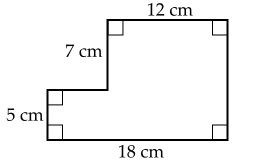
- Calculate the perimeter of the figure in two different ways: one that involves determining the lengths of all the segments in the diagram, and one that does not.
- Calculate the area of the figure in two different ways: one that involves addition and one that involves subtraction.
Questions 3 to 5 refer to the following information.
Michael is building a swimming pool in the shape of a rectangle with a semi-circle attached to the shorter side. The dimensions of the rectangular part of the pool is \(4.3\) m by \(8.5\) m. The pool will be surrounded on all sides by a cement deck \(1\) m wide.
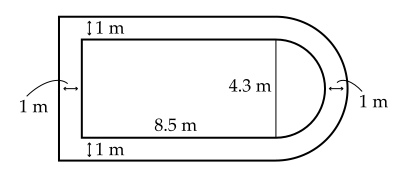
- Michael wants to buy a pool cover that will just cover his pool.
If the pool cover material costs \($11.50\)/m2, what will be the total cost of the cover?
- What is the area of the cement needed to create the deck?
- Michael needs to build a fence around the entire pool and deck area. He already has a \(1.5\) m wide gate but needs to buy the rest of the fencing. What length of fencing does he need?
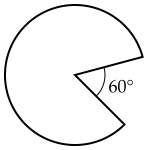
- The shape below has an area of \(100\) cm2. What is the perimeter of the shape?
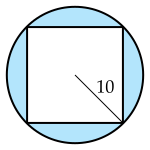
- In Figure 1, a circle with radius \(10\) is inscribed in a square. In Figure 2, a square is inscribed in a circle of radius \(10\). In each figure, the area between the two shapes is shaded. Which figure has the greater shaded area?
Figure 1
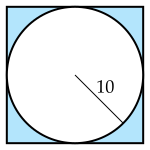
Figure 2
- Hunter has two shapes, Shape 1 and Shape 2. He can makes a Composite shape by adding Shape 2 to Shape 1 or by subtracting Shape 2 from Shape 1.
- What could Shape 1 and Shape 2 be so that the perimeter of the Composite shape is less than the perimeter of Shape 1?
- What could Shape 1 and Shape 2 be so that the perimeter of the Composite shape is equal to the perimeter of Shape 1?
- What could Shape 1 and Shape 2 be so that the perimeter of the Composite shape is greater than the perimeter of Shape 1?
Questions 9 and 10 refer to the following information.
A composite shape is formed by two overlapping congruent circles with radius \(8\) cm and centres \(A\) and \(C\). The circles intersect at points \(B\) and \(D\) so that \(ABCD\) is a square.
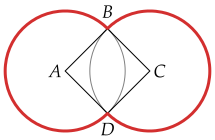
- Determine the perimeter of the composite figure.
- Calculate the area of the composite figure.