Example 2
A cone, sphere, and a cylinder all have the same radius and the same height. What is the relationship between their volumes?
Solution
If the cylinder and the cone have the same height as the sphere, their heights are \(2r\).
Recalling the formula for the following volumes and substituting \(h=2r\) we get:
\[\begin{align*} V_{\text{Cone}} &=\frac{1}{3}\pi r^2h\\ & =\frac{1}{3}\pi r^2\left(2r\right)\\ &=\frac{2}{3}\pi r^3 \end{align*}\]
\[V_{\text{Sphere}}=\frac{4}{3}\pi r^3\]
\[\begin{align*} V_{\text{Cylinder}}&=\pi r^2h\\ &=\pi r^2\left(2r\right)\\ &=2\pi r^3 \end{align*}\]
We know that the volume of the cone is one-third of the volume of the cylinder since they have the same base and height.
Notice that the volume of the sphere is double the volume of the cone. Therefore, the sphere's volume is two-thirds the volume of the cylinder.
Example 3
A box of golf balls has the shape of a rectangular prism. Each box contains \(3\) rows of \(4\) golf balls. The diameter of a golf ball is \(42.7\) mm.
How much empty space is in the box?
Solution
The height of the box is \(1\) ball or \(42.7\) mm, the width is \(4\left(42.7\right)=170.8\) mm, and the length is \(3\left(42.7\right)=128.1\) mm.
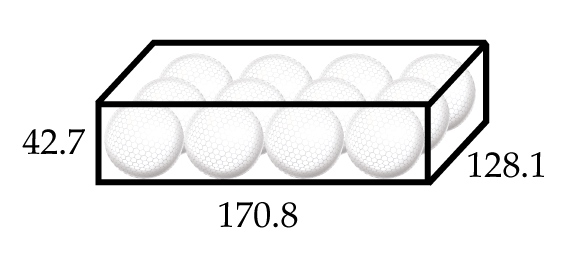
Source: Golf Ball - pikepicture/iStock/Getty Images
We can use this information to determine the volume of the box:
\[\begin{align*} V_{\text{Box}}&=lwh\\ &=42.7\left(170.8\right)\left(128.1\right)\\ &=934~253.796 \end{align*}\]
The radius of a golf ball is \(21.35\) mm. We can use this information to determine the volume of one golf ball:
\[\begin{align*} V_{\text{Ball}}&=\frac{4}{3}\pi r^3\\ &=\frac{4}{3}\pi \left(21.35^3\right)\\ &= 40~764.51\ldots \end{align*}\]
Subtracting the volume of the \(12\) balls from the volume of the box, we get the volume of empty space.
\[\begin{align*} V_{\text{Empty Space}}&=V_{\text{Box}}-12V_{\text{Ball}} \\ & = 934\:253.796-12\left(40~764.51\ldots\right) \\ & = 445~079.65\ldots \end{align*}\]
The volume of empty space in the box is approximately \(445~079.7\) mm3 or \(445.08\) cm3.
Example 4
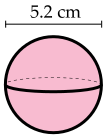
A spherical scoop of ice cream has a diameter of \(5.2\) cm.
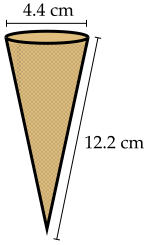
It is put on an ice cream cone with a diameter of \(4.4\) cm and a slant height of \(12.2\) cm.
If the ice cream is left to melt and drip inside the cone, will it overflow the cone?
Solution
To determine if the melted ice cream will overflow the cone, we need to compare their volumes.
Ice Cream
Cone
The radius of the scoop of ice cream is half of the diameter or \(2.6\) cm. We can use this to determine the volume of the ice cream scoop:
\[\begin{align*} V_{\text{Ice Cream}} & =\frac{4}{3}\pi r^3\\ & =\frac{4}{3}\pi \left(2.6^3\right)\\ & = 73.62\ldots \end{align*}\]
The radius of the cone is \(2.2\) cm and the slant height is \(12.2\) cm. We can use this information to form a right triangle.
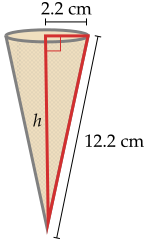
Applying the Pythagorean Theorem, we can find the height:
\[\begin{align*} h&=\sqrt{s^2-r^2}\\ &=\sqrt{12.2^2-2.2^2}\\ &=12 \end{align*}\]
Therefore, the height of the cone is \(12\) cm.
Moreover, we can determine the volume of the cone:
\[\begin{align*} V_{\text{Cone}}& =\frac{1}{3}\pi r^2 h\\ & =\frac{1}{3}\pi \left(2.2^2\right)\left(12\right) \\ &= 60.82\ldots \end{align*}\]
We found that the volume of the ice cream is approximately \(73.6\) cm3 and the volume of the cone is approximately \(60.8\) cm3. Since the volume of ice cream is greater than the volume of the cone, the melted ice cream will overflow.