Volume and Surface Area of Optimal Cylinders
Recall
The optimal cylinder has a height that is double its radius.
Let's investigate how this relationship affects the formulas for its volume and surface area.
Let \(r\) represent the radius and \(h=2r\) represent the height of the cylinder.
We will substitute \(h=2r\) into each formula so that \(r\) is the only unknown dimension and then simplify.
Volume
\[\begin{align*} V&=\pi r^2 h \\ V&=\pi r^2 \left(2r\right) \\ V&=2\pi r^3 \end{align*}\]
Surface Area
\[\begin{align*} SA&=2\pi r^2 +2\pi rh \\ SA&=2\pi r^2 +2\pi r\left(2r\right) \\ SA&=2\pi r^2 + 4\pi r^2 \\ SA&=6\pi r^2 \end{align*}\]
The volume and surface area formulas for the optimal cylinder only depend on the radius, \(r\).
- \(V=2\pi r^3\)
- \(SA=6\pi r^2\)
You know that for a cube, its surface area is made of \(6\) squares.
Did you notice that for the "cube-like" cylinder, its surface area is equal to that of \(6\) circles?
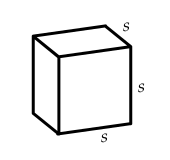
\(SA = 6\left(s^2\right)\)
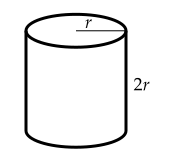
\(SA=6\left(\pi r^2\right)\)
Example 4
A cylindrical container of peanuts has a volume of \(450\) cm3. What is the minimum amount of cardboard needed to make the container? Round your answer to 1 decimal place.
Solution
For the minimum amount of cardboard, we must have an optimal cylinder with
- \(V=2\pi r^3\)
- \(SA=6\pi r^2\)
We know the volume is \(450\) cm3 so we can substitute and solve for \(r\).
\[\begin{align*} V&=2\pi r^3\\ 450&=2\pi r^3\\ r^3&=\dfrac{450}{2\pi}\\ r&=\sqrt[3]{\dfrac{225}{\pi}}\\ r&= 4.15\ldots \end{align*}\]
Now, we can calculate the minimum surface area.
\[\begin{align*} SA&=6\pi r^2\\ SA&= 6\pi \left(4.15\ldots\right)^2\\ SA&= 325.07\ldots \\ \end{align*}\]
The minimum amount of cardboard needed is approximately \(325.1\) cm2.