Alternative Format — Lesson 2: Angle Properties of Triangles

Let's Start Thinking

Triangles

Triangles are important shapes. Triangles are used often in the following scenarios:

  • Construction or engineering because of the stability that they provide. 
    A ridge beam supporting the roof of a building.
  • Trigonometry because properties of right triangles are used to calculate unknown distances.
    A triangle ABC where AC is 10 km and angle BAC is 2 degrees. A train is at vertex A, we are looking for the distance of side BC.

Understanding the angle relationships in triangles will prepare you for the study of trigonometry later in your math lessons. Understanding the angle relationships in triangles also helps us understand angle relationships in other polygons. This is because all other polygons can be constructed by joining triangles.

In this lesson, we are going to focus on the properties of the interior and exterior angles of a triangle. We will solve problems using these properties.


Lesson Goals

  • Determine the sum of the interior angles of a triangle
  • Determine the sum of the exterior angles of a triangle
  • Explore other relationships between interior and exterior angles, particularly in different types of triangles
  • Use angle relationships in triangles to:
    • solve for missing angles
    • classify triangles
    • identify whether conjectures are true or false

Try This

In an isosceles triangle, one of the angle measures is twice the other. What type of triangle could this be (acute, right, or obtuse)? 


Classifying Triangles


Triangles

A triangle is made of three points, called vertices, connected by three line segments, called edges (or sides). 

The name of a triangle consists of its three vertices.

A triangle where the vertices are labelled A, B, and C.

For example, this triangle is called \(\triangle ABC\) (although it could also be called \(\triangle BAC\), or any other possible ordering of the vertices). 

The three angles which lie on the inside of the triangle, at each of the vertices, are called interior angles

For example, the acute angles \(\angle ABC\), \(\angle BAC\) and \(\angle ACB\) are the interior angles of this triangle. 


When naming the interior angles of a triangle, we often shorten the notation to consist of the vertex only. For example, 

  • \(\angle BAC\) is named \(\angle A\)
  • \(\angle ABC\) is named \(\angle B\)
  • \(\angle ACB\) is named \(\angle C\) 

Note that this is only done if the interior angles are not ambiguous (i.e., if it is clear to which triangle and which angles we are referring) . 

Classifying Triangles by Side Lengths 

One way to classify triangles is by examining their side lengths. There are three types of triangles that arise when we do this:

  • An equilateral triangle, which has all three sides equal in length,

    The sides of the equilateral triangle all measure 5 centimetres.

  • An isosceles triangle, which has two sides equal in length, and

    Two of the sides of an isosceles triangle measure 5 centimetres, the third side has a length of 6 centimetres.

  • A scalene triangle, which has three sides that are all different in length.

    The sides of this scalene triangle measure 5, 6, and 8 centimetres.

Since the definition of an isosceles triangle does not say that exactly two sides are equal in length, all equilateral triangles can be considered as isosceles as well. That is, an equilateral triangle is a special case of an isosceles triangle. 

Note: On a diagram, any sides on a triangle that have the same number of tick marks are equal in length.

The sides of an equilateral triangle are marked with identical hash marks to indicate they are all of equal length.

Two of the sides of an isosceles triangle are marked with identical hash marks to indicate they are of equal length. The third side is unmarked.

For example, \(\triangle ABC\) is equilateral, since all three side lengths are equal.

\(\triangle DEF\) is isosceles, since two side lengths are equal. 

A triangle with no tick marks on any of the sides means that none of the side lengths are known to be equal.

Classifying Triangles by Angles 

Another way to classify triangles is by examining the measure of the interior angles. Again, there are three types of triangle:

  • An acute triangle, which has interior angles that are all acute (i.e., all less than \(90^\circ\)).

    The angles in this acute triangle measure, 70 degrees, 70 degrees, and 40 degrees.

  • A right triangle, which has one interior angle of \(90^\circ\) (i.e., one right angle).

    The angles of this right triangle measure 70 degrees, 90 degrees, and 20 degrees.

  • An obtuse triangle, which has one obtuse interior angle (i.e., one interior angle greater than \(90^\circ\)).

    The angles of this obtuse triangle measure 20 degrees, 140 degrees, and 20 degrees.

These classifications will be used frequently throughout this lesson.

Did You Know?

Triangles that are not right triangles are known as oblique triangles. This means that both acute triangles and obtuse triangles are oblique triangles.


The Interior Angles of a Triangle


In this section, we will be exploring the relationship between the three interior angles of a triangle.


Explore This 1

Description

In the following investigation, what is the relationship between angles in a triangle? Do you notice something regardless of the size, and/or shape of the triangle that you create? Also notice what happens to the sum of the interior angles.

The following are examples of different triangles you could have created. 

Example 1

An acute triangle with interior angles of 78, 66, and 36 degrees.

Sum of interior angles: \(78^\circ + 66^\circ + 36^\circ= 180^\circ\)

Example 2

A right triangle with interior angles of 64, 90, and 26 degrees.

Sum of interior angles: \(64^\circ + 90^\circ + 26^\circ= 180^\circ\)

Example 3

An obtuse triangle with interior angles of 14, 16, and 150 degrees.

Sum of interior angles: \(14^\circ + 16^\circ + 150^\circ= 180^\circ\)

Interactive Version

Interior Angles in a Triangle


Explore This Summary

You may have noticed that, no matter what type of triangle you constructed, the three interior angles of the triangle always added to \(180^\circ\).


Sum of the Interior Angles of a Triangle

In the first Explore This activity, we saw an important fact about triangles.

The interior angles of a triangle have a sum of \(180^\circ\)

You can verify this for yourself by creating a triangle on paper and cutting it out.

Cut out of a triangle.

Mark each of the interior angles so you can keep track of them

The interior angles of a triangle are labelled angle a, b, and c.

If you rip or cut the corners off of the triangle,

you can reassemble them so that the angles all share the same vertex.

You will find that, all together, the three angles form a straight line, and so they must add to \(180^\circ\).

Justifying the Sum of Interior Angles

The fact that the sum of the interior angles of a triangle is \(180^\circ\) can be justified using some other geometric relationships.

Start by drawing \(\triangle ABC\). We can label the measures of interior angles of this triangle using \(a^\circ\) at vertex \(A\), \(b^\circ\) at vertex \(B\), and \(c^\circ\) at vertex \(C\).

Draw a line segment \(PQ\) through vertex \(A\) that is parallel to edge of the triangle \(BC\).

Now the figure contains two parallel line segments, with two of the sides of the triangle, \(AB\) and \(AC\), acting as transversals. That means that we can use the properties of parallel lines in a transversal to help answer this question. 

Side \(AB\), along with the parallel line segments, creates a pair of alternate angles, interior \(\angle b\) and \(\angle PAB\).

Alternate angles are equal, so we can mark the measure of \(\angle PAB\) as \(b^\circ\), as well.

Side \(AC\) also creates a pair of alternate angles, interior \(\angle c\) and \(\angle QAC\). 

These two angles are equal, so we can mark the measure of \(\angle QAC\) as \(c^\circ\) too.

Looking at line segment \(PQ\), we can see that the angles marked \(b^\circ\), \(a^\circ\), and \(c^\circ\) share a vertex and form a straight line. 

That means that the measures of these angles must add to \(180^\circ\). So 

\(a+b+c=180\)

But these angles are also the angles that were originally inside the triangle.

So we have just shown that the sum of the interior angles of a triangle is \(180^\circ\).

Now let's use this property of the interior angles of a triangle to determine the measures of some unknown angles.

Example 1

Two of the interior angles of a triangle measure \(79^\circ\) and \(47^\circ\). What is the measure of the third interior angle?

Solution

Although it's possible to answer this question without drawing a diagram, that's always a good strategy to use for a geometry problem. So let's draw a triangle with one angle measuring \(79^\circ\) and a second angle measuring \(47^\circ\).

We can use a variable, such as \(d^\circ\), to represent the measure of the unknown angle.

Given that the sum of the interior angles of a triangle must be \(180^\circ\), we can say that

\( 79+47+d=180 \)

Simplifying and solving, we find that

\(\begin{align*} 79+47+d&=180 \\ 126 + d &\;= 180 \\ d &\;= 54 \end{align*}\)

Therefore, the third interior angle measures \(54^\circ\).

Alternatively:

We can also find the measure of the third interior angle without an equation by subtracting the two known angles from \(180^\circ\). We get that

\(180^\circ-79^\circ-47^\circ=54^\circ\)

Can a Triangle Have More than One Right Angle?

Recall

A triangle is right if it contains one right angle.

You may have wondered why just one right angle. Can a triangle have more than one right angle? Let's use what we know about sum of the interior angles of a triangle to answer this question. Let’s investigate.

Consider \(\triangle PQR\).

Let's assume that there are, in fact, two right angles in this triangle. So \(\angle P=90^\circ\) and \(\angle Q = 90^\circ\).

Recall that

\(\angle P + \angle Q + \angle R = 180^\circ \)

Since \(\angle P\) and \(\angle Q\) are both \(90^\circ\),  \(\angle P+\angle Q = 180^\circ\). 

This means that \(\angle R = 0^\circ\).

It's not possible for a triangle to have an angle of \(0^\circ\) at any of its vertices. If it did, it would just be two sides, one on top of the other. Since this condition is not possible, our assumption that there could be twp \(90^\circ\) angles must have been wrong.

Therefore, a triangle cannot have more than one right angle. 

Note that a similar argument can be made for obtuse triangles, which contains one obtuse angle. A triangle cannot have more than one obtuse angle, either.


Check Your Understanding 1

Question

\(\triangle ABC\) has two known interior angles, \(\angle ABC = 24^\circ\) and \(\angle BAC = 125^\circ\). What is the measure of the missing interior angle, \(\angle ACB\)? 

Answer

The measure of \(\angle ACB\) is \(31^\circ\).

Feedback

Let \(d^\circ\) represent the missing angle, \(\angle ACB\).

The sum of the interior angles of a triangle is \(180^\circ\), so we can solve the following equation:

\(\begin{align*} d+125+24 &= 180 \\ d + 149 &= 180\\ d &= 31\end{align*}\)

Therefore, the measure of \(\angle ACB\) is \(31^\circ\).


Example 2

Given the following diagram, determine the measure of \(\angle BAC\).  

Triangle ADE has point B on line AD and point C on point AE. Line BC is parallel to Line DE. Angle ABC is 75 degrees. Angle AED is 80 degrees.

Solution

Since the line through \(B\) and \(C\) is parallel to the line through \(D\) and \(E\), \(\angle ABC\) is corresponding to \(\angle ADE\) (and the two angles are equal). 

Therefore,  \(\angle ADE = 75^\circ\).

Now consider the larger triangle, \(\triangle ADE\).  \(\angle BAC\) is one of the interior angles of this triangle and we know the measures of the other two interior angles:  \(\angle D=75^\circ\) and \(\angle E=80^\circ\).

Since the interior angles of a triangle add to \(\)\(180^\circ\), \(\angle BAC=180^\circ - 75^\circ-80^\circ\). 

Thus, \(\angle BAC=25^\circ\). 


Note that it would have also been possible to solve this question by finding \(\angle ACB\) first, then considering the smaller triangle \(\triangle ABC\). 

Example 3

\(\triangle RST\) has interior angles \(\angle R=z^\circ\), \(\angle S=\left(\dfrac12z\right)^\circ\) and \(\angle T = (7z+10)^\circ\), for some value of \(z\). 

Is \(\triangle RST\) an acute, right, or obtuse triangle? 

Solution

To classify the triangle as acute, right, or obtuse, we need to know the measures of the interior angles.

To determine the measures of the interior angles, we need to determine the value of \(z\).

We know that the interior angles must have \(\angle R + \angle S + \angle T= 180^\circ\), and so \(z + \left(\dfrac12z\right) + (7z+10)=180\). This equation can be solved for \(z\):

\(\begin{align*} z + \dfrac12z + 7z+10&=180 \\ \dfrac{17}2z+10&=180 \\ 17z+20 &= 360 \\ 17z &= 340 \\ z &= 20\end{align*} \)

We can use the value \(z=20\) to determine the measure of the angles. 

Since \(\angle R = z^\circ\), \(\angle R=20^\circ\).

\(\begin{align*} \angle S &= \left(\dfrac12z \right)^\circ \\ &= \left(\dfrac12(20) \right)^\circ \\ &= 10 ^\circ \end{align*} \)

and 

\(\begin{align*} \angle T &= (7z+10)^\circ \\ &= (7(20)+10)^\circ \\ &= 150^\circ\end{align*} \)

Since one of the interior angles of the triangle (\(\angle T\)) is greater than \(90^\circ\), \(\triangle RST\) is an obtuse triangle. 


Check Your Understanding 2

Question — Version 1

\(\triangle JKL\) has interior angles \(\angle J = z^\circ\), \(\angle K = \left( \dfrac{1}{4}z \right)^\circ\), and \(\angle L = \left( \dfrac{5}{4} z \right)^\circ\). What is the measure of \(\angle L\)?

Answer — Version 1

The measure of \(\angle L\) is \(90^\circ\).

Feedback — Version 1

Since the sum of the interior angles of a triangle is \(180^\circ\), we can solve the following equation for \(z\):

\(\begin{align*} z + \dfrac{1}{4}z + \dfrac{5}{4}z & = 180 \\ \dfrac{4}{4} z + \dfrac{1}{4}z + \dfrac{5}{4}z & = 180 \\ \dfrac{10}{4}z &= 180 \\ z &= 180 \cdot \dfrac{4}{10} \\ z &= 72 \end{align*}\)

Use the value of \(z\) to determine the measure of \(\angle L\):

\(\begin{align*} \angle L &= \dfrac{5}{4}z \\ &= \dfrac{5}{4}(72) \\ &= 90\end{align*}\)

Therefore, the measure of \(\angle L\) is \(90^\circ\).

Question — Version 2

\(\triangle PQR\) has interior angles \(\angle P = x^\circ\), \(\angle Q = (2x-10)^\circ\), and \(\angle R = (4x+15)^\circ\). What is the measure of \(\angle R\)?

Answer — Version 2

The measure of \(\angle R\) is \(115^\circ\).

Feedback — Version 2

Since the interior angles of a triangle have a sum of \(180^\circ\), we can solve the following equation for \(x\):

\(\begin{align*} x + 2x - 10 + 4x + 15 &= 180 \\ 7x + 5 &= 180 \\ 7x & = 175 \\ x &= 25 \end{align*}\)

Use the value of \(x\) to determine the measure of \(\angle R\):

\(\begin{align*} \angle R &= (4x+15)^\circ \\ &=(4(25)+15)^\circ \\ &= 115^\circ \end{align*}\)

Therefore, the measure of \(\angle R\) is \(115^\circ\).


Conjectures and Counterexamples

In geometry, we often make conjectures. A conjecture is a statement that has not been proven to be true, but for which there is some evidence to suggest that it might be true. It is usually much easier to demonstrate that a conjecture is false than it is to prove that a conjecture is true. 

One counterexample (which is an example that contradicts the conjecture) is enough to demonstrate that a conjecture is false. 

For instance, in a previous example we found an obtuse triangle containing a \(10^\circ\) angle. This may lead us to make the conjecture that all triangles that contain a \(10^\circ\) angle are obtuse. We will explore this statement further in the next example.  

Example 4

Confirm or deny the following conjecture: If a triangle has one interior angle measuring \(10^\circ\), it must be an obtuse triangle.  

Solution

In a previous question, we saw that it is possible for a triangle to have interior angles of \(10^\circ\), \(20^\circ\), and \(150^\circ\). 

Triangle RST is an obtuse triangle where angle S measures 10 degrees, angle R measures 20 degrees, and angle T measures 150 degrees.

This triangle is obtuse, and so it is an example that supports the conjecture.

However, it is also possible to have a triangle with interior angles of \(10^\circ\), \(85^\circ\) and \(85^\circ\). This is because \(10^\circ+85^\circ+85^\circ=180^\circ\). 

Triangle ABC has angles A and C both measuring 85 degrees and angle B measuring 10 degrees.

This triangle is acute (since all of the angles are less than \(90^\circ\)), so we have found a counterexample.

This is enough to demonstrate that the conjecture is false

Although one counterexample is sufficient to demonstrate that a conjecture is false, providing supporting examples does not prove that a conjecture is true (even if you have many supporting examples). To prove that a statement is true, another technique, such as a direct algebraic proof, is needed. 

Example 5

Confirm or deny the following conjecture: If one of the angles in a triangle is a right angle, the other two angles are complementary.  

Solution

Recall

Two angles are complementary if their sum is \(90^\circ\). 

Let's start by examining some examples of right-angled triangles. 

Triangle 1: 

It is possible to have a right-angled triangle where the other two angles are \(70^\circ\) and \(20^\circ\) 

(since \(90^\circ+70^\circ+20^\circ=180^\circ\)).  

A right angle triangle where the interior angles measure 20 degree, 70 degrees, and 90 degrees.

\(70^\circ + 20 ^\circ = 90^\circ\), so \(70^\circ\) and \(20^\circ\) are complementary. 

This example supports the conjecture.

Triangle 2: 

It is also possible to have a right-angled triangle where the other two angles are \(45^\circ\) and \(45^\circ\) (since \(90^\circ+45^\circ+45^\circ=180^\circ\)). 

A triangle where the interior angles measure 45 degrees, 45 degree, and 90 degrees.

\(45^\circ\) and \(45^\circ\) are also complementary. 

This example supports the conjecture as well.

Although our supporting examples are not enough to prove the conjecture, they have helped us to see why it might be true. Let's see if we can prove it in general.

Proof:

Consider the right triangle \(\triangle ABC\). 

Triangle ABC has angle A measuring 90 degrees.

Since the interior angles of a triangle add to \(180^\circ\), \(\angle A + \angle B + \angle C = 180^\circ\). 

However, \(\angle A=90^\circ\), so \( 90^\circ + \angle B + \angle C = 180^\circ\).

It follows that \(\)\(\angle B + \angle C = 90^\circ\), and so \(\angle B\) and \(\angle C\) are complementary. 

Therefore, the statement is true.


Exterior Angles of a Triangle


We've spent some time talking about the interior angles of a triangle, now let's discuss the exterior angles. 

Identifying Exterior Angles

Exterior angles are created by extending one of the sides of the triangle at each vertex. 

In the following triangle, one of the sides at each vertex has been extended producing a new angle at each vertex, these are the exterior angles.
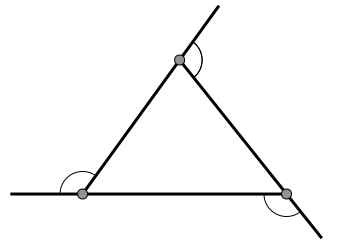
It should be noted that there are actually two ways to create the exterior angles at each vertex since at each vertex, there are two sides that can be extended. 

If we extend the second side at each vertex, we produce even more angles. In fact, there are now two more angles at each vertex.
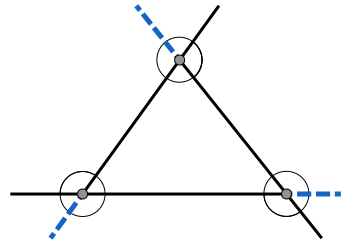
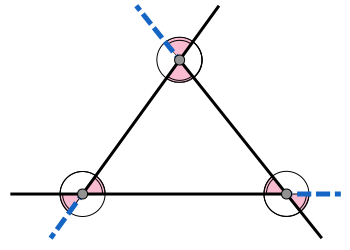
However, one of these new angles is opposite the nearest interior angle so it's equal to that interior angle.
The other new angle at each vertex is opposite to the first exterior angle that we found. So it's equal to that exterior angle.
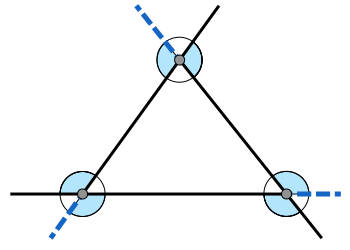
This means that it doesn't matter which side of the triangle you extend. As long as you extend one side at each vertex, you will produce the correct exterior angles.

Relating Exterior and Interior Angles

Let's return to the triangle with only one exterior angle at each vertex.
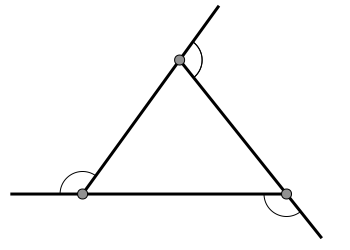
You may have noticed that each interior angle is adjacent to and shares a vertex with an exterior angle. And each pair of interior and exterior angles forms a straight line. 
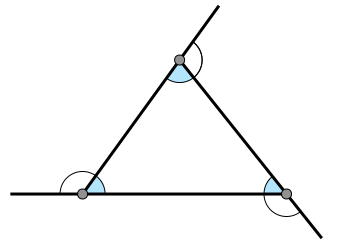
This means that the measures of each exterior angle and the adjacent interior angle add to \(180^\circ\).

We can say this in another way.

The exterior angle at a vertex of a triangle is supplementary to the interior angle found at the same vertex. 

Thus, we can see three pairs of supplementary angles on this diagram.

Let's look at a numerical example of this.

Example 6

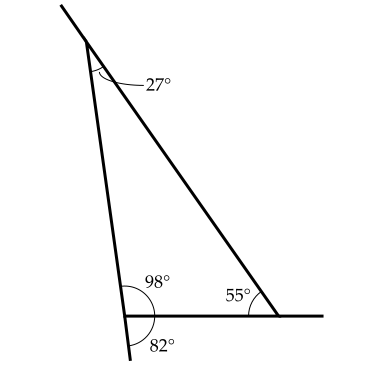
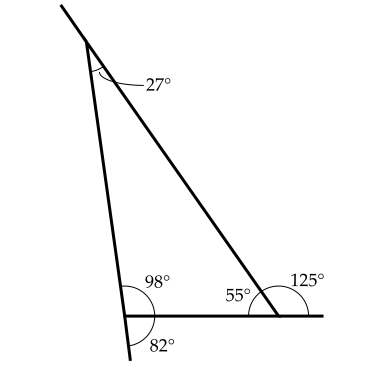
A triangle has interior angles measuring \(98^\circ\), \(55^\circ\), and \(27^\circ\). What are the measures of the exterior angles of this triangle?

Solution

Although it's possible to answer this question without a diagram, drawing one may help us visualize a solution a little bit better. Let's sketch a triangle and mark the interior angles as \(98^\circ\), \(55^\circ\), and \(27^\circ\).
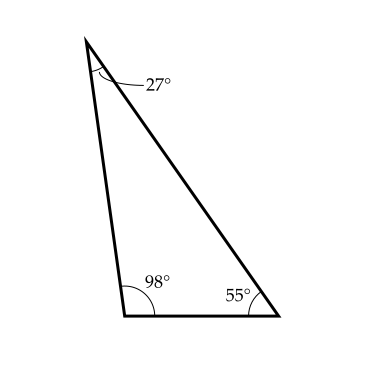
We can even add the exterior angles to this diagram by extending one of the sides at each vertex. 
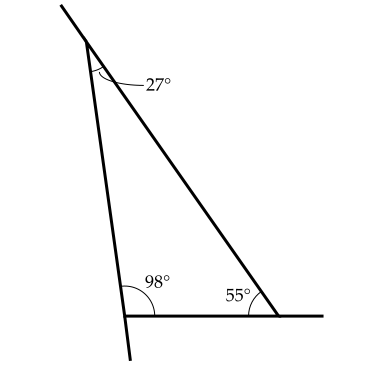
The \(98^\circ\) interior angle is supplementary to the exterior angle right beside it. So that angle must be \(180^\circ-98^\circ=82^\circ\). 
Similarly, the exterior angle adjacent to the \(55^\circ\) interior angle is equal to \(180^\circ-55^\circ=125^\circ\).
The exterior angle next to the \(27^\circ\) interior angle is calculated the same way to obtain a measure of \(180^\circ-27^\circ=153^\circ\).
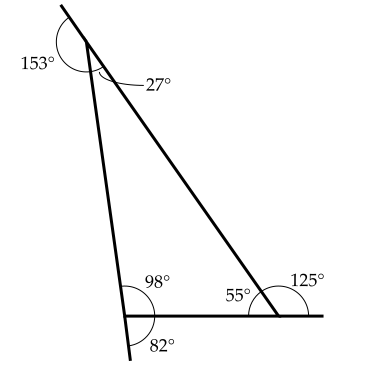
Therefore, the exterior angles are \(82^\circ\), \(125^\circ\), and \(153^\circ\).

Next, you'll have a chance to explore more properties of exterior angles.

Explore This 2

Description

In the following investigation, what is the relationship between the exterior angles in a triangle? Do you notice something regardless of the size, and/or shape of the triangle that you create? Also notice what happens to the sum of the exterior angles.

The following are examples of different triangles you could have created. 

Example 1
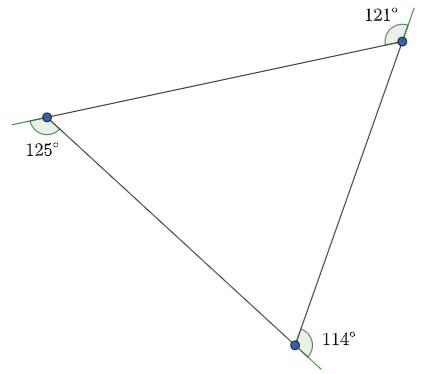
An acute triangle with exterior angles of 121, 125, and 114 degrees.

Sum of exterior angles: \(121^\circ + 125^\circ + 114^\circ= 360^\circ\)

Example 2
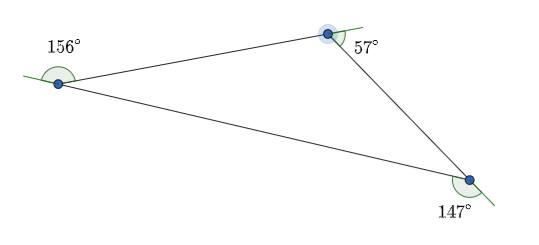
An obtuse triangle with exterior angles of 57, 156, and 147 degrees.

Sum of exterior angles: \(57^\circ + 156^\circ + 147^\circ= 360^\circ\)

Example 3
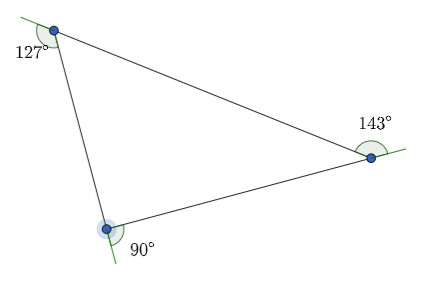
A right triangle with interior angles of 127, 90, and 143 degrees.

Sum of exterior angles: \(127^\circ + 90^\circ + 143^\circ= 360^\circ\)

Interactive Version

Exterior Angles in a Triangle

Explore This 2 Summary

In the Explore This activity, you hopefully noticed an important fact about the exterior angles of a triangle. 

The sum of the exterior angles of a triangle is \(360^\circ\). 

Illustrating the Sum of Exterior Angles

This demonstration might help you to see why this is the case.

Imagine that there is a triangular pathway and you're going to walk around it one time and end up facing the same way you started. 
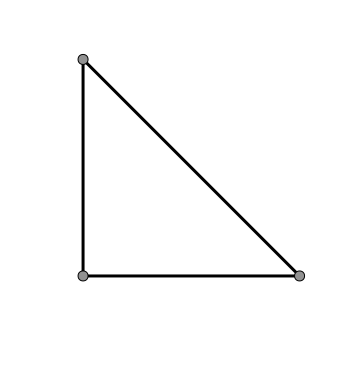
A triangular pathway.

Let's say you start at one vertex facing towards the next vertex.
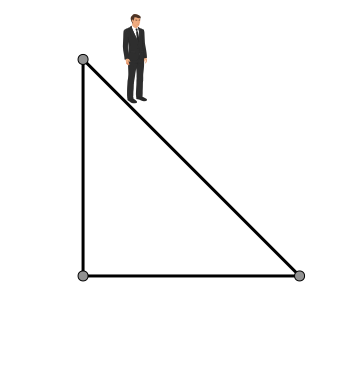
To walk around the path, you need to walk along one side of the triangle.
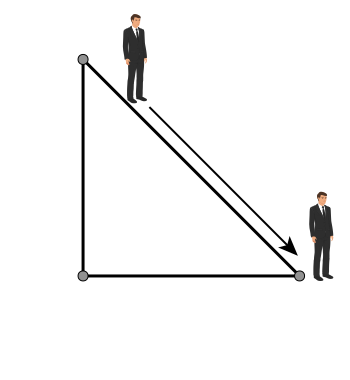
Then, once you reach the second vertex, you need to rotate just enough so that you are pointed in the direction of the next vertex. The amount of rotation is the measure of the exterior angle of the triangle at that vertex.
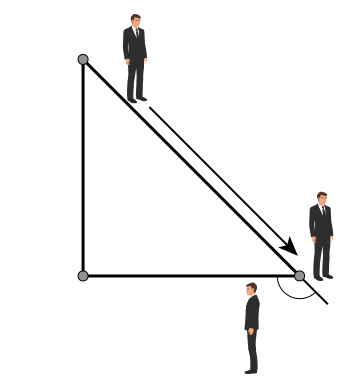
Then, you would walk along the next side.
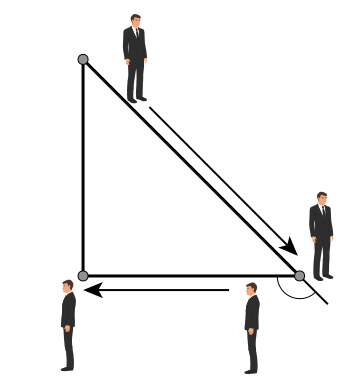
Once you reach the third vertex, you would rotate so that you're facing the direction of the starting vertex, which is another exterior angle. 
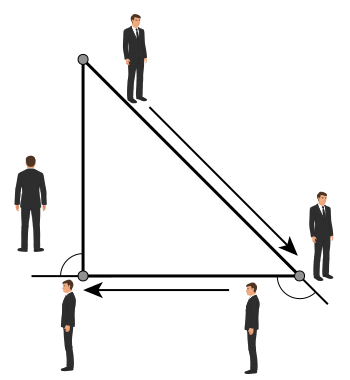
Finally, once you walk along the last side of the triangle and return to your starting position,
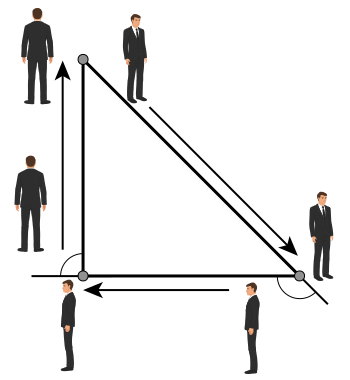
you would rotate enough so that you end up facing in the same direction you started.
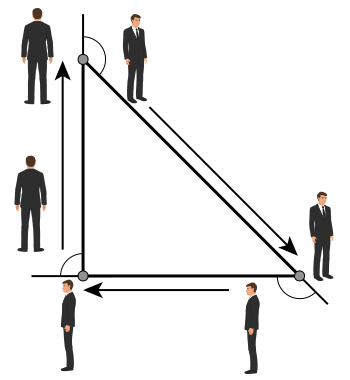
Ignoring how far you would have had to walk, think of how many full turns you would have completed to end up facing in the same direction you started. It would be just one full turn, which is \(360^\circ\).


Check Your Understanding 3

Question

\(\triangle ABC\) has two known exterior angles. The exterior angle at vertex \(B\) is \(100^\circ\) and at vertex \(C\) is \(165^\circ\). What is the measure of the missing exterior angle at vertex \(A\)?

Answer

The measure of the unknown exterior angle is \(95^\circ\).

Feedback

Let \(x^\circ\) represent the measure of the unknown exterior angle.

The sum of the exterior angles of a triangle is \(360^\circ\), so we can solve the following equation:

\(\begin{align*} x + 165 + 100 &= 360 \\ x+265 &= 360 \\ x &= 95 \end{align*}\)

Therefore, the missing exterior angle measures \(95^\circ\).

Note: This can also be determined by subtracting the two given angles from \(360^\circ\), i.e., \(360^\circ - 165^\circ - 100^\circ = 95^\circ\).


Justifying the Sum of the Exterior Angles of a Triangle

Let's consider why the sum of the exterior angles of a triangle is \(360^\circ\). 

Let the measures of the exterior angles be represented by \(d^\circ\), \(e^\circ\), and \(f^\circ\), as indicated in this diagram.

A triangle where the exterior angles measure d degrees, e degrees, and f degrees.

Remember that pairs of adjacent interior and exterior angles are supplementary

So the interior angle adjacent to \(d\) measures \((180-d)^\circ\).

Similarly, the interior angle adjacent to \(e\) measures \((180-e)^\circ\) and the interior angle adjacent to \(f\) measures \((180-f)^\circ\).

Since the sum of the interior angles is \(180^\circ\), we can write that \((180-d)+(180-e)+(180-f)=180\).

Let's simplify and rearrange this equation:

\(\begin{align*} 180-d+180-e+180-f &= 180 \\ 540 - d - e -f &= 180 \\ - d- e - f &= -360 \\ \end{align*} \)

Remember that we can divide both sides of the equation by \(-1\), so \(d+e+f=360\).

Therefore, the exterior angles of a triangle have a sum of \(360^\circ\), as required. 

Example 7 

The exterior angles of a triangle measure \(x^\circ\), \((x-20)^\circ\), and \((x+5)^\circ\). Determine the value of \(x\). 

Solution

The triangle can be drawn like this:

An image of a triangle where the exterior angles measure x degrees, x minus 20 degrees, and x plus 5 degrees.

Since the exterior angles of a triangle add to \(360^\circ\), we can solve the following equation:

\(\begin{align*} x+x-20+x+5&=360 \\ 3x-15 &= 360 \\ 3x &= 375 \\ x &= 125\end{align*}\)

Example 8

 Consider \(\triangle ABC\) below. The exterior angle at vertex \(C\) measures \(110^\circ\), and the exterior angle at vertex \(A\) measures \(95^\circ\). Determine the measure of the interior angle at vertex \(B\), indicated by \(q\) in the diagram. 

Solution

Let \(p\) represent the measure of the exterior angle at vertex \(B\). 

Since the exterior angles of a triangle add to \(360^\circ\), 

\(\begin{align*} p &= 360^\circ - 110^\circ-95^\circ \\ p &= 155^\circ \end{align*} \)

Adjacent interior and exterior angles are supplementary, so \(p+q=180^\circ\). 

This means that \(q =25 ^\circ\). 

Alternate Method:

Since adjacent interior and exterior angles are supplementary, 

  • The interior angle at vertex \(C\) is \(70^\circ\)
  • The interior angle at vertex \(A\) is \(85^\circ\)

The interior angles of a triangle add to \(180^\circ\), so \( q = 180^\circ-70^\circ-85^\circ\), or \(q=25^\circ\).

Example 9

The interior angles at two of the vertices of a triangle are \(15^\circ\) and \(21^\circ\). Determine the measure of the exterior angle at the third vertex, indicated by \(y\) in the diagram. 

A diagram of the described triangle.

Solution

Let \(x\) represent the measure of the remaining interior angle (adjacent to \(y\)). 

Since the interior angles of a triangle add to \(180^\circ\), \(\)\( x = 180^\circ - 15^\circ- 21^\circ \) and so \(x=144^\circ\). 

Adjacent interior and exterior angles are supplementary, so \(x+y=180^\circ\).

This means that \(y=36^\circ\). 

It is interesting to note that \(36^\circ=15^\circ+21^\circ\). In fact, this is a pattern that can be observed on all triangles.


Exterior Angle Theorem

Here we're going to discuss what is known as the exterior angle theorem, which is related to what we observed in a previous example.

Exterior Angle Theorem

The measure of an exterior angle of a triangle is equal to the sum of the two interior angles at the other vertices (i.e., the sum of the two interior angles that are not adjacent to the exterior angle, which are called the remote interior angles).

Let's see how this looks on a triangle. Consider this triangle where \(a^\circ\), \(b^\circ\), and \(c^\circ\) are the interior angles and \(d^\circ\), \(e^\circ\), and \(f^\circ\) are the exterior angles.

We'll start with the exterior \(\angle d\). The theorem states that the measure \(d\) is equal to the sum of the two interior angles at the other two vertices. These two angles are \(b\) and \(c\). Therefore, \(d=b+c\). 

Similarly, we can say that ‌\(e=a+c\),

and \(f=a+b\).

In summary, in this triangle, 

  • \(d=b+c\)
  • \(e=a+c\)
  • \(f=a+b\)

Proof of Exterior Angle Theorem

Let's prove why this is the case. It is enough to show that the relationship holds for one exterior angle.

Let's look at an exterior angle that measures \(d^\circ\) and the non-adjacent, or remote, interior angles that measure \(b^\circ\) and \(c^\circ\).

Recall that the interior angle adjacent to \(d\) is supplementary to \(d\). So the interior angle adjacent to \(d\) has a measure of \((180-d)^\circ\).

We now have measures for all three of the interior angles of the triangle. Since the interior angles of the triangle have a sum of \(180^\circ\), we can say that

\( (180-d)+b+c =180 \)

Removing the brackets and subtracting \(180\) form both sides, we get that

\(\begin{align*} (180-d)+b+c &=180\\ 180-d + b + c &\;= 180 \\ b + c - d &\;= 0 \\ b + c &\;= d \end{align*}\)

Therefore, the measure of an exterior angle is equal to the sum of the measures of the interior angles at the other two vertices, \(b\) and \(c\), as required. 

Now let's use this result in an example.

Example 10

One of the interior angles of a triangle measures \(38^\circ\), while an exterior angle at another vertex measures \(108^\circ\), as shown in the diagram. Determine the measure of the interior angle at the third vertex, indicated by \(k^\circ\). 

Solution

We can use the exterior angle theorem here since the angles \(k^\circ\) and \(38^\circ\) are interior angles that are not adjacent to the exterior angle marked \(108^\circ\). 

Using the Exterior Angle theorem, 

\(\begin{align*} k+38 &= 108 \\ k &\;= 70 \end{align*}\)

It is also possible to solve this and other way. 

Alternate Solution:

We could find the measure of the interior angle adjacent to \(108^\circ\), which is \(72^\circ\). The three interior angles of the triangle add to \(180^\circ\). So

\(\begin{align*} 72+38+k &= 180 \\ k &\;= 70 \end{align*}\)

Therefore, the interior angle at the third vertex measures \(70^\circ\).


Did You Know?

Euclid's Exterior Angle Theorem also relates the interior and exterior angles of a triangle. It states that the measure of an exterior angle of a triangle is greater than either of the measures of the remote interior angles.

For example, in the following diagram, \(a \gt b\) and \(a \gt c\). 

A triangle where two of the interior angles of a triangle measure b and c respectively. The third vertex of a triangle has an exterior angle of a.

You may have noticed that this theorem is not as specific as the Exterior Angle theorem that was discussed earlier in the lesson.

Historical Fact

Euclid was a Greek mathematician who lived around \(300\) BCE. He is most famous for developing a system of geometry (known as Euclidean geometry) which is described in his collection of books called the Elements.


Check Your Understanding 4

Question — Version 1

\(\triangle ABC\) has an interior angle at vertex \(B\) that measures \(35^\circ\), while an exterior angle at vertex \(C\) measures \(97^\circ\), as shown in the following diagram. Determine the measure of the exterior angle at vertex \(A\), indicated by \(x^\circ\).

Answer — Version 1

The value of \(x^\circ\) is \(118^\circ\).

Feedback — Version 1

The exterior angle adjacent to the \(35^\circ\) interior angle at vertex \(B\) measures \(145^\circ\), since those two angles are supplementary. 

The exterior angles of the triangle add to \(360^\circ\), so \(x+145+97=360\). It follows that \(x=118\).

Question — Version 2

\(\triangle ABC\) has an interior angle at vertex \(B\) that measures \(51^\circ\), while an exterior angle at vertex \(C\) measures \(102^\circ\), as shown in the following diagram. Determine the measure of the interior angle at vertex \(A\), indicated by \(x^\circ\).

Answer — Version 2

The value of \(x^\circ\) is \(51^\circ\).

Feedback — Version 2

The interior angle adjacent to the \(102^\circ\) interior angle at vertex \(C\) measures \(78^\circ\), since those two angles are supplementary. 

The interior angles of the triangle add to \(180^\circ\), so \(x+78+51=180\). It follows that \(x=51\).

Question — Version 3

\(\triangle ABC\) has interior angles at vertex \(B\) and \(C\) that measure \(35^\circ\) and \(18^\circ\) respectively, as shown in the following diagram. Determine the measure of the exterior angle at vertex \(A\), indicated by \(x^\circ\).

Answer — Version 3

The value of \(x^\circ\) is \(53^\circ\).

Feedback — Version 3

The measure of an exterior angle is equal to the sum of the interior angles at the other two vertices. So, \(x=18+35=53\).

Therefore, the value of \(x\) is \(53\).


Example 11

Confirm or deny the following statement:

A triangle with an exterior angle of \(100^\circ\) will be an obtuse triangle.

Solution

We begin by examining some triangles that have an exterior angle of \(100^\circ\).  

Triangle 1: 

A triangle with an exterior angle of \(100^\circ\) has an interior angle of \(80^\circ\) (since adjacent interior and exterior angles are supplementary).

By the Exterior Angle Theorem (or since all of the interior angles need to add to \(180^\circ\)), the other two interior angles add to \(100^\circ\). 

So, a triangle with an exterior angle of \(100^\circ\) could have interior angles of \(80^\circ\), \(95^\circ\) and \(5^\circ\).

The exterior angle of 100 degrees has the same vertex as the interior angle of 80 degrees.

This triangle is an obtuse triangle, since it has an interior angle greater than \(90^\circ\).

This example supports the conjecture. Recall, however, that this does not mean that the statement is true.  

Triangle 2: 

A triangle with an exterior angle of \(100^\circ\) could also have interior angles of \(80^\circ\), \(60^\circ\) and \(40^\circ\). 

The exterior angle of 100 degrees has the same vertex as the interior angle of 80 degrees.

This an acute triangle, not an obtuse triangle.

We have found a counterexample, and so the statement is false

Exterior Angles and Acute, Right, and Obtuse Triangles

Here are some notes on the exterior angles of different types of triangles:

  • The interior angles of an acute triangle are all less than \(90^\circ\).
    • It follows that the exterior angles of an acute triangle are all obtuse (i.e., greater than \(90^\circ\)). 
  • One of the interior angles of a right triangle is equal to \(90^\circ\), and the two other interior angles are acute.
    • It follows that one of the exterior angles of a right triangle is \(90^\circ\) and the other two exterior angles are obtuse
  • One of the interior angles of an obtuse triangle is greater than \(90^\circ\), and the two other interior angles are acute.
    • It follows that one of the exterior angles of an obtuse triangle is acute and the other two exterior angles are obtuse.

Example 12

Two of the exterior angles of a triangle are \(157^\circ\) and \(113^\circ\). Classify the triangle as acute, right, or obtuse.

Solution

Both \(157^\circ\) and \(113^\circ\) are obtuse. However, all triangles have at least two obtuse exterior angles. We need to find the third exterior angle.

The third exterior angle is \(360^\circ-157^\circ-113^\circ=90^\circ\).

Therefore, the triangle is a right triangle.

Note: You can verify this result by determining the interior angles of the triangle. 

The interior angle of this triangle measure 23 degrees, 67 degrees, and 90 degrees.


Relating the Sides and Angles of a Triangle


In addition to the relationships between the interior and exterior angles of a triangle, there is also a relationship between the interior angles and sides of a triangle.

A triangle's largest interior angle is opposite to the largest side. 

A triangle's smallest interior angle is opposite to the smallest side. 

A triangle has angles 100 degrees, 50 degrees, and 30 degrees. The side length opposite 100 degrees is 20 centimetres. The side length opposite 50 degrees is 15.56 centimetres, The side length opposite 30 degrees is 10.15 centimetres,

In this triangle, the largest side, \(20\) cm, is opposite to the largest interior angle, \(100^\circ\).

A triangle has angles 90 degrees, 55 degrees, and 35 degrees. The side length opposite 35 degrees is 3.5. The side length opposite 55 degrees is 5. The side length opposite 90 degrees is 6.1.

In this triangle, the smallest side, \(3.5\) units, is opposite to the smallest interior angle, \(35^\circ\).

This relationship leads to the following fact:

If any of a triangle's interior angles are equal, the sides opposite these angles are equal in length.

or

If any of a triangle's sides are equal in length, the interior angles opposite these sides are equal. 

Note that, since the exterior angles of a triangle are supplementary to the adjacent interior angles, a triangle that has two or more equal interior angles will have the same number of equal exterior angles. 

Equilateral Triangles

Recall

An equilateral triangle is a triangle with all three sides equal in length. 

This means that all of the interior angles of an equilateral triangle are equal.

Since the interior angles of a triangle must add to \(180^\circ\), the interior angles of an equilateral triangle are all \(60^\circ\) (since \(3(60^\circ)=180^\circ\)). 

The angle of an equilateral triangle all measure 60 degrees. In this triangles the sides all measure 8 units.

It also follows that all of the exterior angles of an equilateral triangle are equal.

Since the exterior angles of a triangle must add to \(360^\circ\), the exterior angles of an equilateral triangle are all \(120^\circ\) (since \(3(120^\circ)=360^\circ\)). This is also consistent with the fact that adjacent interior and exterior angles are supplementary (as \(60^\circ+120^\circ=180^\circ\)).

To recap:

Each interior angle of an equilateral triangle measures \(60^\circ\).

Each exterior angle of an equilateral triangle measures \(120^\circ\). 

The sides of an equilateral triangle all measure the same length.

Did You Know?

An equiangular triangle is a triangle whose interior angles are equal. Therefore, an equilateral triangle can also be called an equiangular triangle.

Isosceles Triangles

Recall

An isosceles triangle is a triangle that has two sides that are equal in length. 

Since an isosceles triangle has two sides that are equal in length, it must also have two interior angles that are equal in measure (and therefore two exterior angles that are equal in measure). 

In an isosceles triangle, the interior angles opposite the equal sides are equal in measure.

In this triangle each equal angle measure 73 degrees while their opposite sides measure 7 units.  The third angle measures 34 degrees and its opposite side measures 4.1 units.

Example 13

\(\triangle PQR\) is an isosceles triangle with \(\angle P=25^\circ\), \(\angle Q=130^\circ\), and \(\angle R=25^\circ\).

Which of its sides (\(PQ\), \(PR\), and \(QR\)) are equal in length?

Solution

It may help to draw this triangle.

An image of the triangle PQR.

Since \(\angle P\) and \(\angle R\) are equal in measure, the sides opposite these angles will be equal in length. 

Therefore, sides \(QR\) and \(PQ\) are equal in length. 

Example 14

An isosceles triangle has one angle measuring \(57^\circ\), as shown in the diagram. Determine the angle measure indicated by \(d^\circ\). 

The angle measuring 57 degrees is not one of the equal angles in an isosceles triangle. The angle measuring d degrees is opposite one of the equal sides.

Solution

The equal sides of the triangle are indicated in the diagram. The angles opposite these equals sides are equal in measure, so there are two angles in the triangle with a measure of \(d^\circ\).

Since the interior angles of a triangle add to \(180^\circ\), we can solve the following equation to determine the value of \(d\)

\(\begin{align*} d+d+57&=180\\ 2d + 57 &= 180 \\ 2d &= 123 \\ d &= 61.5 \end{align*}\)

Therefore, the required angle measure is \(61.5^\circ\).

Mental Check: \(61.5^\circ+61.5^\circ + 57^\circ = 180^\circ\)

Example 15

An isosceles triangle has an exterior angle measuring \(105^\circ\), as shown in the diagram. Determine the angle measure \(p\). 

The exterior angle measuring 105 degrees is at the same vertex as an interior angle that is across from an equal side. Angle p is an exterior angle at a vertex where the interior angle is not opposite an equal side.

Solution

There are a few different ways to solve this problem. Here are two of the methods.

Method 1

An isosceles triangle has two equal exterior angles, opposite the two equal sides.

So the third exterior angle measures 105 degrees.

Since a triangle's exterior angles must have a sum of \(360^\circ\):

\(\begin{align*} p &= 360 ^\circ - 105 ^\circ - 105^\circ\\ p &= 150 ^\circ \end{align*}\)

Method 2

Since the triangle is isosceles, there are two equal interior angles. 

These interior angles are supplementary to \(105^\circ\), and are equal to \(75^\circ\).

The Exterior Angle theorem states an exterior angle of a triangle is equal to the sum of the interior angles at the other two vertices.

So, \(p=75^\circ+75^\circ\), or \(p=150^\circ\). 


Next, let's practice using the angle properties of isosceles and other triangles on some more complicated figures. 


Check Your Understanding 5

Question — Version 1

\(\triangle ABC\) is an isosceles triangle that with \(\angle ABC\) measuring \(36^\circ\), as shown in the following diagram. Determine the measure of \(\angle BCA\), indicated by \(x^\circ\).

Sides BC and AC are of equal length.

Answer — Version 1

The value of \(x\) is \(108\).

Feedback — Version 1

The angles opposite the equal sides both measure \(36^\circ\).

Since the interior angles of a triangle have a sum of \(180^\circ\), \(x+36+36=180\).

This can be solved to obtain \(x=108\).

Angle BCA is 108 degrees.

Question — Version 2

\(\triangle ABC\) is an isosceles triangle that with \(\angle ACB\) measuring \(28^\circ\), as shown in the following diagram. Determine the measure of \(\angle BAC\), indicated by \(x^\circ\).

 Sides BC and AC are of equal length.

Answer — Version 2

The value of \(x\) is \(76\).

Feedback — Version 2

The angles oppsite the equal sides both have a measure of \(x^\circ\).

Since the interior angles of a triangle have a sum of \(180^\circ\), \(28+x+x=180\).

This equation can be simplified and solved:

\(\begin{align*} 28 + 2x &= 180 \\ 2x &= 152 \\ x &= 76\end{align*}\)

Therefore, the value of \(x\) is \(76\).

Angle ABC and angle BAC are both 76 degrees.


Example 16

For each of the figures, determine the angle measure \(x^\circ\).

Figure A

Line segment AD intersects line segment BE at point C. Line segment AB and line segment DE are drawn creating two triangles. Angle BAC is marked as 15 degree and angle ABC is labelled as x degrees. Angle CDE is labelled as 46 degrees and side CD has the same length as side CE.

Figure B

Isosceles triangle QST is drawn where side QT has the same length as ST. Point R is labelled on QS where angle QRT is 70 degrees, angle RTQ is x degrees and RTS is 10 degrees.

For both of these figures it is impossible to identify \(x\) directly. We are going to need to find the measures of some additional angles first.

Solution — Figure A

Let's start with Figure A. 

Line segment AD intersects line segment BE at point C. Line segment AB and line segment DE are drawn creating two triangles. Angle BAC is marked as 15 degree and angle ABC is labelled as x degrees. Angle CDE is labelled as 46 degrees and side CD has the same length as side CE.

Since we can't find \(x\) directly, we need to look for other angles that we can find more easily. Notice the \(\triangle CDE\) has two equal sides, and so it's isosceles.

Triangle CDE is highlighted where angle CDE is 46 degrees and sides CD and CE are equal.

The angles opposite the two equal sides will be equal. So \(\angle CED=46^\circ\).

If we continue to look at \(\triangle CDE\), we know that its interior angles must add to \(180^\circ\). So the missing angle, \(\angle DCE\), will be 

\(\begin{align*} \angle DCE+46^\circ+46^\circ &= 180^\circ \\ \angle DCE &\;= 88^\circ \end{align*}\)

Now, \(\angle ACB\) and \(\angle DCE\) are opposite angles, so they are equal. This means that \(\angle ACB\) measures \(88^\circ\) as well.

We finally have enough information to determine \(x\) in \(\triangle ABC\).

Triangle ABC is highlighted where angle ABC is x degrees, angle BAC is 15 degrees, and angle ACB is 88 degrees.

The interior angles of \(\triangle ABC\) also add to \(180^\circ\). So 

\(\begin{align*} x+15+88 &= 180 \\ x &\;=77 \end{align*}\)

Therefore, the angle measure indicated by \(x\) is \(77^\circ\).

Solution — Figure B

For Figure B, we also need to find the measures of other angles before finding the value of \(x\).

Isosceles triangle QST is drawn where side QT has the same length as ST. Point R is labelled on QS where angle QRT is 70 degrees, angle RTQ is x degrees and RTS is 10 degrees.

We can see that \(\angle QRT\) and \(\angle SRT\) share a vertex and form a straight line. So they're supplementary. 

This means that these two angles must add to \(180^\circ\). So, \(\angle SRT\) measures \(110^\circ\), since \(\angle QRT\) measures \(70^\circ\).

Now let's look at \(\triangle RST\). 

Triangle RST is highlighted where angle SRT is 110 degrees and angle STR measures 10 degrees.

The interior angles of \(\triangle RST\) must add to \(180^\circ\). So

\(\begin{align*} \angle RST+10^\circ+110^\circ &= 180^\circ \\ \angle RST &\;= 60^\circ \end{align*}\)

Consider the larger \(\triangle QST\). It has two equal sides, so it is isosceles.

Triangle QST is highlighted where angle QST is 60 degrees and sides QT and ST are equal.

This means that two of its angles are equal, \(\angle RST\) and \(\angle RQT\). Thus, \(\angle RQT\) measures \(60^\circ\) as well.

We can finally consider \(\triangle QRT\).

Triangle QRT is highlighted where angle RQT is 60 degrees, angle QRT is 70 degrees, and angle QTR is x degrees.

The interior angles of \(\triangle QRT\) also add to \(180^\circ\). So

\(\begin{align*} x+60+70 &= 180 \\ x &\;= 50 \end{align*}\)

Therefore, the angle indicated by \(x\) measures \(50^\circ\).

Let's take a look at the larger \(\triangle QST\) in Figure B.

Triangle QST where angle QST is 60 degrees and sides QT and ST are equal.

For \(\triangle QST\), the interior \(\angle T\) is

\(\begin{align*} \angle T &= 50^\circ+10^\circ \\ &= 60^\circ \end{align*}\)

The interior angles of \(\triangle QST\) are all \(60^\circ\).

It turns out that \(\triangle QST\) is an equilateral triangle, although we didn't need to know that to solve the question.


Using Angles to Classify Triangles

Because of the relationship between the side lengths and interior angles of a triangle, it is possible to fully classify any triangle using its interior angles alone (without knowing any side lengths).

Here are the different types of triangles:

Type of Triangle Interior Angle Properties: Example
Acute equilateral All angles are equal and less than \(90^\circ\). (In fact, they are all \(60^\circ\).) An equilateral triangle has all three angles measuring 60 degrees.
Acute isosceles Two angles are equal, and all angles are less than \(90^\circ\). An isosceles triangle with one angle measuring 74 degrees, and two angles measuring 53 degrees.
Acute scalene No angles are equal, and all angles are less than \(90^\circ\). A scalene triangle with angles measuring 82, 65, and 33 degrees.
Right isosceles Two angles are equal (both \(45^\circ\)), and one angle equals \(90^\circ\). A right isosceles triangle has one angle measuring 90 degrees and two angles measuring 45 degrees each.
Right scalene No angles are equal, and one angle equals \(90^\circ\). A triangle with angles of 90, 70, and 20 degrees.
Obtuse isosceles Two angles are equal, and one angle is greater than \(90^\circ\). An isosceles triangle has one angle of 150 degrees, and two angles of 15 degrees.
Obtuse scalene No angles are equal, and one angle is greater than \(90^\circ\). A triangle with angles of 105, 45, and 30 degrees.

Note that it is not possible to have a right equilateral or an obtuse equilateral triangle, since an equilateral triangle must have all three interior angles equal to \(60^\circ\). 

Example 17

\(\triangle DEF\) has interior angles \(\angle D=(3y)^\circ\), \(\angle E = \left(\dfrac12y\right)^\circ\), and \(\angle F=(6y-10)^\circ\), for some value of \(y\). Is \(\triangle DEF\) equilateral, isosceles, or scalene? 

Solution

We can classify \(\triangle DEF\) as equilateral, isosceles, or scalene if we know the measure of each of the interior angles. To do this, we need to determine the value of \(y\). 

The sum of the interior angles of a triangle is \(180^\circ\), so we can solve the following equation:

\(\begin{align*} 3y+\dfrac12y+6y-10& =180\\ \dfrac{19}2y - 10 &= 180 \\ \dfrac{19}2y &= 190 \\ 19y &= 380 \\ y &= 20 \end{align*} \)

Now, we can use the value of \(y\) to determine the measures of the interior angles.

\(\begin{align*}\angle D &= (3y)^\circ \\ &= (3(20))^\circ \\ &= 60^\circ\end{align*} \)

\(\begin{align*} \angle E &= \left(\dfrac12 y\right)^\circ \\ &= \left(\dfrac12(20)\right)^\circ \\ &= 10^\circ \end{align*} \)

\(\begin{align*} \angle F &= (6y-10)^\circ \\ &= (6(20)-10)^\circ \\ &= 110^\circ \end{align*} \)

The interior angles of \(\triangle DEF\) are \(60^\circ \), \(10^\circ\), and \(110^\circ\). Since they all have different measures, the triangle is scalene

Try This Revisited

In an isosceles triangle, one of the angle measures is twice the other. What type of triangle could this be (acute, right, or obtuse)? 

Solution

There are two cases to consider.

Case 1: The two equal angles are larger than the third angle (more specifically, twice as large). 

Case 2: The two equal angles are smaller than the third angle (which would be twice their size).

We can solve each of these cases separately.

Case 1: The two equal angles are larger than the third angle.

Let \(x^\circ\) represent the measure of the third angle. Then, the two equal angles each have a measure of \((2x)^\circ\).

We know that \(x+2x+2x=180\). Simplifying and solving, we have that \(5x=180\), or \(x=36\). 

That means that the triangle contains one angle measuring \(36^\circ\) and two angles measuring \(72^\circ\). 

All of the angles in this triangle are less than \(90^\circ\), so this triangle is acute.

Case 2: The two equal angles are smaller than the third angle.

Let \(y^\circ\) represent the measure of each of the equal angles. Then, the third angle has a measure of \((2y)^\circ\). 

We know that \(y+y+2y=180\). Simplifying and solving this equation gives \(4y=180\) or \(y=45\). 

This means that the triangle contains two angles measuring \(45^\circ\) and one angle measuring \(90^\circ\).

This triangle contains one \(90^\circ\) angle, so this triangle is right.

Therefore, an isosceles triangle where one angle measure is twice the other could be an acute triangle or a right triangle.


Wrap-Up


Lesson Summary

  • The interior angles of a triangle have a sum of \(180^\circ\)
  • The exterior angles of a triangle have a sum of \(360^\circ\)
  • There are other relationships between the interior and exterior angles of a triangle
    • An exterior angle is supplementary to the adjacent interior angle (i.e., the interior angle at the same vertex)
    • An exterior angle is equal to the sum of the interior angles at the other two vertices (the Exterior Angle Theorem) 
  • In this lesson, we used properties of the interior and exterior angles of a triangle to solve for missing angles, classify triangles, and verify conjectures

Take It With You

Consider the quadrilaterals \(ABCD\) and \(PQRS\), pictured here.

Quadrilateral ABCD has dividing line AC.

Quadrilateral PQRS has dividing line PR.

What is the sum of the interior angles in each of these quadrilaterals? How do you know?  


Extension: The Triangle Inequality


In this lesson, we discussed angle relationships in triangles. We also discussed the relationship between the side lengths and angles in a triangle.

There are also important relationships between the side lengths of a triangle. One of these relationships is the Pythagorean Theorem, which you may have seen in other lessons. The Pythagorean Theorem relates the side lengths of a right-angled triangle.

Another important relationship that applies to all triangles is known as the triangle inequality. 

The triangle inequality states that any side of a triangle cannot be longer than the sum of the lengths of the other two sides.

So, in a triangle with side lengths of \(a\), \(b\), and \(c\): 

  • \(a \le b+c\)
  • \(b \le a+c \), and 
  • \(c \le a+ b\)

It is important to note that all three of these inequalities must hold.

An acute triangle with side lengths, a, b, and c.

An obtuse triangle with side lengths, a, b, and c.

For both of the triangles displayed above, \(a \lt b+c\), \(b \lt a+c\), and \(c \lt a+b\).

If one of the side lengths is longer than the sum of the other two, those two sides won't meet. This does not produce a triangle.

A triangle with side lengths 3, 4, and 10 cannot exist because 3 plus 4 is less than 10.

If \(a=b+c\), \(b=a+c\) or \(c=a+b\), this produces what is known as a degenerate triangle.

A degenerate triangle has an area of \(0\) and consists of two overlapping line segments. 

Consider a triangle with side lengths of \(2\), \(5\), and \(7\) units. 

Although \(2 \lt 5+7\), and \(5 \lt 2+7\), we have that \(7=2+5\).

This produces a degenerate triangle, as seen below.

A degenerate triangle ABC line segments AC and BC when combined form line segment AB.

In geometry, we are most often interested in non-degenerate triangles (i.e., triangles that have an area greater than \(0\)). 

Note: In a non-degenerate triangle, each side is shorter than the sum of the other two sides. So for a non-degenerate triangle with side lengths of \(a\), \(b\), and \(c\), the triangle inequality becomes:

  • \(a \lt b+c\)
  • \(b \lt a+c \), and 
  • \(c \lt a+ b\)

Example 18

Is it possible to create a non-degenerate triangle with the following three side lengths? Justify your answer.

  1. \(8\), \(8\), and \(17\) units
  2. \(3\), \(8\), and \(10\) units
  3. \(2\), \(3\), and \(5\) units

Solution — Part A

Since \(17 \not \le 8+8\), the triangle inequality does not hold for these three side lengths.

(This is the case even though \(8 \lt 8+17\), since all three of the inequalities must hold.)

Therefore, it is not possible to create any triangle (even a degenerate one) with side lengths of \(8\), \(8\), and \(17\) units.

Solution — Part B

  • \(10 \lt 3+8\)
  • \(3 \lt 8 + 10\), and 
  • \(8 \lt 3+10\)

Therefore, it is possible to create a non-degenerate triangle with side lengths of \(3\), \(8\), and \(10\) units. 

Solution — Part C

  • \(2 \lt 3+5\)
  • \(3 \lt 2+5\), and
  • \(5=2+3\).

Thus, the triangle inequality holds for these three side lengths. 

However, \(5 \not \lt 2+3\), so we would have a degenerate triangle. 

Therefore, it is not possible to create a non-degenerate triangle with side lengths of \(2\), \(3\), and \(5\) units.

Note: Although all three inequalities in the triangle inequality must hold, we only need to check one of them. Here's why:

Consider three non-negative numbers \(a\), \(b\), and \(c\), where none of the numbers are greater than \(c\). That is, \(a \le c\) and \(b \le c.\)

Then, no matter what the three numbers are, it must be true that \(a \le b+c\) (since \(b \ge 0\)) and that \(b \le a+c \) (since \(a \ge 0\)). 

The only inequality we can't be sure about is whether or not \(c \le a+b\).

Since the side lengths of a triangle are always non-negative, we can apply this idea to the triangle inequality. 

When verifying if three side lengths would produce a triangle, we only need to check one of the inequalities: \(c \le a+b\), where \(c\) is the longest of the three side lengths. The other two triangle inequalities will hold by default.