Explore This 3 Summary
As you completed the Explore This activity, you may have noticed that:
- In a parallelogram, the location where the diagonals intersect always splits both diagonals into two equal parts (i.e., it divides both diagonals in half).
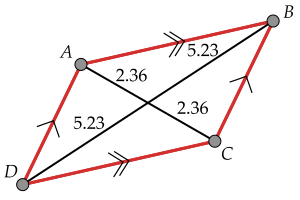
Here, diagonal \(AC\) divides diagonal \(BD\) in half and diagonal \(BD\) divides diagonal \(AC\) in half.
- In a trapezoid, the location where the diagonals intersect doesn't usually divide either of the diagonals in half.
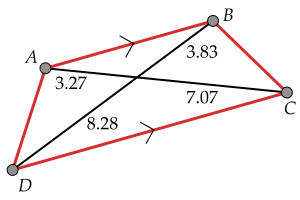
Here, diagonal \(AC\) does not divide diagonal \(BD\) in half and diagonal \(BD\) does not divide diagonal \(AC\) in half.
- In a convex kite, the location where the diagonals intersect divides one of the diagonals in half, but not necessarily the other.
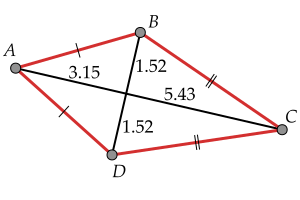
Here, diagonal \(AC\) divides diagonal \(BD\) in half, while diagonal \(BD\) does not divide diagonal \(AC \) in half.
When Do the Diagonals of a Quadrilateral Bisect Each Other?
We can use some slightly different terminology to summarize our findings from the Explore This activity.
A line segment, angle, or shape is bisected if it is split in half.
In the Explore This activity we found that sometimes the diagonals of a quadrilateral bisect each other, and sometimes they do not. It turns out that this depends on the type of quadrilateral.
The diagonals of a parallelogram always bisect each other.
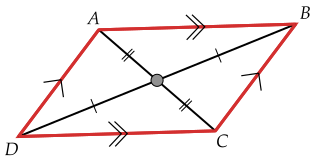
This means that the diagonals of a rectangle, rhombus, or square bisect each other (since these are all types of parallelograms).
We also saw cases where the diagonals did not divide each other in half.
Usually, neither of the diagonals of a trapezoid bisects the other.
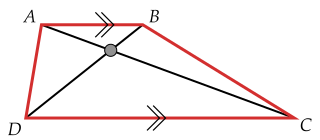
We say "usually" because a parallelogram is a type of trapezoid, and the diagonals of a parallelogram bisect each other.
The diagonals of a kite do not usually bisect each other.
However, one of the diagonals of a convex kite always bisects the other.
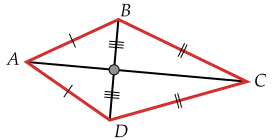
Sometimes both diagonals bisect each other. This happens in the case of a rhombus, which is both a special type of kite and a special type of parallelogram.
Now that we've discussed when the diagonals of a quadrilateral might bisect each other, we are going to explore the angle at which they bisect each other.