Explore This 2 Summary
In the activity above, you may have observed the following:
- There are two distinct triangles, \(\triangle ABC\) and \(\triangle ABC'\), which can be constructed provided \(\angle C\) is not a right angle.
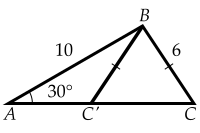
- In \(\triangle ABC\), the angle opposite to \(AB\) is acute. In \(\triangle ABC'\), the angle opposite to \(AB\) is obtuse. In fact, these angles turn out to be supplementary.
Let's look now at what can happen when we overlook these observations while solving a triangle.
The Ambiguous Case of the Sine Law
Consider the triangle given in the diagram above with \(AB=10\), \(BC=6\), and \(\angle A = 30^{\circ}\). The first step in solving this triangle would be to use the sine law to get an equation for the sine of \(\angle C\).
\[ \frac{\sin(A)}{a} = \frac{\sin(C)}{c} \]
Rearranging and substituting known values, we get
\[ \begin{align*} \sin(C) &= \frac{c}{a} \cdot \sin(A) \\ &= \frac{10}{6} \cdot \sin(30^{\circ}) \\&= \frac{5}{6} \end{align*} \]
Next, we would use the inverse sine operation on a calculator to determine \(\angle C\).
\[ \sin(C) = \frac{5}{6} \quad \implies \quad \angle C = \sin^{-1}\left(\frac{5}{6}\right) \approx 56^{\circ}\]
This is where we must be careful. Our calculator ignores the possibility that \(\angle C\) is the obtuse angle supplementary to this value (i.e., \(180^{\circ} - 56^{\circ} = 124^{\circ}\)). There are actually two triangles that can be constructed using the given information. As such, we call this the ambiguous case of the sine law.
It is possible that two distinct oblique triangles can be constructed given two side lengths and one opposing angle. In this case, we say that the solution is ambiguous.
Let's return now to our Try This problem with the possibility of encountering ambiguous cases in mind.
Try This Revisited
In \(\triangle ABC\), determine obtuse \(\angle B\) to the nearest degree.
Solution
Observe that we are given two side lengths and one opposing angle.
- \(BC = 6.0\)
- \(AC = 8.0\)
- \(\angle A = 40^{\circ}\)
Therefore, we should keep in mind the possibility that we will be able to construct two triangles consistent with these parameters.
To begin, let us apply the sine law to get an equation for \(\sin(B)\).
\[ \frac{\sin(A)}{BC} = \frac{\sin(B)}{AC} \]
Rearranging and substituting known values, we get
\[ \begin{align*} \sin(B) &= \frac{AC}{BC} \cdot \sin(A) \\ &= \frac{8.0}{6.0} \cdot \sin(40^{\circ}) \\ & \approx 0.857 \end{align*} \]
Using the inverse sine operation, we find
\[ \begin{align*} \angle B &= \sin^{-1}\left(0.857\right) \\ & \approx 59^{\circ} \end{align*} \]
At this point that we note that the supplementary angle \(180^{\circ} - 59^{\circ} = 121^{\circ}\) will also give a sine ratio of approximately \(0.857\). We have encountered the ambiguous case of the sine law. We illustrate the two cases below.
Fortunately, in this problem, we can remove the ambiguity. Recall that the question specifically states that \(\angle B\) is obtuse. This means that we can eliminate \(\angle B \approx 59^{\circ}\) as a possibility leaving us with \(\angle B \approx 121^{\circ}\).
In conclusion, \(\angle B\) is approximately equal to \(121^{\circ}\).