Exercises


Lesson 1: Similarity and Congruence


  1. In each of the sets of diagrams below, determine which two figures are congruent.

      1. Image 1.
      2. Image 2.
      3. Image 3.
      4. Image 4.
      1. Image 1.
      2. Image 2.
      3. Image 3.
      4. Image 4.
    1. Sketch three triangles that are not similar.
    2. Sketch three rectangles that are similar but not congruent.
    3. Are all circles congruent? Are all circles similar? Explain your reasoning.
  2. Explain why congruence is a special case of similarity.
  3. Scale models of three of Canada's tallest towers are made with scale factors of \(\dfrac{1}{500}\). How tall will the model of each tower be? Give your answer in centimetres to the nearest centimeter.
    1. CN Tower in Toronto, Ontario at \(553\) metres tall.
    2. Calgary Tower in Calgary, Alberta at \(191\) metres tall.
    3. Cape Race Transmitter Tower in Cape Race, Newfoundland and Labrador at \(410\) metres tall.
  4. The ratio of the areas of two similar polygons is \(25:9\).
    1. What is the ratio of corresponding side lengths?
    2. What is the ratio of the perimeters of the polygons?
  5. The ratios of the perimeters of two similar polygons is \(25:9\).
    1. What is the ratio of corresponding side lengths?
    2. What is the ratio of the areas of the polygons?
  6. Marnie is tiling a floor in an office building. The square tiles that she likes are available in three different sizes: \(12\times 12\) inches, \(18\times 18\) inches, and \(24\times 24\) inches. She knows that she will need \(900\) of the \(24 \times 24\) inch tiles to tile the floor.

    1. How many of the \(12\times 12\) inch tiles are needed to tile the same area of floor?

    2. How many of the \(18\times 18\) inch tiles are needed to tile the same area of floor?

  7. The PhotoFramers Company prints and frames pictures. They charge per square centimetre to print the picture and per centimetre along the perimeter to frame it. Zach takes in his camera to have a picture printed. For one size of the picture, he would pay \($ 20\) to have it printed and \($ 50\) for the frame. If, instead, he doubles the length and width of this picture and then has it printed and framed, what would the total cost be?

  8. Congruent figures can be found in art. Research the work "Regular Division of the Plane" by M. C. Escher. Can you construct a similar tessellation of irregular shapes that interlock to completely cover a surface?

  9. A \(50\) metre by \(20\) metre rectangular plot of land, \(ABCD\), will be used as a dog park. A fence will be put along the outer perimeter and from point \(X\) to point \(Y\) to divide the area into two fenced-in regions — one for large dogs and the other for small dogs.

    Point X lies on AB and point Y lies on CD. AB equals 50 and AD equals 20.

    1. Determine the length of \(BX\) if the two fenced-in regions are similar and the section for small dogs is smaller than the one of large dogs.

    2. Determine the ratio of the perimeter of the region for large dogs to the perimeter of the regions for small dogs.

    3. Determine the ratio of the area of the region for large dogs to the area of the regions for small dogs.


Lesson 2: Similar Triangles


  1. A carpenter builds two triangular trusses for a construction job. The trusses must be similar to one another.

    A triangular truss is made of three pieces of wood that form a triangle.

    Which of the following tests performed on each truss would be guaranteed to yield enough information to check for similarity? 

    1. Measure any one angle.
    2. Measure any two angles.
    3. Measure all three angles.
    4. Measure any one side and any one angle.
    5. Measure any one side and any two angles.
    6. Measure any two sides and any one angle.
    7. Measure any two sides and the contained angle.
    8. Measure all three sides.
  2. Which of the following statements about isosceles triangles are true? Provide examples to support your answers.
    1. All pairs of isosceles triangles are similar.
    2. Two isosceles triangles each containing at least one side length equal to \(1\) must be similar.
    3. Two isosceles triangles each containing at least one \(20^{\circ}\) angle must be similar.
    4. Two isosceles triangles each containing at least one \(120^{\circ}\) angle must be similar.
  3. In the flag of Antigua and Barbuda (shown below), there are three similar triangles and two congruent triangles. Label points on the flag and use them to write appropriate statements of similarity and congruence using similarity rules as needed.

    The rectangular flag is split into three large triangles created by drawing lines from the top left corner and top right corner to the middle of the bottom. Inside the middle triangle are two other triangles that share a vertex with the larger middle triangle. On top of the two smaller triangles but inside the larger triangle is a sun like shape.
  4. Consider the following diagram:

    Right angle triangle ABC shares a vertex with right angle triangle EDC where angles B and D are 90 degrees.

    1. Prove that \(\triangle ABC \sim \triangle EDC\).
    2. If \(\dfrac{AB}{DE} = \dfrac{3}{2}\), then determine the value of the ratio \(\dfrac{CE}{AC}\).
    3. If \(CD = 16\) and \(CE = 20\), then determine the lengths of all sides of \(\triangle ABC\).
  5. On a sunny day, Clara stands beside a tall tree. Her shadow measures \(3.1\) m long on the ground. At the same time, the tree's shadow measures \(11\) m along the ground.
    1. If Clara's height is known to be \(1.7\) m, then how tall is the tree to the nearest metre?
    2. Explain why it is important that the shadows are measured at the same time.
  6. When the Sun is at a particular angle, the \(45.7\) m flagpole on Windsor, Ontario's waterfront casts a shadow \(74.1\) m long. If the Sun's rays hit the \(171\) m tall Jeddah flagpole in Saudi Arabia at the same angle, what would be the length of its shadow to the nearest metre?
  7. Mickey looks up to the top of a \(14\) ft high lamp post. Directly behind the very top of the lamp post, Mickey spots his friend Lulu standing on her balcony. If \(6.0\) ft tall Mickey is standing \(8.0\) ft from the base of the lamp post and Lulu's apartment is \(110\) ft behind the lamp post, then how high is Lulu's balcony to the nearest foot?
  8. Two university buildings are connected by a \(17\) m long above-ground walkway with a glass floor. A \(1.6\) m tall student notices that if they are at the start of the walkway and look through the glass floor at a point \(2.0\) m ahead, they are staring directly at the base of the other building. Determine how high above the ground the walkway floor is to the nearest meter.
  9. A company is planning to build a rope bridge across a river. A diagram of the river shows the start and end points of the bridge. The company has made distance measurements on one side of the river as shown in the diagram. Calculate the length of the bridge to the nearest metre.

    From the starting point, a right triangle with base 32 is drawn across the river to the end of the rope bridge. The line of the rope bridge also extends backwards from the starting point creating another right triangle with base 11 and height 17.

  10. In a science class, pinhole cameras are made out of boxes that are \(34.0\) cm by \(34.0\) cm by \(21.0\) cm. In the middle of a square face, a small hole is punctured and then covered with tape. In a darkroom, the entire inside of the opposite square face is covered with photosensitive paper. Emily is using her pinhole camera to take a picture of her friend Daniel who is \(180\) cm tall. What is the closest that the front of the pinhole camera can be to Daniel so that his entire \(180\) cm frame is in the picture? Assume that the camera is not held at an angle. Give you answer to the nearest centimetre.

Lesson 3: Tangent Ratio


  1. Suppose the Sun casts light that makes an angle of \(40^{\circ}\) with the horizontal. Determine the length of the shadow of a \(1.8\) metre tall person to one decimal place.
  2. Honghui wishes to determine the distance across a river given by \(AC\). He walks \(8.0\) metres from point \(A\) to point \(B\) and measures \(\angle B = 66^{\circ}\). What is the length of \(AC\) in metres to one decimal place?

  3. Camryn is playing golf and her ball initially sits at point \(A\) which is \(150\) yards from the hole at point \(B\). She hits the ball \(6.0\) degrees off-target and it stops rolling at point \(C\). How far is her ball from the hole to the nearest yard? Assume the golf course is flat.

  4. A company is installing a ramp outside of their building to make it wheelchair accessible. They know that the ratio of the rise to the run should be at most \(1:12\). What is the maximum angle, \(\theta\), that the ramp can make with the ground to the nearest decimal place?
  5. Consider the following right-angled triangle:

    Triangle ABC with with right angle at A and side lengths BC is 145 mm and AC is 92 mm.

    1. Determine the missing side length to the nearest millimetre.
    2. Determine the measure of both acute angles to the nearest degree.
  6. The two congruent red triangles in the flag of Trinidad and Tobago are separated by two white stripes and a black stripe. The height to base length ratio of the entire flag is \(3:5\). Along the bottom edge of the flag, the ratio of the base length of one triangle to the sum of the base lengths of the stripes is \(7:3\) as shown.
    In a rectangular flag, one right-angled triangle sits so the right angle is in the bottom-left corner. The other triangle is an 180-degree rotation of the first, which is then shifted to the right where the white and black stripes fill the parallelogram left between the triangles.
    1. Determine the tangent ratio exactly for each of the two acute angles in one of the red triangles.
    2. Compute each of the two acute angles to the nearest degree.
    3. Explain why it is possible to determine the angles in part (b) without knowing the actual dimensions of the flag.

The following definitions are required for questions 7 through 9.

When an object is sighted above an observer's horizontal plane, the angle between the observer's line of sight and the horizontal is called the angle of elevation.

When an object is sighted below an observer's horizontal plane, the angle between the observer's line of sight and the horizontal is called the angle of depression.

  1. Two buildings are \(100\) metres apart. Building 1 is shorter than Building 2. From the edge of the roof of Building 1 closest to Building 2, the angle of elevation to the top of Building 2 is \(25.0^{\circ}\). From that same point, the angle of depression to the bottom of Building 2 is \(30.0^{\circ}\). Determine the height of Building 2 to the nearest metre.

  2. The Mount Royal Cross in Montréal stands at the northeastern peak of the mountain and overlook parts of the island. A tourist standing at a certain spot on the mountain notices that the angle of elevation to the base of the cross is \(66.8^{\circ}\) and the angle of elevation to the top of the cross is \(69.3^{\circ}\). If the horizontal distance between the tourist and the cross is \(100\) metres, determine the height of the cross to the nearest metre.

  3. While standing a certain distance across flat ground from the base of the CN tower, Raj notices that the angle of elevation to the top of the CN Tower is \(41.3^{\circ}\). He then walks \(180\) metres toward the CN Tower and notices that the angle of elevation to the top of the tower has increased to \(50.9^{\circ}\). Determine the height of the CN Tower to the nearest metre.
  4. The cotangent (denoted \(\cot\)) of an angle is defined as the reciprocal of the tangent ratio:

    \( \cot(\theta) = \dfrac{1}{\tan(\theta)} = \dfrac{1}{\frac{\text{opp}}{\text{adj}}} = \dfrac{\text{adj}}{\text{opp}}\)

    1. Use a calculator to compute the tangent and cotangent ratios for \(20^{\circ}\), \(40^{\circ}\), \(50^{\circ}\), and \(70^{\circ}\) each to three decimal places. What do you notice about these values? Why do you think this happens?
    2. In the "Take It With You" section of the lesson, you were asked to determine the tangent ratio for \(0^{\circ}\) and \(90^{\circ}\). Now, find the cotangent ratio for these two angles and explain your reasoning.

Lesson 4: Sine and Cosine Ratios


  1. In 1914, construction began on the Connaught Tunnel in British Columbia to allow trains to pass through the Selkirk Mountains. The track through this tunnel made an angle of just \(0.544^{\circ}\) with the horizontal and the change in elevation from end-to-end was \(76.7\) metres. Determine the length of the track to the nearest hundred metres.

    An old black and white photo of one of the entrances to the tunnels.
  2. In \(\triangle ABC\), the length of side \(AB\) is \(6\) cm, the length of side \(BC\) is \(10\) cm, and \(\angle B = 70^{\circ}\). Determine the area of the triangle to the nearest cm2.

  3. Consider the following right-angled triangle \(ABC\):

    Side AB is 3, AC is 5, and BC is 4, angle B is right, and angle A is theta.

    1. Determine the sine, cosine, and tangent ratio of the angle \(\theta\).
    2. Use the inverse sine, inverse cosine, and inverse tangent operations to determine the angle \(\theta\) to the nearest degree. (You should get the same result each time.)
  4. A ladder is leaned against the side of a house for a repair job. For safety reasons, the distance from the base of the ladder to the wall must be no less than one quarter of the length of the ladder. Determine the maximum angle to the nearest degree that the ladder can make with the horizontal while being safe. (Be sure to round your answer down to the nearest degree because rounding up would give an unsafe angle.)
  5. In Example 4 of this lesson, we used inverse trigonometric operations to compare the measures of \(\angle a\), \(\angle b\), and \(\angle c\) in the triangles below and showed that angles \(a\) and \(c\) are equal.

    Triangle 1 (Angle \(a\))

    Right triangle with angle a. Opposite of angle a is 12 and hypotenuse is 20.

    Triangle 2 (Angle \(b\))

    Right triangle with angle b. Opposite of angle b is 24 and adjacent is 30.

    Triangle 3 (Angle \(c\))

    Right triangle with angle c. Adjacent to angle c is 28 and hypotenuse is 35.

    1. Use the Pythagorean Theorem and similarity instead of trigonometry to compare triangles \(1\), \(2\), and \(3\) to argue that angles \(\angle a\) and \(\angle c\) are equal to each other but not equal to angle \(\angle b\).
    2. Compare this approach to the approach used in Example 4.
  6. A given trigonometric ratio determines the shape of a right-angled triangle but not its size.
    1. Sketch and label the side lengths of three different right-angled triangles with an interior angle \(\theta\) such that \(\tan(\theta) = 1\).
    2. Calculate \(\sin(\theta)\) and \(\cos(\theta)\) in each of these triangles.
    3. What do you notice about your answers in part (b)? Explain why this makes sense.
  7. Two right-angled triangles, \(\triangle ABC\) and \(\triangle BCD\), have side \(BC\) in common. The hypotenuse of \(\triangle ABC\) is side \(AB\) and the hypotenuse of \(\triangle BCD\) is side \(BC\).

    In triangle ABC, angle C is 90 degrees. In triangle BDC angle D is 90 degrees.

    Given that \(AB = 18\) cm, \(CD = 6\) cm, and \(\angle A = 23^{\circ}\), determine the measure of \(\theta = \angle BCD\) to the nearest  degree.

    1. Complete the following table. Give all values to three decimal places.
      \(\theta\) \( ( \sin(\theta) )^2 \) \( ( \cos(\theta) )^2 \) \( ( \sin(\theta) )^2 + ( \cos(\theta) )^2 \)
      \( 0^{\circ} \) \(0\) \(1.000\) \(1.000\)
      \( 12^{\circ} \)      
      \( 40^{\circ} \)      
      \( 73^{\circ} \)      
      \( 90^{\circ} \)      
    2. The values in the final column suggest that \((\sin(\theta))^2 + (\cos(\theta))^2 = 1\) for any value of \(\theta\). This turns out to be true and is often referred to as the Pythagorean trigonometric identity. Beginning with the Pythagorean Theorem, use the definitions of the sine and cosine ratios (i.e., \(\sin(\theta) = \dfrac{\text{opp}}{\text{hyp}}\) and \(\cos(\theta) = \dfrac{\text{adj}}{\text{hyp}}\)) to prove this identity and see if you can explain where its name comes from.

  1. For acute \(\triangle ABC\), the sine law states

    \( \dfrac{\sin(A)}{a} = \dfrac{\sin(B)}{b} = \dfrac{\sin(C)}{c}\)

    1. Suppose \(\angle C\) is a right angle. Can the sine law still be applied?
    2. Use the sine law to find the acute angles in a right-angled triangle with side lengths of \(3\), \(4\), and \(5\) to one decimal place.
  2. Consider \(\triangle ABC\) with \(a = 12.3\), \(\angle A = 34.6^{\circ}\), and \(\angle B = 67.5^{\circ}\). Sketch and label \(\triangle ABC\) and determine the unknown side lengths and angle to one decimal place.
  3. Consider the following acute \(\triangle DEF\).

    Triangle DEF has angle E equal 80 degrees, EF is 18, and DF is 30.

    1. Explain why the length of side \(f\) cannot be calculated in one step using the sine law.
    2. Determine the length of side \(f\) to the nearest integer.
  4. A vertical flagpole is supported at a single point part way up by two \(2.5\) metre lengths of rope. The ropes are attached to different points on a vertical post and are taut. The angle between the two lengths of rope is \(28^{\circ}\). How far apart are the two points where the ropes are attached to the post to the nearest tenth of a metre?

  5. A rectangle with width \(121\) mm is divided into four triangles by drawing its diagonals. Given that the angle between the diagonals in a triangle which includes the width of the rectangle as an edge is \(144^{\circ}\) (as shown), determine the height of the rectangle to the nearest millimetre.

    You are encouraged to solve this question with and without the sine law for comparison.

  6. The peak of Mount Robson has the highest elevation in the Canadian Rocky Mountains. Kinney Lake sits at the base of Mount Robson at an elevation of \(853\) m above sea level. Points \(A\) and \(B\) are located on opposite sides of Kinney Lake separated by a distance of \(2500\) m. Let point \(C\) be located directly below the peak of Mount Robson at the same elevation as Kinney Lake. Measurements reveal \(\angle BAC = 70.0^{\circ}\) and \(\angle ABC = 85.0^{\circ}\). Moreover, the angle of elevation from point \(A\) to the peak of Mount Robson (let this be point \(D\)) is \(27.7^{\circ}\). Determine the elevation of the peak of Mount Robson above sea level to the nearest ten metres.

  7. A group of math students are each given the following items:
    • One \(60\) cm piece of string
    • Four push pins
    • A protractor
    • A ruler
    • One piece of corrugated cardboard

    The following instructions are then given to the students.

    1. Pin one end of the string to the cardboard.
    2. Measure \(24\) cm along the string from the first pin and pin this point down so that this segment of string is straight.
    3. Measure another \(20\) cm along the string from the second pin and pin this point down so that the second segment of string is straight and forms a \(45^{\circ}\) angle with the first segment.
    4. With the remaining \(16\) cm of string taut, form a triangle by pinning the end of the string somewhere along the first segment.

    Students notices that their classmates have not all made triangles that are congruent with each other. By following the above instructions, how many non-congruent triangles can be made? Explain your answer.

  8. The Peace Tower is located on Parliament Hill in Ottawa. Alphonso decides to use his trigonometry skills to determine the height of the tower. To do so, he begins by picking two points on the ground and labelling them \(A\) and \(B\). He also labels the base of the tower by \(C\) and the top of the tower by \(D\). Next, he makes the following measurements: 

    \(AB = 51\) m, \(\angle BAC = 72^{\circ}\), \(\angle ABC = 70^{\circ}\), and \(\angle CAD = 51^{\circ}\)

    Determine the height of the Peace Tower to the nearest metre.


Lesson 6: The Cosine Law


  1. Consider the following triangle, \(\triangle JKL\).

    The side opposite angle K is lower case k, the side opposite angle L is lower case l, and the side opposite angle J is lower case j.

    1. Suppose side lengths \(k\) and \(\ell\) and \(\angle J\) are known. Use the cosine law to write an equation that could be used to solve for the square of side length \(j\).
    2. Suppose all three side lengths of \(\triangle JKL\) are known. Use the cosine law to write an equation that could be used to solve for the cosine of \(\angle K\).
    1. Explain why the cosine law (and not the sine law) must be used when solving a triangle if the only known measures of the triangle are its three side lengths.
    2. Explain why neither the sine law nor the cosine law can help you solve a triangle when the only known measures are its three angles.
  2. Luisa would like to determine the width of a pond. Starting on one side of the pond, she walks \(410\) metres in a straight line to a rock sitting some distance in front of the pond. From here she turns and walks \(290\) metres in a straight line and arrives at the other end of the pond. Her path walking towards the rock made an angle of \(75^{\circ}\) with her path walking away from the rock.

    The distance across the pond is unknown.

    Determine the width of the pond to the nearest ten metres.

  3. A golf ball sits directly west of the hole which is in the centre of a circular green with diameter \(18\) metres. A distance of \(130\) metres separates the ball from both the northernmost and southernmost points on the green.

    The angle between the ball and the northernmost and southernmost points of the green is marked. A compass rose showing north, east, south, and west is given.

    Within what angle (to the nearest degree) must the golfer hit the ball in order for it to have a chance of landing on the green?

  4. Bianca and Clinton are fishing together on a calm lake when they both get their hooks caught in the same spot on something at the bottom of the lake. Bianca has let out \(3.1\) metres of line and estimates that her fishing line makes an angle of \(58^{\circ}\) with the horizontal. If the tips of their rods are at the same height but \(3.8\) metres apart horizontally, then how much line has Clinton let out to the nearest tenth of a metre?

    Two people on opposite sides of a fishing boat with a pole out of the water. The lines each look like they go under boat.

  5. A regular pentagon is inscribed in a circle with radius \(7.0\) cm. What is the perimeter of the pentagon to the nearest tenth of a centimetre? (Hint: Imagine splitting up the pentagon into a group of five congruent triangles.)

  6. A class activity requires students to construct an isosceles triangle using a \(10\) metre piece of string. The instructions say that at least one side must be exactly \(3\) metres long and that the entire string must be used. Terry and Dion each complete the activity successfully, but their triangles are not congruent. To the nearest tenth of a degree, find the measure of all of the angles in each of their constructions.
  7. Two boats, the Albatross and the Barracuda, leave port at the same time. The Albatross travels in a direction \(40^{\circ}\) east of north at \(20\) km/h. The Barracuda travels in a direction \(64^{\circ}\) east of south at \(25\) km/h. To the nearest kilometre, how far apart are the boats after two hours?

Lesson 7: Applications With Acute Triangles


  1. In order to solve a triangle for all unknown values, which \(3\) of the \(6\) measures (angles and sides) must be given if the following steps are to be used in the order they appear?
    1. cosine law, sine law, interior angles sum
    2. sine law, interior angles sum, cosine law
    3. cosine law, cosine law, sine law
  2. Triangle \(ABE\) is inscribed in the rectangle \(ABCD\) with \(E\) on the side \(CD\). The side lengths of the rectangle are \(AB=25\) and \(BC=19.7\), \(\angle CBE=26^\circ\), and \(\angle EAD=38^\circ\). 

    1. Find the length of \(AE\) to the nearest decimal place.
    2. Can you verify your answer to part a) using a different method?
  3. In trapezoid \(ABCD\), \(AB\) is parallel to \(DC\), \(AB=3.2\), \(AD=2.7\), \(\angle BAD=81^\circ\), and \(\angle BCD=52^\circ\). Find the length of \(BC\), to \(1\) decimal place.
  4. A dog, a cat, and a rabbit are waiting to greet their owner as shown in the diagram. The dog is \(4.2\) m from the cat and \(2.2.\) m from the rabbit. The dog must turn his head \(90^\circ\) to go from looking at the cat to looking at the rabbit. He sees the door at an angle of \(38^{\circ}\) while turning his head in this way. Meanwhile, the cat must turns its head \(70^{\circ}\) to go from looking at the dog to looking at the door.

    The angle created by the rabbit, dog, and cat is a right angle.
    1. How far is each pet from the door?
    2. The owner walks through the door and all three pets take off at the same time to meet her. If the dog runs at \(6.5\) m/s, the cat runs at \(5.5\) m/s, and the rabbit hops at \(6.0\) m/s, which animal will reach the owner first?
  5. Did You Know?

    When light travels from one medium to another, it appears to bend. The relationship between the angle of incidence, \(\theta_1\), and the angle of refraction, \(\theta_2\), when light passes through the boundary between one medium and a second medium is described by Snell's Law which says

    \[k=\dfrac{\sin\left(\theta_1\right)}{\sin\left(\theta_2\right)}\]

    where \(k\) is called Snell's index of refraction.

    Between two mediums, a vertical line is drawn perpendicular to the mediums. A line comes from Medium 1 through the vertical line and changes direction as it enters Medium 2. The angle between the line and the perpendicular line in Medium 1 is labelled theta1. The angle between the line in Medium 2 and the perpendicular line is labelled theta2.

    Students are trying to identify a mystery material by shining a laser through into it at various angles. The mystery material is known to be quartz, zircon, or diamond whose indices of refractions are given in the following table:

    Material Snell's Index of Refraction in a Vacuum
    Quartz \(1.46\)
    Zircon \(1.92\)
    Diamond \(2.42\)

    When they performed their experiment in air with angle of incidence of \(20^\circ\), the resulting angle of refraction was \(10.4^\circ\). For an angle of incidence of \(25^\circ\), the resulting angle of refraction was \(12.9^\circ\).

    1. What is the mystery material?
    2. One more measurement was taken to confirm the conclusion. If the mystery material was correctly identified and the angle of incidence was \(30^\circ\), what should the angle of refraction have been? Round your answer to one decimal place.
  6. When an object is sighted above an observer's horizontal plane, the angle between the observer's line of sight and the horizontal is called the angle of elevation.

    A light aircraft flies directly over Marilyn at a constant altitude of \(4\) km. As the aircraft flew away, Marilyn measured its angle of elevation at two points, one minute apart. The angle of elevation was \(52^\circ\) at the first point and the angle was \(28^\circ\) at the second point. What was the speed of the aircraft, in km/h?

    A small airplane.
  7. Determine the perimeter of pentagon \(ABCDE\), accurate to one decimal place, if
    • in \(\triangle ABE\), \(AB=EB\), \(\angle ABE=18^\circ\), and \(AE=1.9\) m;
    • in \(\triangle BCE\), \(\angle CBE=82^\circ\) and \(\angle BCE=90^\circ\); and
    • in \(\triangle CDE\), \(CE=DE\) and \(\angle CED=37^\circ\).
    1. Determine the area of a regular octagon inscribed in a circle of radius of \(20\) cm. Round your answer to \(2\) decimal places.

    2. An \(n\)-sided regular polygon is inscribed in a circle of radius \(r\). Prove that the area of the polygon is \(\dfrac12nr^2\sin\left(\dfrac{360^\circ}{n}\right)\).
  8. In \(\triangle ABC\), \(AC=BC\) and \(\dfrac{AB}{AC}=r\). Prove \(\cos\left( A\right)+\cos\left( B\right)+\cos\left( C\right)=1+r-\dfrac{r^2}2\). (Green et al., 2001)
  9. For the non-right-angled triangle \(RSW\), \(\cos\left( W\right)=\dfrac{12}{13}\) and \(\tan\left( S\right)=\dfrac12\). Determine the ratio \(SR:SW\). (Green et al., 2001)

Reference: Green, R., Carli, E. G., Nicholls, G. T., Dunkley, R. G., Wilson, L., & University of Waterloo. (2001). Harcourt mathematics 11: Functions/relations. Toronto: Harcourt Canada.


Lesson 8: Oblique Triangles


  1. The diagram illustrates the crank and piston assembly of an automobile engine. If \(PQ=5.32\) cm, \(PR=6.18\) cm, and \(\angle QPR=116^\circ\), calculate the length of \(QR\) correct to two decimal places.

    The crank makes a triangle with segments QP, PR, and RQ connecting with the piston at point R.

  2. A coaxial cable must be laid to connect point \(A\) on the mainland to an island station at point \(B\). From points \(A\) and \(C\) on the mainland, a surveyor finds that \(\angle  BAC=105^\circ\) and \(\angle BCA=39^\circ\). If \(AC\) is \(300\) m, find the length of the cable required to the nearest metre.
  3. For each description, determine whether there are two, one, or no triangles which satisfy the measures given. Find the values of all interior angles if triangles exist. Round your answers to the nearest degree.
    1. \(\triangle ABC:~a = 6,~ b = 24, ~\angle B = 38^\circ\)
    2. \(\triangle DEF:~d = 15, ~e = 9,~\angle E = 34^\circ\)
    3. \(\triangle GHI:~g = 120,~ h = 92,~\angle H = 42^\circ\)
    4. \(\triangle JKL:~j = 3, ~k = 5, ~\angle J = 41^\circ\)
    5. \(\triangle MNO:~m = 19, ~n = 17,~\angle M = 6^\circ\)
    6. \(\triangle PQR:~p = 27, ~q = 12, ~\angle Q = 37^\circ\)
  4. Triangle \(ABC\) is drawn with \(AB=25\) and \(\angle ABC=30^\circ\).
    1. What is the minimum length of \(AC\)?
    2. Determine all possible lengths of \(AC\) that would allow two different triangles to be drawn.

  5. A pilot, flying due east, is radioed that there is a nasty storm straight ahead. The pilot is instructed to turn the plane \(20^\circ\) to the north and continue on this heading for one hour. After the one hour, the pilot turns an acute angle towards the south to head back to the original flight path. It takes the pilot \(40\) minutes to meet the original flight path and turn the plane to again head due east. If the plane flew at a constant speed of \(726\) km/h, how much time was lost from the original flight plan? Give your answer to the nearest minute.
    1. In \(\triangle ABC\), \(a=6\), \(b=7\), and \(c=5\). Find the area of \(\triangle ABC\). Round your answer to one decimal place.
    2. For any acute triangle \(ABC\), show that the area of \(\triangle ABC\) is equal to \(\dfrac12ac\sin\left( B\right)\).
    3. For any oblique triangle \(ABC\), show that the area of \(\triangle ABC\) is equal to \(\dfrac12ac\sin\left( B\right)\).
  6. In \(\triangle DEF\), \(d = 11\) and \(e = 16\). Determine the possible measures for \(\angle D\), rounded to one decimal place, so that 
    1. \(\triangle DEF\) has one solution;
    2. \(\triangle DEF\) has two solutions.
  7. Two fishing boats, \(F\) and \(G\), are \(115\) nautical miles (nm) apart when they each hear the same emergency SOS call from a cruise ship. The captain of \(F\) estimates that she is \(72\) nm from the cruise ship and the fishing boats can travel at \(44\) knots.

    Did You Know?

    The nautical mile (nm) is a unit of measurement in the air and on water and the knot is its corresponding unit of speed.

    \[\begin{align*} 1 \text{ nm }&=1852 \text{ m}\\ 1 \text{ knot}& = 1 \text{ nm/h} \end{align*}\]
    1. The captain of \(F\) measures that from her perspective, the angle between their sight line to the cruise ship and their sight line to boat \(G\) is \(31^\circ\). How long will it take each boat to reach the cruise ship? Round your answer to \(1\) decimal place.
    2. Suppose the \(31^\circ\) in part a) is instead the angle measured by the captain of \(G\) between their sight line to the cruise ship and their sight line to boat \(F\). Determine all possible values for how long it will take boat \(G\) to reach the cruise ship. Round your answer to \(1\) decimal place.
  8. Two ships with underwater sonar detection equipment have located the wreckage of an old sailing ship on the sea floor. The wreck \(W\) is located on the bottom of a vertical plane \(ABW\) which passes through the ships on the surface at points \(A\) and \(B\). When the distance \(AB\) between the ships is \(6000\) m, the angles of depression to the wreck are \(\angle WAB=73^\circ\) and \(\angle WBA=41^\circ\). Determine all possible values of the depth of the wrecked ship to the nearest metre.

    When an object is sighted below an observer's horizontal plane, the angle between the observer's line of sight and the horizontal is called the angle of depression.

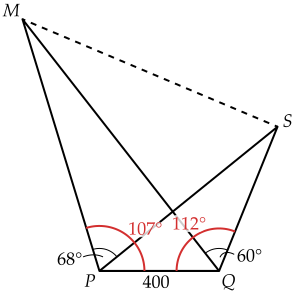
  9. To determine the distance between two inaccessible mountain peaks, \(M\) and \(S\), a base line of \(400\) m is laid out between the points \(P\) and \(Q\) in the valley below. Angles at \(P\) and \(Q\) are measured to obtain \(\angle MPS=68^\circ\), \(\angle MPQ=107^\circ\), \(\angle MQS=60^\circ\), and \(\angle PQS=112^\circ\). Determine the distance \(MS\), to the nearest metre.

Lesson 9: Applications in Three-Dimensional Settings


  1. Determine the length of \(DG\) to the nearest whole number.

    Triangle DEF shares side DF with triangle DGF. Angle DEF is 35 degrees, EF = 15, angle DFE and DFG = 90 degrees, and angle FGD = 45 degrees.

  2. Determine the length of \(AB\) to the nearest whole number.

    Triangle ABC shares side BC with triangle BCD. Angle BAC is 27 degrees, angle ACB = 90 degrees, angle CDB = 70 degrees, and CD and DB = 15.

  3. Rectangular prism \(ABCDEFGH\) has length \(10\) cm, width \(8\) cm, and height \(5\) cm. Determine the angle between the body diagonal \(AG\) and the base to the nearest degree.

    The face ABCD is the top of the prism and EFGH is the base of the pyramid.

  4. A hot air balloon sits at a point \(A\) above the ground. A triangle, \(\triangle BCD\) is formed on the ground with point \(C\) directly below the hot air balloon. Determine the height of the balloon to the nearest metre given the measurements in the diagram.

    Angle ADC = 64 degrees, angle ACD = 90 degrees, angle ACB = 90 degrees, angle CBD = 50 degrees, angle BDC = 56 degrees, and length BD = 200 m.

  5. A surveyor makes careful measurements and constructs a diagram to determine the height, \(h\), of a mountain. Determine this height using the given measurements to the nearest metre.

    A right triangle starts at a point with angle 15.217 degrees has opposite side with length h. The adjacent side is shared with a second triangle. From the point, a side length of 4350 m is drawn at an angle of 72.418 degrees to the adjacent side of the right triangle. The angle opposite the adjacent side of the right triangle is 63.283 degrees.

  6. A regular octahedron \(ABCDEF\) has eight equilateral triangle faces, each with edge lengths of \(24\) cm.

    The shape is drawn so that the top point of the octaheadron is A and the bottom point is F.

    Determine the volume of this octahedron.

    (You may find it useful to recall that the volume of a right square-based pyramid is given by \(V = \frac{1}{3}a^2 h\) where \(a\) is the length of one edge of the square base and \(h\) is the height.)

  7. Determine \(\angle BAC\) in tetrahedron \(ABCD\) to the nearest degree.

    Angles ADB and ADC = 90 degrees and angle BDC = 95 degrees. BD = 18, AD = 15, and DC = 14.

  8. Two cars leave an intersection at the same time, each on a different straight road. The angle between the two roads is \(12^{\circ}\). One car travels at \(90\) km/h and the other car travels at \(120\) km/h. After \(20\) minutes, a police helicopter hovering \(1.0\) km above a line on the ground connecting the two cars, notes the angle of depression to the slower car is \(14^{\circ}\). What is the horizontal distance (i.e., distance along the ground) from the helicopter to the faster car? Give your answer to the nearest kilometre.