Exercises


  1. Suppose the Sun casts light that makes an angle of \(40^{\circ}\) with the horizontal. Determine the length of the shadow of a \(1.8\) metre tall person to one decimal place.
  2. Honghui wishes to determine the distance across a river given by \(AC\). He walks \(8.0\) metres from point \(A\) to point \(B\) and measures \(\angle B = 66^{\circ}\). What is the length of \(AC\) in metres to one decimal place?

  3. Camryn is playing golf and her ball initially sits at point \(A\) which is \(150\) yards from the hole at point \(B\). She hits the ball \(6.0\) degrees off-target and it stops rolling at point \(C\). How far is her ball from the hole to the nearest yard? Assume the golf course is flat.

  4. A company is installing a ramp outside of their building to make it wheelchair accessible. They know that the ratio of the rise to the run should be at most \(1:12\). What is the maximum angle, \(\theta\), that the ramp can make with the ground to the nearest decimal place?
  5. Consider the following right-angled triangle:

    Triangle ABC with with right angle at A and side lengths BC is 145 mm and AC is 92 mm.

    1. Determine the missing side length to the nearest millimetre.
    2. Determine the measure of both acute angles to the nearest degree.
  6. The two congruent red triangles in the flag of Trinidad and Tobago are separated by two white stripes and a black stripe. The height to base length ratio of the entire flag is \(3:5\). Along the bottom edge of the flag, the ratio of the base length of one triangle to the sum of the base lengths of the stripes is \(7:3\) as shown.
    In a rectangular flag, one right-angled triangle sits so the right angle is in the bottom-left corner. The other triangle is an 180-degree rotation of the first, which is then shifted to the right where the white and black stripes fill the parallelogram left between the triangles.
    1. Determine the tangent ratio exactly for each of the two acute angles in one of the red triangles.
    2. Compute each of the two acute angles to the nearest degree.
    3. Explain why it is possible to determine the angles in part (b) without knowing the actual dimensions of the flag.

The following definitions are required for questions 7 through 9.

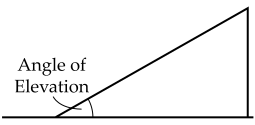
When an object is sighted above an observer's horizontal plane, the angle between the observer's line of sight and the horizontal is called the angle of elevation.
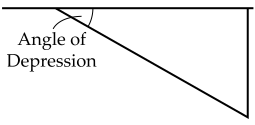
When an object is sighted below an observer's horizontal plane, the angle between the observer's line of sight and the horizontal is called the angle of depression.
  1. Two buildings are \(100\) metres apart. Building 1 is shorter than Building 2. From the edge of the roof of Building 1 closest to Building 2, the angle of elevation to the top of Building 2 is \(25.0^{\circ}\). From that same point, the angle of depression to the bottom of Building 2 is \(30.0^{\circ}\). Determine the height of Building 2 to the nearest metre.

  2. The Mount Royal Cross in Montréal stands at the northeastern peak of the mountain and overlook parts of the island. A tourist standing at a certain spot on the mountain notices that the angle of elevation to the base of the cross is \(66.8^{\circ}\) and the angle of elevation to the top of the cross is \(69.3^{\circ}\). If the horizontal distance between the tourist and the cross is \(100\) metres, determine the height of the cross to the nearest metre.

  3. While standing a certain distance across flat ground from the base of the CN tower, Raj notices that the angle of elevation to the top of the CN Tower is \(41.3^{\circ}\). He then walks \(180\) metres toward the CN Tower and notices that the angle of elevation to the top of the tower has increased to \(50.9^{\circ}\). Determine the height of the CN Tower to the nearest metre.
  4. The cotangent (denoted \(\cot\)) of an angle is defined as the reciprocal of the tangent ratio:

    \( \cot(\theta) = \dfrac{1}{\tan(\theta)} = \dfrac{1}{\frac{\text{opp}}{\text{adj}}} = \dfrac{\text{adj}}{\text{opp}}\)

    1. Use a calculator to compute the tangent and cotangent ratios for \(20^{\circ}\), \(40^{\circ}\), \(50^{\circ}\), and \(70^{\circ}\) each to three decimal places. What do you notice about these values? Why do you think this happens?
    2. In the "Take It With You" section of the lesson, you were asked to determine the tangent ratio for \(0^{\circ}\) and \(90^{\circ}\). Now, find the cotangent ratio for these two angles and explain your reasoning.