Slope and Right-Angled Triangles
Right-angle triangles are a useful tool for discussing slopes.
Recall
\[\mathrm{slope} = \frac{\mathrm{rise}}{\mathrm{run}} \]
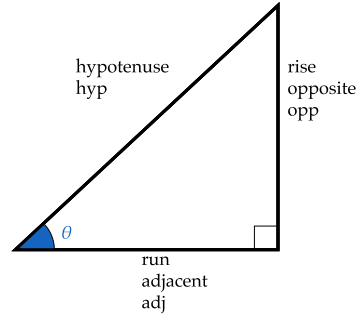
The angle adjacent to the run and opposite to the rise is called the slope angle.
More generally, we denote an angle of interest with a symbol. The Greek letter \(\theta\) (pronounced theta) is frequently used.
Since the concepts of rise and run tend to be associated with vertical and horizontal distances respectively, it is helpful to generalize these ideas too. We do this by describing the legs of the triangle as either adjacent or opposite to the angle of interest, as illustrated in the diagram. We can abbreviate hypotenuse, opposite, and adjacent to hyp, opp, and adj, respectively.
The Tangent Ratio
Let's now formally define the tangent ratio.
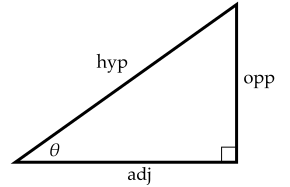
In a right-angled triangle, the tangent of an acute angle is the ratio of the opposite side length to the adjacent side length.
\[\tan(\theta) = \frac{\text{opp}}{\text{adj}}\]
Common Practice
- In equations, note that we will always write "tan" for tangent.
- We will also often say "tan", instead of "tangent" when referring to the tangent ratio.
- It is good practice to write brackets around the angle, to prevent confusion with respect to order of operations.
Example 1
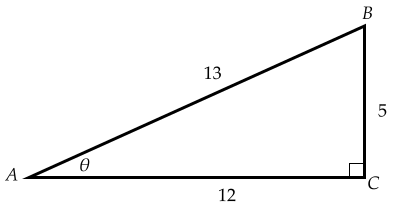
Determine \(\tan (\theta)\) for the triangle shown using the definition \(\tan (\theta) = \dfrac{\text{opp}}{\text{adj}}\).
Solution
With respect to the angle \(\theta\)
- the opposite side length is equal to \(5\) and
- the adjacent side length is equal to \(12\).
Therefore, we can determine the tangent ratio, or tan of the angle \(\theta\):
\[ \begin{align*} \tan(\theta) &= \dfrac{\text{opp}}{\text{adj}} \\ \tan (\theta )&= \frac{5}{12} \end{align*}\]
Check Your Understanding 1
Question
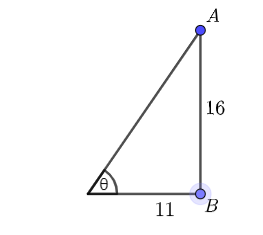
Construct a right triangle with \(\tan(\theta)=\dfrac{\text{opp}}{\text{adj}}=\dfrac{16}{11}\)
Answer
Created with GeoGebra. Author: University of Waterloo. CC BY-NC-SA 4.0.
Feedback
One way to construct the desired triangle is to set the side length opposite of \(\theta\) to \(16\) and the side length adjacent to \(\theta\) to \(11\).
Interactive Version
Tangent Ratio
Explore This 1
Question
Modify the lengths of the legs of the given triangle, with values between \(1\) and \(36\), to construct as many triangles as you can with \(\tan(\theta)=\dfrac{\text{opposite}}{\text{adjacent}}=\dfrac{1}{2}\).
Description
We will begin by finding two triangles that fit the criteria. Consider a right triangle with both legs having length \(5\). In this case \(\tan(\theta)=\dfrac{\text{opposite}}{\text{adjacent}}=\dfrac{5}{5}\)
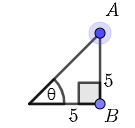
Observe that if we increase the length of the adjacent side to \(10\), then \(\tan(\theta)=\dfrac{5}{10}=\dfrac{1}{2}\).
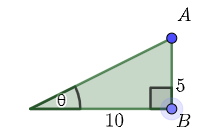
Now consider increasing the length of the adjacent side to \(12\). Now, \(\tan(\theta)=\dfrac{5}{12}\)
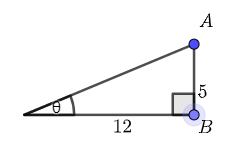
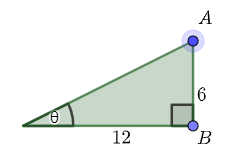
Observe that if we now increase the length of the opposite side to \(6\), then \(\tan(\theta)=\dfrac{\text{opposite}}{\text{adjacent}}=\dfrac{6}{12}=\dfrac{1}{2}\).
Created with GeoGebra. Author: University of Waterloo. CC BY-NC-SA 4.0.
Continue your investigation to see how many more triangles fit the criteria.
Interactive Version
Explore the Tangent Ratio in Triangles
Explore This 1 Summary
In this activity, you may have noticed that a tangent ratio of \(\dfrac{1}{2}\) can be achieved in multiple ways. In fact, if it weren't for the size limitation of the question, it could be achieved in infinitely many ways.
Why is this?
The tangent ratio is the rise over the run, so as long as rise and run are in a \(1\) to \(2\) ratio, the tangent ratio simplifies to \(\dfrac{1}{2}\) regardless of the size of the triangle.
Note that \(\tan (\theta )= \dfrac{\text{opp}}{\text{adj}} = \dfrac{1}{2}\) for each triangle:
You may have also observed that all of the triangles with this tangent ratio are similar to one another. One way to see why this is, is to recall that any two similar triangles will have the same shape. This means that corresponding side lengths are in the same proportions. Therefore, any scale factor difference in side lengths between two similar triangles is cancelled out when computing a ratio of two side lengths within one of those triangles.
Example 2
Let's look at an example making use of similarity to compute a tangent ratio.
Determine \(\tan(D)\) given that \(\triangle ABC \sim \triangle EDF\).
Solution
Given \(\triangle ABC \sim \triangle EDF\), we know that \(\angle B\) and \(\angle D\) are corresponding, and therefore equal. Consequently, their tangent ratios will also be equal.
From the perspective of angle \(B\) in \(\triangle ABC\), the opposite side length is \(8\) while the adjacent side length is \(6\). The ratio of these two values simplifies to \(\dfrac{4}{3}\).
Therefore, \(\tan(D) = \dfrac{4}{3}\).