Exercises


  1. In 1914, construction began on the Connaught Tunnel in British Columbia to allow trains to pass through the Selkirk Mountains. The track through this tunnel made an angle of just \(0.544^{\circ}\) with the horizontal and the change in elevation from end-to-end was \(76.7\) metres. Determine the length of the track to the nearest hundred metres.
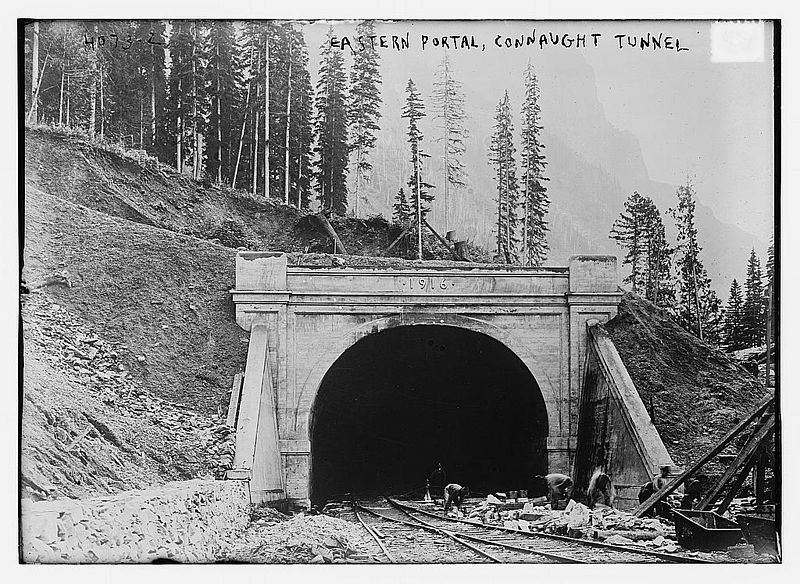
    An old black and white photo of one of the entrances to the tunnels.
  2. In \(\triangle ABC\), the length of side \(AB\) is \(6\) cm, the length of side \(BC\) is \(10\) cm, and \(\angle B = 70^{\circ}\). Determine the area of the triangle to the nearest cm2.

  3. Consider the following right-angled triangle \(ABC\):

    Side AB is 3, AC is 5, and BC is 4, angle B is right, and angle A is theta.

    1. Determine the sine, cosine, and tangent ratio of the angle \(\theta\).
    2. Use the inverse sine, inverse cosine, and inverse tangent operations to determine the angle \(\theta\) to the nearest degree. (You should get the same result each time.)
  4. A ladder is leaned against the side of a house for a repair job. For safety reasons, the distance from the base of the ladder to the wall must be no less than one quarter of the length of the ladder. Determine the maximum angle to the nearest degree that the ladder can make with the horizontal while being safe. (Be sure to round your answer down to the nearest degree because rounding up would give an unsafe angle.)
  5. In Example 4 of this lesson, we used inverse trigonometric operations to compare the measures of \(\angle a\), \(\angle b\), and \(\angle c\) in the triangles below and showed that angles \(a\) and \(c\) are equal.

    Triangle 1 (Angle \(a\))

    Right triangle with angle a. Opposite of angle a is 12 and hypotenuse is 20.

    Triangle 2 (Angle \(b\))

    Right triangle with angle b. Opposite of angle b is 24 and adjacent is 30.

    Triangle 3 (Angle \(c\))

    Right triangle with angle c. Adjacent to angle c is 28 and hypotenuse is 35.

    1. Use the Pythagorean Theorem and similarity instead of trigonometry to compare triangles \(1\), \(2\), and \(3\) to argue that angles \(\angle a\) and \(\angle c\) are equal to each other but not equal to angle \(\angle b\).
    2. Compare this approach to the approach used in Example 4.
  6. A given trigonometric ratio determines the shape of a right-angled triangle but not its size.
    1. Sketch and label the side lengths of three different right-angled triangles with an interior angle \(\theta\) such that \(\tan(\theta) = 1\).
    2. Calculate \(\sin(\theta)\) and \(\cos(\theta)\) in each of these triangles.
    3. What do you notice about your answers in part (b)? Explain why this makes sense.
  7. Two right-angled triangles, \(\triangle ABC\) and \(\triangle BCD\), have side \(BC\) in common. The hypotenuse of \(\triangle ABC\) is side \(AB\) and the hypotenuse of \(\triangle BCD\) is side \(BC\).

    In triangle ABC, angle C is 90 degrees. In triangle BDC angle D is 90 degrees.

    Given that \(AB = 18\) cm, \(CD = 6\) cm, and \(\angle A = 23^{\circ}\), determine the measure of \(\theta = \angle BCD\) to the nearest  degree.

    1. Complete the following table. Give all values to three decimal places.
      \(\theta\) \( ( \sin(\theta) )^2 \) \( ( \cos(\theta) )^2 \) \( ( \sin(\theta) )^2 + ( \cos(\theta) )^2 \)
      \( 0^{\circ} \) \(0\) \(1.000\) \(1.000\)
      \( 12^{\circ} \)      
      \( 40^{\circ} \)      
      \( 73^{\circ} \)      
      \( 90^{\circ} \)      
    2. The values in the final column suggest that \((\sin(\theta))^2 + (\cos(\theta))^2 = 1\) for any value of \(\theta\). This turns out to be true and is often referred to as the Pythagorean trigonometric identity. Beginning with the Pythagorean Theorem, use the definitions of the sine and cosine ratios (i.e., \(\sin(\theta) = \dfrac{\text{opp}}{\text{hyp}}\) and \(\cos(\theta) = \dfrac{\text{adj}}{\text{hyp}}\)) to prove this identity and see if you can explain where its name comes from.