Let's return now to our Try This problem.
Try This Revisited
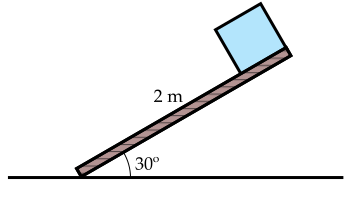
A block is placed near the end of a \(2\) metre long horizontal board. The same end is then raised off of the ground so that the board becomes inclined. The block will slip when the angle between the board and the floor reaches \(30^{\circ}\).
How high must the end of the board be raised for the block to slip?
Solution
At the moment the block slips, let's drop an imaginary vertical line from the end of the board to the ground to form a right-angled triangle.
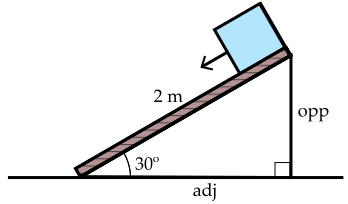
Goal: To determine the height (or opposite side length) of this right-angled triangle.
We can do this with the sine ratio because it relates the opposite and hypotenuse side lengths.
\[ \sin (\theta)= \frac{\mathrm{opp}}{\mathrm{hyp}} \quad \implies \quad \mathrm{opp} = \mathrm{hyp} \cdot \sin ( \theta )\]
Using our calculator, we find that \(\sin (30^{\circ} )= 0.5\).
Substituting this result and the board length of \(2\) metres for the hypotenuse in the previous equation gives
\[ \mathrm{opp} = 2 (0.5) = 1\]
Therefore, the end of the board must be raised to a height of \(1\) metre for the block to slip.
This example illustrates how to use the sine ratio to solve for the opposite side length in a right-angled triangle starting from the hypotenuse. A similar computation can be done to solve for the adjacent side length.
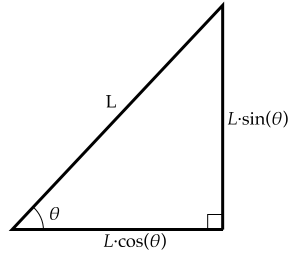
In a right-angled triangle with a hypotenuse of length \(L\):
- the opposite side length is given by \(L \cdot \sin (\theta)\) and
- the adjacent side length is given by \(L \cdot \cos (\theta)\).