Alternative Format — Lesson 2: Related and Coterminal Angles

Let's Start Thinking

Snow Tricks

Performing tricks is essential for competitive snowboarders and freestyle skiers.

Snowboarder doing a trick during a jump.  

Skier doing a trick during a jump.

A 360 spin is when a competitor makes a full turn while going down the ski hill or while she is in the air.

A sequenced photo showing a snowboarder turning around 360 degrees while jumping.

The higher the number, the more spin there is in the trick.

1440 Triple Cork

One of the most difficult maneuvers is called the 1440 triple cork, where a snowboarder does 4 full turns, because \(4 \times 360 = 1440\). While the turns are going on, the boarder is simultaneously doing 3 somersaults. All this happens in about 3 seconds.

A sequence showing the 1440 triple cork.

In this lesson, we will continue our extension of trigonometric ratios to include negative angles and angles greater than \(360^\circ\).


Lesson Goals

  • Define and calculate related acute angles and trigonometric ratios for angles between ‌\(0^\circ\) and \(360^\circ\).
  • Calculate the measure of angles between ‌\(0^\circ\) and \(360^\circ\) from a given trigonometric ratio.
  • Define coterminal angles to connect negative angles and angles greater than \(360^\circ\) with angles between ‌\(0^\circ\) and \(360^\circ\).

Try This

  1. Without using a calculator, determine the primary trigonometric ratios of \(-540^\circ\).
  2. Identify two other angles whose trigonometric ratios would be equal to the trigonometric ratios of \(-540^\circ\).

Related Angles


Inverse Operations for Trigonometric Ratios

Recall from a previous lesson that calculators have inverse operations to compute the angle corresponding to a given trigonometric ratio to a very high precision.

  • inverse sine operation is denoted sin-1
  • inverse cosine operation is denoted cos-1
  • inverse tangent operation is denoted tan-1

For example, the angle \(\theta\) in \(\triangle ABC\) can be found by making an equation using any of the primary trigonometric ratios and solving for \(\theta\). 
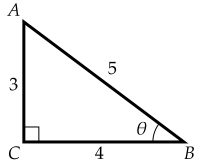
Side AB is length 5, BC is length 4, and AC is length 4. Angle B is theta. Angle C is a right angle.

Sine Ratio

\[\begin{align*} \sin \left(\theta\right)&=\dfrac{3}{5}\\ \sin^{-1}\left(\sin \left(\theta\right)\right)&=\sin^{-1}\left(\dfrac{3}{5}\right)\\ \theta &=\sin ^{-1}\left(\dfrac{3}{5}\right)\\ \theta &\approx 36.87^\circ \end{align*}\]

Cosine Ratio

\[\begin{align*} \cos \left(\theta\right)&=\dfrac{4}{5}\\ \theta &=\cos ^{-1}\left(\dfrac{4}{5}\right)\\ \theta &\approx 36.87^\circ \end{align*}\]

Tangent Ratio

\[\begin{align*} \tan \left(\theta\right)&=\dfrac{3}{4}\\ \theta&=\tan ^{-1}\left(\dfrac{3}{4}\right)\\ \theta &\approx 36.87^\circ \end{align*}\]

Solving for \(\theta\) in each of the three equations gives the same answer of approximately \(36.87^\circ\).

In the next example, when angles are not acute, our calculators may not directly provide the answer we are looking for.

Example 1

Use the fact that \(\sin \left(\alpha\right)=\dfrac{5}{13}, 0^\circ \lt \alpha\lt 90^\circ\), to answer the following questions.

  1. Draw a diagram showing \(\alpha\) and another angle, \(A\), between \(0^\circ\) and \(360^\circ\) so that \(\sin\left(A\right)=\sin\left(\alpha\right)\) and \(A \neq \alpha\).  How are these two angles related?
  2. Find the measures of \(A\) and \(\alpha\), to the nearest degree.

For any angle \(\theta\) in standard position whose terminal arm passes through the point \(P\left(x,y\right)\), the primary trigonometric ratios are

  • \(\sin\left(\theta\right)=\dfrac{y}{r}\)
  • \(\cos\left(\theta\right)=\dfrac{x}{r}\)
  • \(\tan\left(\theta\right)=\dfrac{y}{x}\)

where \(r=\sqrt{x^2+y^2}\) is the distance from the origin to the point \(P\) (or the radius of the circle that \(P\) lies on).

Solution — Part A

Since \(\sin \left(\alpha\right)=\dfrac{5}{13}\) and \(\alpha\) lies in the first quadrant (because we were told that \(0^\circ \lt \alpha\lt 90^\circ\)), a point \(P\left(x,y\right)\) on its terminal arm could have \(y=5\) and \(r=13\). We can determine the value of \(x.\)

\[\begin{align*} r&=\sqrt{x^2+y^2} \\ r^2&=x^2+y^2 \\ 13^2&=x^2 +5^2\\ x^2&=169-25\\ x&=\pm \sqrt{144}\\ x&= \pm 12 \end{align*}\]

Since \(\alpha\) is in the first quadrant, the \(x\)-coordinate of \(P\) is \(12\).

The sine ratio is positive in Quadrant Ⅰ and Quadrant Ⅱ, so the terminal arm of \(A\) must be in Quadrant Ⅱ, with \(\sin \left(A\right)=\dfrac{5}{13}\), \(y=5\), \(r=13\), and \(x=-12\).

Since the point \(\left(-12,5\right)\) is a reflection of the point \(\left(12,5\right)\) in the \(y\)-axis, \(A\) and \(\alpha\) are supplementary angles. That is, \( A=180^\circ - \alpha\).

Solution — Part B

First solve for \(\alpha\) using our calculator.

\[\begin{align*} \sin \left(\alpha\right)&=\dfrac{5}{13}\\ \alpha &=\sin ^{-1}\left(\dfrac{5}{13}\right)\\ \alpha &\approx 22^\circ \end{align*}\]

Next, calculate the obtuse angle \(A\) given what we learned in part a).

\[\begin{align*} A&=180^\circ- \alpha\\ &\approx 180^\circ -22^\circ\\ &\approx 158^\circ \end{align*}\]

Note: Calculators are programmed to give one answer for inverse trig calculations. We were able to determine \(\alpha\) directly, but we had to use the value of \(\alpha\) along with our knowledge of angles in standard position to determine the value for \(A\), since its terminal arm was in Quadrant II. Since \(\alpha\) is a critical part of this calculation, we call it the reference angle or the related acute angle of \(A\).

Example 2

Use the fact that \(\sin \left(\alpha\right)=\dfrac{5}{13}, 0^\circ \lt \alpha\lt 90^\circ\), to answer the following questions.

  1. Determine another angle, \(B\), between \(0^\circ\) and \(360^\circ\) so that \(\cos\left(B\right)=\cos\left(\alpha\right)\) and \(B \neq \alpha\). How are these two angles related?
  2. Determine another angle, \(C\), between \(0^\circ\) and \(360^\circ\) so that \(\tan\left(C\right)=\tan\left(\alpha\right)\) and \(C \neq \alpha\). How are these two angles related?

Solution — Part A

Since \(\sin \left(\alpha\right)=\dfrac{5}{13}\) and \(\alpha\) lies in the first quadrant, a point \(P\left(x,y\right)\) on its terminal arm could have \(y=5\), \(r=13\), and \(x=12\). Previously, we found that \( \alpha \approx 22^\circ\).

The cosine ratio is positive in Quadrant Ⅰ and Quadrant Ⅳ. Since \(B \neq \alpha\), the terminal arm of \(B\) must be in Quadrant Ⅳ and the point \(\left(12,-5\right)\) is a point on its terminal arm.

Angle B goes from the positive x-axis to the terminal arm going through the point 12, negative 5. Angle alpha goes from the positive x-axis to that same terminal arm going through the point 12, negative 5.

From the diagram, the relationship between \( B\) and \(\alpha\) is \( B=360^\circ- \alpha\), so \( B\approx360^\circ-22^\circ=338^\circ\).

Solution — Part B

The tangent ratio is positive in Quadrant Ⅰ and Quadrant Ⅲ and \(C \neq \alpha\) so the terminal arm of \( C\) must be in Quadrant Ⅲ and the point \(\left(-12,-5\right)\) is a point on its terminal arm.

Angle C goes from the positive x-axis to the terminal arm going through the point negative 12, negative 5. Angle alpha goes from the negative x-axis to that same terminal arm going through the point negative 12, negative 5.

From the diagram, the relationship between \( C\) and \(\alpha\) is  \( C=180^\circ+ \alpha\), so \( C\approx180^\circ+22^\circ=202^\circ\).


Related Acute Angles

Previously, we saw that angles in Quadrant Ⅱ, Ⅲ, or Ⅳ had trig ratios that were equal to or the opposite of corresponding ratios of an acute angle in Quadrant Ⅰ. This angle has a name.

A related acute angle \(\alpha\), of an angle \(\theta\) in standard position, is the acute angle formed between the terminal arm of angle \(\theta\) and the \(x\)-axis.

A related acute angle is also called a reference angle.

A related acute angle is also called a reference angle. The related acute angle can be expressed in terms of its standard position angle depending on the quadrant of the terminal arm. Let's examine this visually.

Quadrant Ⅰ

The angles \(\alpha\) and \(\theta\) are the same.

\(\alpha=\theta\)

Quadrant Ⅱ

Notice the angle \(\theta\) is from the positive \(x\)-axis to the terminal arm, but the angle \(\alpha\) is from the terminal arm to the negative \(x\)-axis.

In this case, the two angles are supplementary. So

\(\alpha+\theta=180^\circ\)

\(\alpha=180^\circ-\theta\)

Quadrant Ⅲ

The angle theta is from the positive x-axis to the terminal arm, and the angle alpha is from the negative x-axis to the terminal arm.

\(\alpha+180^\circ=\theta\)

\(\alpha=\theta-180^\circ\)

Quadrant Ⅳ

The angle ‌θ is from the positive ‌x-axis to the terminal arm, and the angle ‌α is from the terminal arm to the positive ‌x-axis.

Angles \(\theta\) and \(\alpha\) together make a full revolution, so

\(\alpha+\theta=360^\circ\)

\(\alpha=360^\circ-\theta\)

The trig ratios of \(\theta\) have the same or opposite value as the corresponding trigonometric ratios of \(\alpha\) according to the CAST rule.


Example 3

Determine the related acute angle \(\alpha\) for

  1. \(\theta = 257^\circ\)
  2. \(\theta = 341^\circ\)

Solution — Part A

Drawing the angle \(257^\circ\) in standard position, its terminal arm is in Quadrant Ⅲ. Its related acute angle is \(\alpha=\theta-180^\circ=257^\circ-180^\circ=77^\circ\).

Solution — Part B

Drawing the angle \(341^\circ\) in standard position, its terminal arm is in Quadrant Ⅳ. The related acute angle of \(341^\circ\) is \(\alpha=360^\circ-\theta=360^\circ-341^\circ=19^\circ\).

Example 4

Determine another angle between \(0^\circ\) and \(360^\circ\) that has the same cosine ratio as \(165^\circ\). 

Solution

Let's start with a sketch of the angle \(165^\circ\) with its terminal arm in Quadrant Ⅱ.

Its related acute angle is \(\alpha=180^\circ-165^\circ=15^\circ\).

In Quadrant Ⅱ, the cosine ratio is negative. The other angle with the same cosine ratio must be in Quadrant Ⅲ since Quadrant Ⅲ is the only other quadrant in which cosine is negative. It must have the same related acute angle \(\alpha=15^\circ\).

Therefore, the other angle is \(180^\circ+15^\circ=195^\circ\).


Check Your Understanding 1

Question — Version 1

Determine another angle between \(0^\circ\) and \(360^\circ\) that has the same cosine ratio as \(\cos(118^\circ)\).

Answer — Version 1

The other angle is \(242^\circ\).

Feedback — Version 1

The angle \(118^\circ\) is in Quadrant Ⅱ and its related acute angle is \(\alpha=180^{\circ}-118^{\circ}=62^{\circ}\). In Quadrant Ⅱ, the cosine ratio is negative. The other angle with the same cosine ratio must be in Quadrant Ⅲ since Quadrant Ⅲ is the only other quadrant where cosine is negative, and it must have the same related acute angle \(\alpha=62^{\circ}\).

Therefore, the other angle is \(180^\circ + 62^\circ = 242^\circ\).

Question — Version 2

Determine another angle between \(0^\circ\) and \(360^\circ\) that has the same cosine ratio as \(\tan(224^\circ)\).

Answer — Version 2

The other angle is \(44^\circ\).

Feedback — Version 2

The angle \(224^\circ\) is in Quadrant Ⅲ and its related acute angle is \(\alpha=224^{\circ}-180^{\circ}=44^{\circ}\). In Quadrant Ⅲ, the tangent ratio is positive. The other angle with the same tangent ratio must be in Quadrant Ⅰ since Quadrant Ⅰ is the only other quadrant where tangent is positive, and it must have the same related acute angle \(\alpha=44^{\circ}\).

Therefore, the other angle is \( 44^\circ\).


Example 5

A circular saw has a guard to protect the user from the saw blade. A grid is overlaid on an image of a circular saw so that the centre of the saw is at \(\left(0,0\right)\) and the guard covers the saw from the positive \(x\)-axis counter-clockwise to the point \(C\left(3,-4\right)\). Determine the angle of the cutting edge of the saw blade that is covered.

A circular saw.

A grid superimposed over the circular saw, with the given points plotted.

Solution

Superimposing a grid on an image enables us to use mathematics to model a real life situation.

The position of the saw on this grid is essential to solving this problem. To answer this question, we will need to know the angle of the covered part of the saw blade.

Our strategy to solve this problem is the following:

  • First, set up trigonometric equation to find the related acute angle \(\alpha\). We are finding \(\alpha\) first because our calculators are good at finding acute angles, but less reliable at finding obtuse and reflex angles.
  • Knowing \(\alpha\), we will then be able to find the standard position angle \(\theta\).

From the point \(C\left(3,-4\right)\) given, we know that \(x=3\), \(y=-4\), and, using the coordinates, the tangent ratio of \(\theta\) is \(-\dfrac{4}{3}\). We will make this ratio positive to find the related acute angle \(\alpha\). So, using our calculator,

\[\begin{align*} \tan (\alpha) &=\frac{4}{3} \\ \alpha &=\tan ^{-1}\left(\frac{4}{3}\right) \\ \alpha & \approx 53.13^{\circ} \end{align*}\]

A sketch of the related acute angle and the angle \(\theta\) in Quadrant Ⅳ shows us how the two angles make a complete revolution.

So the standard position angle whose terminal arm passes through the point \(C\) is  \(\theta=360^\circ-\alpha\approx306.87^\circ\).

Therefore, the angle of the saw blade that is covered is approximately \(307^\circ\).


Coterminal Angles


Direction of Rotation

Recall

An angle in standard position is defined to have its initial arm on the positive \(x\)-axis and the angle rotates counterclockwise to the terminal arm for positive angles.

Negative angles rotate in the opposite direction or the clockwise direction from the positive \(x\)-axis to their terminal arms.

Example 6

Draw each angle in standard position.

  1. \(0^\circ\)
  2. \(360^\circ\)
  3. \(-360^\circ\)

Solution

Looking at these angles, you might notice that there will be some similarities in the three diagrams.

  1. For \(0^\circ\), the initial and terminal arms are both on the positive \(x\)-axis.

  1. An angle of \(360^\circ\) is one full revolution so its terminal arm is also on the positive \(x\)-axis. To indicate that this is not the \(0^\circ\) angle, we make sure to label the \(360^\circ\) and indicate the full revolution with an arrow for the direction of rotation.

  1. A negative angle rotates in the clockwise direction. The \(-360^\circ\) angle is \(1\) full rotation in the clockwise direction. Again, we clearly label the angle and indicate the direction in our diagram.

The terminal arm for all three of these angles is on the positive \(x\)-axis because their measures are \(1\) or \(2\) rotations apart. Notice that there is \(360^\circ\) between the angles in parts a) (\(0^\circ\)) and b) (\(360^\circ\)) and between the angles in part a) and c) (\(-360^\circ\)), but there is \(720^\circ\) between the angles in parts b) and c). These angles are described as coterminal angles.

Coterminal Angles

When two angles in standard position have the same terminal arm, they are called coterminal angles.

For example, the angle ‌\(480^\circ\) is more than one full rotation. Since

\[480^\circ=360^\circ+120^\circ\]

\(480^\circ\) and \(120^\circ\) are coterminal angles.

To draw \(120^\circ\), its terminal arm would be in Quadrant Ⅱ.

For \(480^\circ\), it has the same terminal arm so we show the full revolution plus the extra \(120^\circ\), and then label the angle measure.

We could find another coterminal angle to \(480^\circ\) by rotating clockwise for a negative angle.

\(480^\circ - 2(360^\circ)\) gives us another coterminal angle of \(-240^\circ\).

In fact, there are infinitely many coterminal angles to \(480^\circ\). They are \(\left\{ 480^\circ+360^{\circ}n,n \in \mathbb{Z} \right\}\).


Check Your Understanding 2

Question — Version 1

The angle \(-630^\circ\) is in standard position. In which quadrant, or on which axis, does the terminal arm lie?

Answer — Version 1

The angle \(-630^\circ\) is coterminal to \(90^\circ\). Its terminal arm lies on the positive \(y\)-axis.

Question — Version 2

The angle \(480^\circ\) is in standard position. In which quadrant, or on which axis, does the terminal arm lie?

Answer — Version 2

The angle \(480^\circ\) is coterminal to \(120^\circ\). Its terminal arm lies in Quadrant Ⅱ.

Interactive Version

Coterminal Angles


Try This Revisited

  1. Without using a calculator, determine the primary trigonometric ratios of \(-540^\circ\).
  2. Identify two other angles whose trigonometric ratios would be equal to the trigonometric ratios of \(-540^\circ\).

Solution — Part A

Let's start by finding a coterminal angle to \(-540^\circ\) that is between \(0^\circ\) and \(360^\circ\) so we can easily draw the angle.

If we rotate \(540^\circ\) clockwise starting from the positive \(x\)-axis, we would complete one full rotation plus another \(180^\circ\) to reach \(540^\circ\), which places the terminal arm on the negative \(x\)-axis. That is,

\[-540^\circ = -(360^\circ + 180^\circ)\]

We can pick any point on the terminal arm to determine the trigonometric ratios.

Let's use \(\left(-1,0\right)\) so \(x=-1,y=0\) and \(r=1\).

The ratios are

\(\sin\left(-540^\circ\right)=\dfrac{y}{r}=\dfrac{0}{1}=0\)

\( \cos\left(-540^\circ\right)=\dfrac{x}{r}=\dfrac{-1}{1}=-1\)

\( \tan\left(-540^\circ\right)=\dfrac{y}{x}=\dfrac{0}{-1}=0\)

Solution — Part B

Notice that \(\left(-1,0\right)\) is also on the terminal arms of the angles  \(-180^\circ\) and \(180^\circ\).

So the trigonometric ratios above are the same as the trigonometric ratios of \(-180^\circ\) and \(180^\circ\) and any other coterminal angles to \(-540^\circ\).

Coterminal Angles and Trigonometric Ratios

If two angles in standard position are coterminal angles, then their trigonometric ratios are equal.

That is

\[\sin \left( \theta \right) = \sin \left(\theta+360^\circ n\right)\]\[\cos \left( \theta \right) = \cos \left(\theta+360^\circ n\right)\]\[\tan \left( \theta \right) = \tan \left(\theta+360^\circ n\right)\]

where \(n \in \mathbb{Z}\).


Check Your Understanding 3

Question — Version 1

Without using a calculator, determine the values of the following ratios by selecting one of the given options.

  1. \(\sin(270^\circ)\)
    1. \(1\)
    2. \(0\)
    3. \(-1\)
    4. undefined
  2. \(\cos(270^\circ)\)
    1. \(1\)
    2. \(0\)
    3. \(-1\)
    4. undefined
  3. \(\tan(270^\circ)\)
    1. \(1\)
    2. \(0\)
    3. \(-1\)
    4. undefined

Answer — Version 1

  1. c)
  2. b)
  3. d)

Feedback — Version 1

The terminal arm of \(270^\circ\) is on the negative \(y\)-axis. The point \((0,1)\) is on its terminal arm so \(x=0\), \(y=-1\), and \(r=1\).

\(\sin(270^\circ)=\dfrac{y}{r}=\dfrac{-1}{1}=-1\)

\(\cos(270^\circ)=\dfrac{x}{r}=\dfrac{0}{1}=0\)

\(\tan(270^\circ)=\dfrac{y}{x}=\dfrac{-1}{0}=\text{undefined}\)

Question — Version 2

Without using a calculator, determine the values of the following ratios by selecting one of the given options.

  1. \(\sin(-540^\circ)\)
    1. \(1\)
    2. \(0\)
    3. \(-1\)
    4. undefined
  2. \(\cos(-540^\circ)\)
    1. \(1\)
    2. \(0\)
    3. \(-1\)
    4. undefined
  3. \(\tan(-540^\circ)\)
    1. \(1\)
    2. \(0\)
    3. \(-1\)
    4. undefined

Answer — Version 2

  1. b)
  2. c)
  3. b)

Feedback — Version 2

The terminal arm of \(-540^\circ\) is on the negative \(x\)-axis. The point \((-1,0)\) is on its terminal arm so \(x=-1\), \(y=0\), and \(r=1\).

\(\sin(-540^\circ)=\dfrac{y}{r}=\dfrac{0}{1}=0\)

\(\cos(-540^\circ)=\dfrac{x}{r}=\dfrac{-1}{1}=-1\)

\(\tan(-540^\circ)=\dfrac{y}{x}=\dfrac{0}{-1}=0\)


Wrap-Up


Lesson Summary

In this lesson, we learned the following:

  • A related acute angle \(\alpha\), of an angle \(\theta\) in standard position, is the acute angle formed between the terminal arm of angle \(\theta\) and the ‌\(x\) -axis.

    Quadrant Ⅰ

    \(\alpha=\theta\)

    Quadrant Ⅱ

    \(\alpha+\theta=180^\circ\)

    \(\alpha=180^\circ-\theta\)

    Quadrant Ⅲ

    \(\alpha+180^\circ=\theta\)

    \(\alpha=\theta-180^\circ\)

    Quadrant Ⅳ

    \(\alpha+\theta=360^\circ\)

    \(\alpha=360^\circ-\theta\)

  • Excluding the multiples of \(90^\circ\),
    • there are exactly two angles between \(0^\circ\) and \(360^\circ\) that have the same given sine ratio;
    • there are exactly two angles between \(0^\circ\) and \(360^\circ\) that have the same given cosine ratio; and
    • there are exactly two angles between \(0^\circ\) and \(360^\circ\) that have the same given tangent ratio.
  • Coterminal angles are angles in standard position that have the same terminal arm.
    • An angle \(\theta\) has infinitely many coterminal angles.\[\left\{\theta + 360^\circ n,n\in\mathbb{Z}\right\}\]
    • The trigonometric ratios of an angle \(\theta\) in standard position are equal to the trigonometric ratios of any of its coterminal angles. For \(n \in \mathbb{Z}\),\[\sin \left( \theta \right) = \sin \left(\theta+360^\circ n\right)\]\[\cos \left( \theta \right) = \cos \left(\theta+360^\circ n\right)\]\[\tan \left( \theta \right) = \tan \left(\theta+360^\circ n\right)\]

Take It With You

Determine all the angles between \(0^\circ\) and \(360^\circ\)  whose related acute angle is

  1. \(\alpha=30^\circ\)
  2. \(\alpha=45^\circ\)
  3. \(\alpha=60^\circ\)