Half Equilateral Triangle
In a half equilateral triangle (also called a \(30^\circ - 60^\circ - 90^\circ\) triangle),
- the angles are \(30^\circ\), \(60^\circ\), and \(90^\circ\); and
- the side lengths are in the ratio \(1:\sqrt{3}:2\).
Example 4
- Draw each angle in standard position and determine the coordinates of a point on its terminal arm.
- \(120^\circ\)
- \(330^\circ\)
- Compare the angles and the points in parts a) and b). What similarities do you notice?
Solution — Part 1a
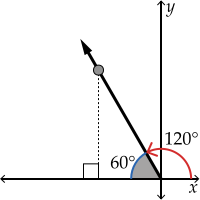
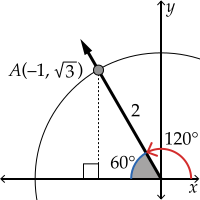
The angle \(120^\circ\) is in Quadrant Ⅱ and its related acute angle is \(180^\circ-120^\circ=60^\circ\).
Recall
The shortest side length of a triangle is always opposite the smallest angle while the longest side length is opposite the largest angle.
We have drawn a \(30^\circ - 60^\circ - 90^\circ\) triangle so the longest side length of \(2\) must be the radius of the circle opposite the right angle. Since the related acute angle \(60^\circ\) is greater than \(30^\circ\), the point on the terminal arm must have a \(y\)-coordinate with a greater absolute value than its \(x\)-coordinate. The point \(A\left(-1,\sqrt{3}\right)\) is on the terminal arm of \(120^\circ\).
Solution — Part 1b
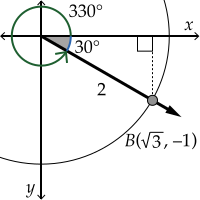
The angle \(330^\circ\) is in Quadrant Ⅳ and its related acute angle is \(360^\circ-330^\circ=30^\circ\).
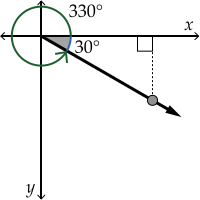
Again we have a \(30^\circ - 60^\circ - 90^\circ\) triangle so the point \(B\) with coordinates \(\left(\sqrt{3},-1\right)\) is on the terminal arm of \(330^\circ\).
Solution — Part 2
You might have noticed that the angles \(120^\circ\) and \(330^\circ\) have different related acute angles but use the same \(30^\circ - 60^\circ - 90^\circ\) triangle with a different side on the \(x\)-axis. The coordinates of points \(A\) and \(B\) are reversed.
Can you think of other angles with these related acute angles?
Related Acute Angle \(30^\circ\)
There are \(4\) terminal arms with the same related acute angle of \(30^\circ\). The points on these terminal arms on the circle with radius \(2\) are \(P_1\left(\sqrt{3},1\right)\)for \(30^\circ\), \(P_2\left(-\sqrt{3},1\right)\)for \(150^\circ\), \(P_3\left(-\sqrt{3},-1\right)\) for \(210^\circ\), and \(P_4\left(\sqrt{3},-1\right)\) for \(330^\circ\).
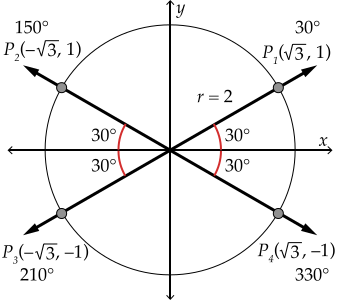
The trigonometric ratios for these angles are summarized:
| |
\(\sin\left(\theta\right)\) |
\(\cos\left(\theta\right)\) |
\(\tan\left(\theta\right)\) |
| \(30^\circ\) |
\(\dfrac{1}{2}\) |
\(\dfrac{\sqrt{3}}{2}\) |
\(\dfrac{1}{\sqrt{3}}\) |
| \(150^\circ\) |
\(\dfrac{1}{2}\) |
\(-\dfrac{\sqrt{3}}{2}\) |
\(-\dfrac{1}{\sqrt{3}}\) |
| \(210^\circ\) |
\(-\dfrac{1}{2}\) |
\(-\dfrac{\sqrt{3}}{2}\) |
\(\dfrac{1}{\sqrt{3}}\) |
| \(330^\circ\) |
\(-\dfrac{1}{2}\) |
\(\dfrac{\sqrt{3}}{2}\) |
\(-\dfrac{1}{\sqrt{3}}\) |
Related Acute Angle \(60^\circ\)
There are \(4\) terminal arms with the same related acute angle of \(60^\circ\). The points on these terminal arms on the circle with radius \(2\) are \(P_1\left(1,\sqrt{3}\right)\) for \(60^\circ\), \(P_2\left(-1,\sqrt{3}\right)\) for \(120^\circ\), \(P_3\left(-1,-\sqrt{3}\right)\) for \(240^\circ\), and \(P_4\left(1,-\sqrt{3}\right)\) for \(300^\circ\).
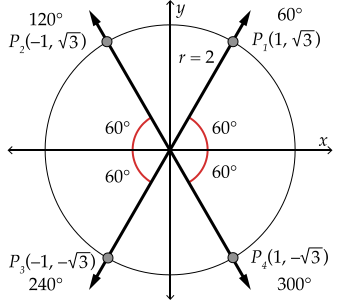
The trigonometric ratios for these angles are summarized:
| |
\(\sin\left(\theta\right)\) |
\(\cos\left(\theta\right)\) |
\(\tan\left(\theta\right)\) |
| \(60^\circ\) |
\(\dfrac{\sqrt{3}}{2}\) |
\(\dfrac{1}{2}\) |
\(\dfrac{\sqrt{3}}{1}=\sqrt{3}\) |
| \(120^\circ\) |
\(\dfrac{\sqrt{3}}{2}\) |
\(-\dfrac{1}{2}\) |
\(-\sqrt{3}\) |
| \(240^\circ\) |
\(-\dfrac{\sqrt{3}}{2}\) |
\(-\dfrac{1}{2}\) |
\(\sqrt{3}\) |
| \(300^\circ\) |
\(-\dfrac{\sqrt{3}}{2}\) |
\(\dfrac{1}{2}\) |
\(-\sqrt{3}\) |
Example 5
Determine the exact values of the sine, cosine, and tangent ratios for each angle.
- \(210^\circ\)
- \(420^\circ\)
- \(-120^\circ\)
Note: The word exact suggests that we must use our special triangles, and not a calculator.
There are similarities to the solutions in this example, but each part will highlight different perspectives that could be used to solve the question.
Solution — Part A: Draw and label special triangle
Since the angle \(210^\circ\) is in Quadrant Ⅲ, its related acute angle is \(30^\circ\). Drawing the \(30^\circ - 60^\circ - 90^\circ\) triangle, we can label the point \(\left(-\sqrt{3},-1\right)\) on the terminal arm and the radius is \(2\).
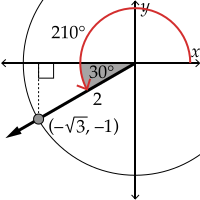
We have \(x=-\sqrt{3}\), \(y=-1\), and \(r=2\).
So the trigonometric ratios of \(210^\circ\) are
\[\begin{align*}\sin\left(210^\circ\right)&=\dfrac{y}{r}=-\dfrac{1}{2}\\ \cos\left(210^\circ\right)&=\dfrac{x}{r}=-\dfrac{\sqrt{3}}{2}\\ \tan\left(210^\circ\right)&=\dfrac{y}{x}=\dfrac{-1}{-\sqrt{3}}=\dfrac{1}{\sqrt{3}}\end{align*}\]
Solution — Part B: Coterminal angles
The angle \(420^\circ\) is coterminal to the angle \(420^\circ -360^\circ=60^\circ\) in Quadrant Ⅰ. Drawing the angle, we can label the point \(\left(1,\sqrt{3}\right)\) on its terminal arm with \(r=2\).
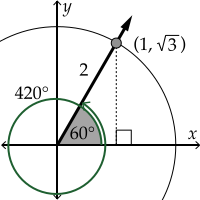
The trigonometric ratios of \(420^\circ\) are
\[\begin{align*} \sin\left(420^\circ\right)&=\sin\left(60^\circ\right)=\dfrac{\sqrt{3}}{2}\\ \cos\left(420^\circ\right)&=\cos\left(60^\circ\right)=\dfrac{1}{2}\\ \tan\left(420^\circ\right)&=\tan\left(60^\circ\right)=\dfrac{\sqrt{3}}{1}=\sqrt{3} \end{align*}\]
Solution — Part C: Use CAST rule and related acute angle
The terminal arm of \(-120^\circ\) is in Quadrant Ⅲ with a related acute angle of \(60^\circ\).
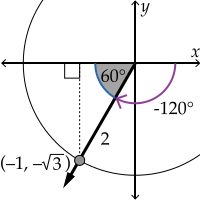
We can use the CAST rule to relate the ratios of \(-120^\circ\) to the ratios of \(60^\circ\). In Quadrant Ⅲ, the sine and cosine ratios are negative but the tangent ratio is positive.
The trigonometric ratios of \(-120^\circ\) are
\[\begin{align*} \sin\left(-120^\circ\right)&=-\sin\left(60^\circ\right)=-\dfrac{\sqrt{3}}{2}\\ \cos\left(-120^\circ\right)&=-\cos\left(60^\circ\right)=-\dfrac{1}{2}\\ \tan\left(-120^\circ\right)&=\tan\left(60^\circ\right)=\sqrt{3} \end{align*}\]