Solving Exponential and Logarithmic Equations Alternative Format
Lesson Part 1
In This Module
- We will solve exponential and logarithmic equations using the properties and laws of exponents and logarithms studied previously.
- We will apply these skills to solve problems involving exponential growth and decay.
Examples
We will begin by looking at an alternate method of solving exponential equations. Previously, we solved exponential equations by expressing the terms on each side of the equation with the same base. In doing so, we could then equate the exponents.
Example 1
Solve \(2(3^{x - 4}) = 25.\)
Solution
In this first example, \(2\), \(3\), and \(25\) cannot easily be expressed with a common base. We can, however, employ the power law of logarithms to assist us in solving this equation.
Before solving this equation, we will first note that there are no restrictions on \(x\), as it is part of an exponent. Therefore, \(x\) can be any real number.
First, if possible, isolate the power containing the variable \(x\). Here, we need to divide both sides of the equation by \(2\).
\[3^{x - 4} =\dfrac{25}{2}\]
Take the base \(10\) logarithm of each side of the equation. Base \(10\) is used since the common logarithm is a principal function key on all scientific calculators.
\[\log(3^{x - 4}) =\log(12.5)\]
Apply the power law for logarithms. When the exponent, \(x - 4\), is brought down, be sure to bracket the terms to ensure multiplication by the binomial.
\[(x - 4)\log(3) =\log(12.5)\]
Isolate the variable, \(x\).
\[(x - 4) =\dfrac{\log(12.5)}{\log(3)}\]\[x =\dfrac{\log(12.5)}{\log(3)} + 4\]
or
\[x =\log_{3}(12.5) + 4\]
We can obtain an approximate value of \(x\) using a calculator.
\[x \approx 6.299\]
Check:
A check can always be done by substituting the value of \(x\) into the original equation. We can demonstrate this with the exact value using the property \(c^{\log_c(n)} = n\).
\[ \begin{align*} x &= \log_{3}(12.5) + 4 \\ \text{L.S.} &= 2\left(3^{\log_{3}(12.5)+4-4}\right) \\ &= 2\left(3^{\log_{3}(12.5)}\right) \\ &= 2(12.5)\qquad\text{ since }c^{\log_{c}(n)}=n \\ &=25 \\ &= \text{R.S.} \end{align*} \]
Or we can use the approximate value and a calculator.
\[ \begin{align*} x &\approx 6.299 \\ \text{L.S.} &= 2(3^{x-4}) \\ &\approx 2(3^{6.299-4}) \\ &\approx 24.9995 \dots \\ &\approx \text{R.S.} \end{align*} \]
Check Your Understanding A
This question is not included in the Alternative Format, but can be accessed in the Review section of the side navigation.
Example 2
Solve \(5^{x-4} = 3(4^{2x + 1}).\)
Solution
In the second example, the powers cannot be simplified to a single power using exponent laws.
\[5^{x - 4} =3(4^{2x+1})\]
So we keep the equation in this form and take the base \(10\) logarithm of each side of the equation.
\[\log(5^{x-4}) = \log\left[3(4^{2x+1})\right]\]
We apply the product law of logarithms and break this up into the sum of two logarithms.
\[\log(5^{x-4}) =\log(3)+\log(4^{2x+1})\]
We than apply the power law of logarithms to bring the exponents down.
\[(x - 4) \log(5) =\log(3) + (2x + 1)\log(4)\]
We must now expand using the distributive property.
\[x\log(5) - 4\log(5) = \log(3) + 2x \log(4) + \log(4)\]
We collect the variable terms to one side of the equation and the constant terms to the other.
\[x\log(5) - 2x\log(4) = \log(3) + \log(4) + 4\log(5)\]
We now factor \(x\) from the two terms on the left side of the equation.
\[x\Big(\log(5) - 2\log(4)\Big) = \log(3) + \log(4) + 4\log(5)\]
Then we isolate \(x\).
\[x =\dfrac{\log(3) + \log(4) + 4\log(5)}{\log(5) - 2\log(4)}\]
We may also express \(x\) as
\[x = \dfrac{\log[3(4)(5^4)]}{\log\left(\dfrac{5}{4^2}\right)} = \dfrac{\log[12(5^4)]}{\log\left(\dfrac{5}{16}\right)}\]
by applying the laws of logarithms again to simplify the expression.
Note:
When using a calculator to approximate the value of \(x\), use appropriate parentheses to ensure the correct order of operations is followed.
Therefore,
\[x = \dfrac{\log[12(5^4)]}{\log\left(\dfrac{5}{16}\right)} \approx -7.671\]
Note:
It is important that there is only one term on each side of the equation when taking the logarithm of each side.
These terms can consist of factors in a product or a quotient.
The product and quotient law of logarithms allow us to manipulate these, as was shown in this example.
However, moving all terms involving variable \( x \) to one side (a common step when solving equations) and then taking the logarithm of each side would not allow us to continue. You would reach a roadblock.
For example,
\[ \begin{align*} 5^{x - 4} &= 3(4^{2x + 1}) \\ 5^{x - 4} - 3(4^{2x + 1}) &= 0 \\ \log{\left[5^{x - 4} - 3(4^{2x + 1})\right]} &= \log{(0)} \end{align*} \]
There is no algebraic way to simplify the logarithm of a difference or the logarithm of a sum (on the left side), and the logarithm of \(0\) is undefined (on the right side).

asikata/iStock/ThinkStock
Graphical Approach Using Technology
\[5^{x - 4} = 3(4^{2x + 1})\]
This equation can also be solved using technology.
Let \(f(x) = 5^{x - 4}\) and \(g(x) = 3(4^{2x + 1})\).
Graph each function using the worksheet provided. By selecting the point of intersection of the two graphs, the coordinates of the points will appear in the legend.
The \(x\)-coordinate of the point of intersection indicates when \(f(x) = g(x)\), thus providing the solution to the equation.
Lesson Part 2
Examples
The next example is an application of exponential decay. Model this situation and solve the problem using the techniques discussed in the previous examples.
Example 3
A sample of radioactive material had a mass of \(56.8\) grams. After \(5\) years, the material decayed to a mass of \(20.5\) grams. Determine the half-life of the substance.
Solution
We will begin with the general form of the equation used to model exponential growth and decay,
\[Q(t) = Q_0(r)^{\frac{t}{T}}\]
where \(r\) is the growth/decay factor, \(Q\) is the quantity remaining after time \(t\), and \(Q_0\) is the initial quantity. \(T\) is the growth/decay period and \(t\) is measured in the same units as \(T\).
In this situation, the decay factor is \(r = \dfrac{1}{2}, Q_0 = 56.8 \text{ g},\) and \(Q = 20.5 \text{ g}\) after \(t = 5\) years.
We must determine \(T\), the half-life period.
\[20.5 = 56.8\left(\dfrac{1}{2}\right)^{\frac{5}{T}}\]
After substituting these values into the general form, we isolate the exponential expression.
\[\left(\dfrac{1}{2}\right)^{\frac{5}{T}} =\dfrac{20.5}{56.8}\]
We then take the logarithm base \(10\) of both sides of the equation.
\[\log\left(0.5\right)^{\frac{5}{T}} =\log\left(\dfrac{20.5}{56.8}\right)\]
Then we apply the power law.
\[\dfrac{5}{T}\log\left(0.5\right) =\log\left(\dfrac{20.5}{56.8}\right)\]
Rearranging this equation, we can then solve for \(T\), the half-life period.
\[T =\dfrac{5\log(0.5)}{\log\left(\dfrac{20.5}{56.8}\right)} \approx 3.4\]
Therefore, the half-life of the substance is approximately \(3.4\) years (since \(t\) is in years).
Example 4
Solve \(3\log(2x) + 6 = 0, x\gt 0.\)
Solution
In this example, we have a single log term.
\[3\log(2x) + 6 = 0\]
We will begin by isolating the logarithm.
\[3\log(2x) = -6\]\[\log(2x) = -2\]
We then convert this logarithmic statement to its equivalent exponential form.
\[2x = 10^{-2}\]
We than solve the resulting equation.
\[2x =\dfrac{1}{100}\]\[x =\dfrac{1}{200}\]
This solution satisfies the original conditions on \(x\), since \(x = \dfrac{1}{200} > 0\).
Example 5
Solve \(\log_{3}(x - 1) = \log_{3}\left(x^2\right) - \log_{3}(x + 3)\). Identify any restrictions on \(x\).
Solution
\[\log_{3}(x - 1) = \log_{3}(x^2) - \log_{3}(x + 3)\]
Before solving this next equation, we must first identify any restrictions on \(x\).
We have
- \(x-1 \gt 0 \quad \Rightarrow \quad x \gt 1 \quad \quad\) and
- \(x^2 \gt 0 \quad \quad \ \Rightarrow \quad x \neq 0 \quad \quad\) and
- \(x+3 \gt 0 \quad \Rightarrow \quad x \gt -3\)
To satisfy all three of these conditions, \(x \gt 1\).
Using the quotient law for logarithms, express the right side of the equation as a single logarithm.
\[\log_{3}(x - 1) = \log_{3}\left(\frac{x^2}{x + 3}\right)\]
For these two base \(3\) logarithms to be equal, the value of the powers (the arguments of each) must be equal.
So we must solve the equation
\[ x - 1 = \dfrac{x^2}{x + 3}\]
By multiplying both sides of the equation by \((x + 3)\) and simplifying, we obtain the answer
\[ \begin{align*} x - 1 &= \dfrac{x^2}{x + 3} \\ (x - 1)(x + 3) &= x^2 \\ x^2 + 2x - 3 &= x^2 \\ 2x - 3 &= 0 \\ x &= \dfrac{3}{2} \end{align*} \]
which satisfies the condition that \(x\gt 1\).
Therefore, \(x = \dfrac{3}{2}\) is a solution to this equation.
Example 6
Solve \(2\log_{4}(x) - \log_{4}(4x + 3) = -1\).
Solution
It is important to place restrictions on \(x\) using the original equation, not the simplified equation as restrictions will change when applying the laws of logarithms and converting to exponential form.
To ensure the arguments of the logarithms are positive,
- \(x \gt 0\)
- \(4x + 3 \gt 0 \Rightarrow x \gt -\dfrac{3}{4}\)
Therefore, \(x \gt 0\).
\[\log_{4}\left(x^2\right) - \log_{4}(4x + 3) =-1\]
Now, we begin solving this equation by simplifying the left side using power and quotient laws.
\[\log_{4}\left(\dfrac{x^2}{4x + 3}\right) =-1\]
We now express this logarithmic statement in its equivalent exponential form.
\[\dfrac{x^2}{4x + 3} =4^{-1}\]
We then solve the resulting rational equation.
\[\dfrac{x^2}{4x + 3} =\dfrac{1}{4}\]\[4x^2 =4x + 3\]\[4x^2 - 4x - 3 = 0\]\[(2x - 3)(2x + 1) = 0\]
The solution to this rational equation is
\[x=\dfrac{3}{2} \quad \text{or} \quad x = -\dfrac{1}{2}\]
However, \(x \gt 0\). Therefore, \(x = \dfrac{3}{2}\) is the only solution to this equation.
The root \(-\dfrac{1}{2}\) is an extraneous root. It is a root of the rational equation formed when converting to exponential form, but it is not a root to the original logarithmic equation.
We must be careful to watch for extraneous roots when solving logarithmic equations since there are always restrictions placed on the variable.
Graphical Approach Using Technology
\[2\log_{4}(x) - \log_{4}(4x + 3) = -1\]
We can solve this equation, or verify the solution found previously, using graphing technology.
Let \(f(x) = 2\log_{4}(x) - \log_{4}(4x + 3)\) and \(g(x) = -1\).
Use the worksheet provided to graph these two functions. By selecting a point of intersection of the two graphs, the coordinates of the point will appear in the legend.
From the worksheet, we see that \(f(x) = g(x)\) when \(x = 1.5\).
Check Your Understanding A and B
These questions are not included in the Alternative Format, but can be accessed in the Review section of the side navigation.
Lesson Part 3
Examples
Example 7 — Part 1
Algebraically, determine all points of intersection of the two functions
\[ \begin{align} f(x) &= \log_{2}(2x - 2) \\ g(x) &= 5 - \log_{2}(x - 1) \end{align} \]
Solution
To find the points of intersection, set \(f(x) = g(x)\).
Before solving this logarithmic equation, we must first identify any restrictions on \(x\). Here, \(x \gt 1\) for the arguments to be positive.
\[\log_{2}(2x - 2) = 5-\log_{2}(x - 1), \ x \gt 1\]
Collect logarithmic terms on one side of the equation and the constant terms to the other.
\[\log_{2}(2x - 2) + \log_{2}(x - 1) =5\]
Apply the product law for logarithms.
\[\log_{2}\left[(2x - 2)(x - 1) \right] = 5\]
Convert this logarithmic statement to exponential form.
\[(2x - 2)(x - 1) =2^5\]
Then solve the resulting quadratic equation.
This quadratic equation can be solved two different ways to shown here.
Method 1
\[ \begin{align*} 2x^2 - 4x + 2 &= 32 \\ 2x^2 - 4x - 30 &= 0 \\ 2(x^2 - 2x - 15) &= 0 \\ 2(x - 5)(x + 3) &= 0 \end{align*} \]
Method 2
\[ \begin{align*} 2(x - 1)^2 &= 2^5 \\ (x - 1)^2 &= 2^4 \\ x - 1 &= \pm 2^2 \\ x - 1 &= \pm 4 \end{align*} \]
So \(x = 5,-3\), but \(x \gt 1\). Therefore, \(x = 5\) (\(x = -3\) is an extraneous root).
There is one point of intersection at \(x = 5\).
Find the \(y\)-coordinate of the point by determining \(f(5)\) or \( g(5).\)
\[ \begin{align*} f(5) &= \log_{2}(2(5) - 2) \\ &= \log_{2}(8) \\ &= 3 \end{align*} \]
\[ \begin{align*} g(5) &= 5 - \log_{2}(5 - 1) \\ &= 5 - \log_{2}(4) \\ &= 5 - 2 \\ &= 3 \end{align*} \]
Therefore, the two functions intersect at \((5, 3)\).
Example 7 — Part 2
Graphically, determine all points of intersection of the two functions
\[ \begin{align*} f(x) &= \log_{2}(2x - 2) \tag{1}\\ g(x) &= 5 - \log_{2}(x - 1) \tag{2} \end{align*} \]
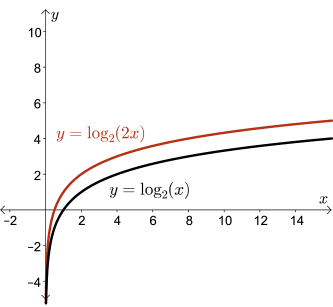
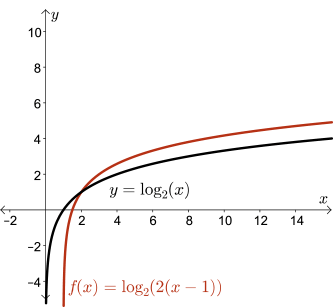
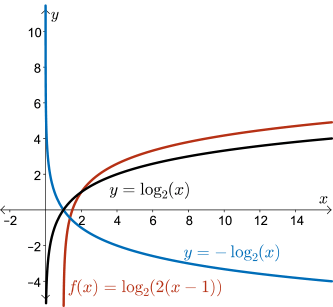
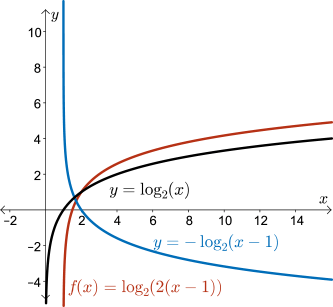
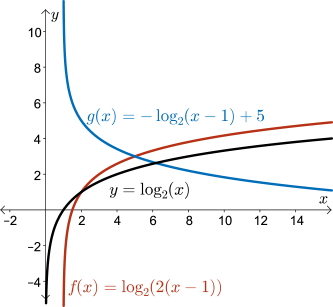
Transformations can also be applied to \(y = \log_2(x)\) to graph \(f(x) = \log_{2}(2x - 2)\) and \(g(x) = 5 - \log_{2}(x - 1)\).
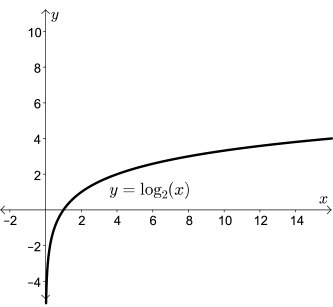
To obtain the graph of \(f(x) = \log_{2}(2(x - 1))\):
- Apply a horizontal stretch about the \(y\)-axis by factor of \(\dfrac{1}{2}\).
- Apply a horizontal translation \(1\) unit right.
To obtain the graph of \(g(x) = -\log_{2}(x - 1) + 5\):
- Apply a reflection in the \(x\)-axis.
- Apply a horizontal translation \(1\) unit right.
- Apply a vertical translation \(5\) units up.
The functions \(f(x)\) and \(g(x)\) intersect at the point \((5, -3)\).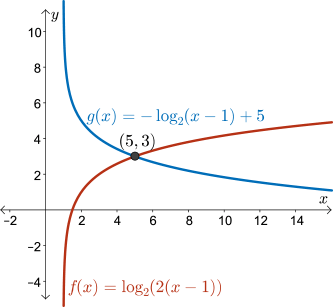
Lesson Part 4
Examples
We will finish up with a more challenging problem.
Example 8
Calculate all possible ratios, \(\dfrac{x}{y}\), if
\[3\log_{5}(x + 2y) - \log_{5}(y) = \log_{5}(x) + \log_{5}(14x + 13y)\]
Solution
Identify the restrictions on the two variables \(x\) and \(y\).
\[3\log_{5}(x + 2y) - \log_{5}(y) = \log_{5}(x) + \log_{5}(14x + 13y)\]
Consider that for \(\log_{5}(x)\) and \(\log_{5}(y)\) to be defined, we have the conditions \(x \gt 0\) and \(y \gt 0\).
These conditions also ensure that \(3\log_{5}(x + 2y)\) and \(\log_{5}(14x + 13y)\) are defined by enforcing that the arguments \(x + 2y \gt 0\) and \(14x + 13y \gt 0\).
Using the laws of logarithms, simplify both sides of the equation.
\[ \begin{align*} 3\log_{5}(x + 2y) - \log_{5}(y) &= \log_{5}(x) + \log_{5}(14x + 13y) \\ \log_{5}(x + 2y)^3 - \log_{5}(y) &= \log_{5}\left[x(14x + 13y)\right] \\ \log_{5}\left[\dfrac{(x + 2y)^3}{y}\right] &= \log_{5}[x(14x + 13y)] \end{align*} \]
We can then equate the arguments. Therefore,
\[\dfrac{(x + 2y)^3}{y} = x(14x + 13y)\]
By expanding and simplifying, collecting all terms to one side of the equation, we have a polynomial equation in two variables.
\[ \begin{align*} (x + 2y)^3 &= xy(14x + 13y \\ (x^2 + 4xy + 4y^2)(x + 2y) &= 14x^2y + 13xy^2 \\ x^3 + 2x^2y + 4x^2y + 8xy^2 + 4xy^2 + 8y^3 &= 14x^2y + 13xy^2 \\ x^3 - 8x^2y - xy^2 + 8y^3 &= 0 \end{align*} \]
This polynomial function in two variables can be factored by grouping.
By factoring \(x^2\) from the first two terms and \(-y^2\) from the last two terms, we are left with the factor \(x - 8y\) in each grouping.
\[x^2(x - 8y) - y^2(x - 8y) = 0\]
Factoring the \(x - 8y\) from each group, we have \(x^2 - y^2\), which can then be factored to \((x + y)(x - y)\).
\[(x - 8y)(x^2 - y^2) = 0\]\[(x - 8y)(x - y)(x + y) = 0\]
Therefore,
\[x=8y\quad \text{or}\quad x=y \quad \text{or} \quad x=-y\]
However, \(x \neq -y\) since \(x>0\) and \(y > 0\).
When \(x = 8y \Rightarrow \dfrac{x}{y} = 8\), and when \(x = y \Rightarrow \dfrac{x}{y} = 1\).
Therefore, the ratio of \(\dfrac{x}{y}\) is \(1\) or \(8\).
You may wish to review the concepts covered in this module and summarized here.
Summary
- Exponential equations, consisting of one term on each side of the equation, can be solved algebraically by taking the logarithm (base \(10\) of both sides of the equation. Apply the appropriate laws of logarithms (in particular, the power law) to re-express the equation and solve for the unknown.
- Logarithmic equations involving only logarithmic terms can be solved by employing the laws of logarithms to express each side of the equation as a single logarithm and applying the property \(m = n\) when \(\log_{c}(m) = \log_{c}(n)\).
- To solve logarithmic equations involving both logarithmic terms and constants, rearrange logarithmic terms to one side of the equation and constants to the other side. Express the logarithmic terms as a single logarithm using the properties of logarithms, and then convert the logarithmic equation to its equivalent exponential form. Solve the resulting equation.
- It is important to identify restrictions on the variable using the original equation when working with logarithmic equations. These restrictions will assist in identifying extraneous roots (a root that does not satisfy the original equation).
- Logarithmic equations can also be solved using graphing technology.
Graphing Tool
See the graphing tool in the side navigation.