Recall
Two rays, or arms, sharing a common endpoint form an angle.
The common endpoint is called the vertex.
The measure of an angle is the amount of rotation about the vertex from the initial arm to the terminal arm.
When the vertex of an angle is positioned at the origin and the initial arm lies along the positive \(x\)-axis, the angle is said to be in standard position.
Standard position angles are positive when rotated counterclockwise.
Standard position angles are negative when rotated clockwise.
The quadrants of the Cartesian plane are numbered according to the rotation of positive angles in standard position.
For example, draw a standard position angle of \(310^{\circ}\).
Did You Know?
The Fédération Dentaire Internationale Numbering System (FDI) is a two-digit system used by dentists to refer to the position of teeth in a patient's mouth.
Patient's Perspective, looking in a mirror
Source: Mouth - alex-mit/iStock/Getty Images
Sketch each angle in standard position.
a. Use the \(x\)-axis and \(y\)-axis as guides:
The terminal arm of \(120^\circ\) is in Quadrant II.
b. The terminal arm of \(224^\circ\) is in Quadrant III.
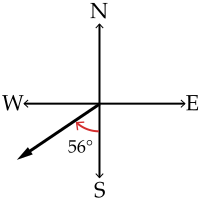
Compass Direction System
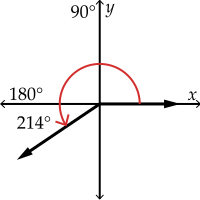
Mathematical Direction System
Recall that from Vancouver, Canada to Sydney, Australia a pilot needs to fly in the direction S\(56^\circ\)W.
Created with GeoGebra. Author: University of Waterloo. CC BY-NC-SA 4.0. https://ggbm.at/gkwcfcsw#