In this lesson, we discussed angle relationships in triangles. We also discussed the relationship between the side lengths and angles in a triangle.
There are also important relationships between the side lengths of a triangle. One of these relationships is the Pythagorean Theorem, which you may have seen in other lessons. The Pythagorean Theorem relates the side lengths of a right-angled triangle.
Another important relationship that applies to all triangles is known as the triangle inequality.
The triangle inequality states that any side of a triangle cannot be longer than the sum of the lengths of the other two sides.
So, in a triangle with side lengths of \(a\), \(b\), and \(c\):
- \(a \le b+c\)
- \(b \le a+c \), and
- \(c \le a+ b\)
It is important to note that all three of these inequalities must hold.
For both of the triangles displayed above, \(a \lt b+c\), \(b \lt a+c\), and \(c \lt a+b\).
If one of the side lengths is longer than the sum of the other two, those two sides won't meet. This does not produce a triangle.
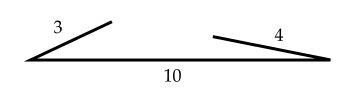
If \(a=b+c\), \(b=a+c\) or \(c=a+b\), this produces what is known as a degenerate triangle.
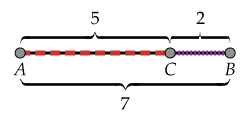
A degenerate triangle has an area of \(0\) and consists of two overlapping line segments.
Consider a triangle with side lengths of \(2\), \(5\), and \(7\) units.
Although \(2 \lt 5+7\), and \(5 \lt 2+7\), we have that \(7=2+5\).
This produces a degenerate triangle, as seen below.
In geometry, we are most often interested in non-degenerate triangles (i.e., triangles that have an area greater than \(0\)).
Note: In a non-degenerate triangle, each side is shorter than the sum of the other two sides. So for a non-degenerate triangle with side lengths of \(a\), \(b\), and \(c\), the triangle inequality becomes:
- \(a \lt b+c\)
- \(b \lt a+c \), and
- \(c \lt a+ b\)
Example 18
Is it possible to create a non-degenerate triangle with the following three side lengths? Justify your answer.
- \(8\), \(8\), and \(17\) units
- \(3\), \(8\), and \(10\) units
- \(2\), \(3\), and \(5\) units
Solution — Part A
Since \(17 \not \le 8+8\), the triangle inequality does not hold for these three side lengths.
(This is the case even though \(8 \lt 8+17\), since all three of the inequalities must hold.)
Therefore, it is not possible to create any triangle (even a degenerate one) with side lengths of \(8\), \(8\), and \(17\) units.
Solution — Part B
- \(10 \lt 3+8\)
- \(3 \lt 8 + 10\), and
- \(8 \lt 3+10\)
Therefore, it is possible to create a non-degenerate triangle with side lengths of \(3\), \(8\), and \(10\) units.
Solution — Part C
- \(2 \lt 3+5\)
- \(3 \lt 2+5\), and
- \(5=2+3\).
Thus, the triangle inequality holds for these three side lengths.
However, \(5 \not \lt 2+3\), so we would have a degenerate triangle.
Therefore, it is not possible to create a non-degenerate triangle with side lengths of \(2\), \(3\), and \(5\) units.
Note: Although all three inequalities in the triangle inequality must hold, we only need to check one of them. Here's why:
Consider three non-negative numbers \(a\), \(b\), and \(c\), where none of the numbers are greater than \(c\). That is, \(a \le c\) and \(b \le c.\)
Then, no matter what the three numbers are, it must be true that \(a \le b+c\) (since \(b \ge 0\)) and that \(b \le a+c \) (since \(a \ge 0\)).
The only inequality we can't be sure about is whether or not \(c \le a+b\).
Since the side lengths of a triangle are always non-negative, we can apply this idea to the triangle inequality.
When verifying if three side lengths would produce a triangle, we only need to check one of the inequalities: \(c \le a+b\), where \(c\) is the longest of the three side lengths. The other two triangle inequalities will hold by default.