System of Equations


Solving Equations

Recall

When we are asked to solve an equation we need to determine the value of the variable(s) that will make the equation true.

If we have solved an equation correctly, the left side of the equation will equal the right side of the equation when the calculated value(s) are substituted in for the variable(s). 

Example 1 — How Many Solutions?

Solve the linear relation \(2x+3y=12\).

Solution

In this question, notice we are given one equation with two unknown variables. If we isolate for one variable, we will simply get an alternative form of the same equation and not a numeric value.

  • Isolating for \(y\rightarrow\quad y=-\dfrac{2}{3}x+4\), or
  • Isolating for \(x\rightarrow\quad x=-\dfrac{3}{2}y+6\)

In fact, because we are only given one equation with two variables, we cannot solve for both variables in the equation. In previous lessons we chose a value for \(x\) and could then calculate the corresponding \(y\)-value. As you have seen previously when working with linear relations, there are an infinite number of solutions to this relation, as represented by the graph shown here. For example, \(x=0,\: y=4\), and \(x=-\frac32,\: y=5\) are two such solutions. In fact, every point that lies along the line is a solution.
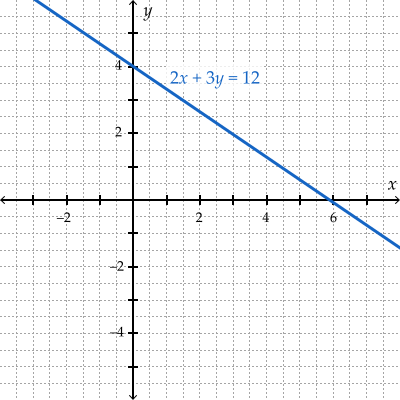
A graph showing the line 2x+3y=12

Solving Systems of Equations

If instead we were asked to consider both of the equations \(2x+3y=12\) and \(x-y=1\) collectively, or as a group, we would be able to solve for both the variables \(x\) and \(y\).

When we are asked to consider equations collectively, we call this a system of equations.

If we are asked to solve the system above, we are being asked to find values of the variables \(x\) and \(y\) that satisfy both of the equations simultaneously. For example, \(x=-3\), \(y=6\) is not a solution to the system of equations above since it does not satisfy the second equation (although it does satisfy the first equation). However, \(x=3\), \(y=2\) is a solution to the system of equations above since these values do satisfy both equations.

When we are asked to solve a system of equations, we are being asked to find values of the variables that satisfy all of the equations simultaneously. 

To solve a system of equations having \(n\) variables, we typically need \(n\) equations written in terms of those variables.

When we are asked to solve a linear system of two equations written in terms of two variables \(x\) and \(y\), we are looking for the point \((x,y)\) that both equations share. In other words we are looking for the point of intersection


Explore This 1


Slide Notes

Glossary

All Slides

Explore This 1 Summary

One Unique Intersection Point No Points of Intersection Infinite Points of Intersection

A graph shows two lines intersecting at the point (2,0)

A graph shows two parallel lines which do not intersect

A graph shows two coincident lines which intersect at every point on the line(s)


Paused Finished
Slide /

Example 2

Determine the equation of a line, which together with the line \(2x+3y=6\), forms a linear system of equations with

  1. no solution,
  2. one solution, and 
  3. infinitely many solutions.

Solution — Part A

For a linear system of equations to have no solution, the lines must be parallel and distinct. The line we are trying to determine will therefore need to have the same slope and a different \(y\)-intercept. It will be easier for us to see the slope and \(y\)-intercept of the given equation if we rearrange it into the form \(y=mx+b\).

\(\begin{align*} 2x+3y&=6\\ 3y&=-2x+6\\ y&=-\dfrac{2}{3}x+2 \end{align*}\)

Therefore, the slope of the second line must be equal to \(-\dfrac{2}{3}\) and the \(y\)-intercept can be any number other than \(2\). One possible solution is \(y=-\dfrac{2}{3}x+10\). We can graph both of these lines to show that they are parallel and distinct, and therefore the system has no solution.

Solution — Part B

For a linear system of equations to have one solution, the slopes must be different. From part a) we know that the slope of the given line is \(-\dfrac{2}{3}\). Therefore, a linear relation with a slope other than \(-\dfrac{2}{3}\) will give us a system of equations with one solution. One possible equation is  \(y=5x+19\). Again, we can graph both of these lines to show that they have one intersection point at \((-3,4)\).  

Solution — Part C

For a linear system of equations to have infinitely many solutions, the second equation must be equivalent to the given equation. We can determine an equivalent representation by multiplying or dividing each term in the equation by the same value.  Let's multiply the original equation by \(-1\).

\(\begin{align*} 2x+3y&=6\\ (-1)(2x)+(-1)(3y)&=(-1)(6)\\ -2x-3y&=-6 \end{align*}\)

We can now graph \(2x+3y=6\) and \(-2x-3y=-6\) and show these are the same line with infinite points of intersection.


Check Your Understanding 1


There appears to be a syntax error in the question bank involving the question field of this question. The following error message may help correct the problem:
null