So far, all of our examples have resulted in a single \((x,y)\) solution, or in other words, one point of intersection.
Recall
We know that two lines can intersect in one of three ways:
- one intersection point,
- no intersection point (parallel and distinct lines), or
- infinite intersection points (same line).
If we don't realize we are given parallel and distinct lines, or the same line, can we still use the substitution method or the elimination method to solve the system of equations?
Example 7
Solve the system of equations by substitution:
\(2(x-y)=8 \tag{1}\)
\(y=x-4 \tag{2}\)
Solution
In this example, Equation \((2)\) already has \(y\) isolated in terms of \(x\), so we can go straight to substituting \(x-4\) for \(y\) in Equation \((1)\) and solve for \(x\).
\[\begin{align*} 2(x-y)&=8\\ 2(x-(x-4))&=8\\ 2(x-x+4)&=8\\ 2x-2x+2(4)&=8\\ 0x&=8-8\\ 0x&=0 \end{align*}\]
Notice that we are left with \(0x=0\). This will be true for all real values of \(x\). Therefore, this system has infinite solutions. This means, the two equations in the system are in fact the same line.
We can show this by rearranging Equation \((1)\) into \(y=mx+b\) as follows:
\[\begin{align*} 2(x-y)&=8\\ 2x-2y&=8\\ -2y&=-2x+8\\ y&=x-4 \end{align*}\]
Or we can show this is true by graphing both equations on the same grid:
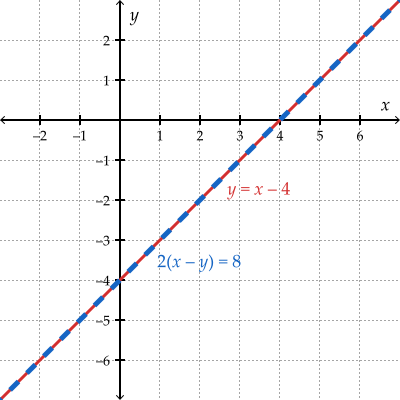
If a system has infinite solutions (the lines are the same), the algebra will show a statement that is true for all real values of \(x\).
Example 8
Solve the system of equations by substitution:
\(y=\dfrac{2}{3}x+5 \tag{1}\)
\(2x-3y=4 \tag{2}\)
Solution
In this example, Equation \((1)\) already has \(y\) isolated in terms of \(x\), so we can go straight to substituting \(\dfrac{2}{3}x+5\) for \(y\) in Equation \((2)\) and solve for \(x\).
\[\begin{align*} 2x-3y&=4\\ 2x-3\left(\dfrac{2}{3}x+5\right)&=4\\ 2x-2x-15&=4\\ 0x=4+15\\ 0x&=19 \end{align*}\]
Notice that we are left with \(0x=19\). This will never be true for any real value of \(x\); the left side of the equation will never equal the right side of the equation. There is no solution to this system of equations. These two lines are parallel and distinct so they will never intersect.
We can show this is true by rearranging Equation \((2)\) into \(y=mx+b\) as follows to show that the lines have the same slope of \(-\dfrac{2}{3}\), and different \(y\)-intercepts:
\[\begin{align*} 2x-3y&=4\\ -3y&=-2x+4\\ y&=\dfrac{2}{3}x-\dfrac{4}{3}\\ \end{align*}\]
We can also visually see on a graph that the two lines are parallel and distinct:
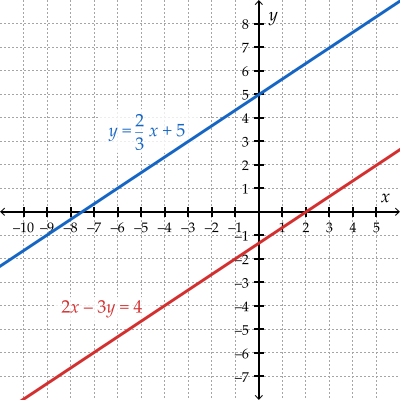
If a system has no solutions (the lines are parallel and distinct), the algebra will show a statement that is never true for any value of \(x\).
If elimination is the method used to solve a system of equations that are the same line or parallel and distinct lines, the algebra will give the same result as the substitution method (i.e., same line will result in \(0x=0\), and parallel and distinct lines will give a result that will never be true, simliar to \(0x=19\)).